Zone 8 gallery
504 species in the database survive zone 8.

hardy kiwi / kiwiberry
Actinidia arguta
Kiwiberry — sweet, aromatic, grape-sized, eaten whole skin and all. The most cold-hardy commercially relevant kiwi (to roughly zone 4), which is also why it readily escapes cultivation in parts of the US Northeast — see spread warning. Fruit color ranges from green to greenish-yellow through to a form with fully purple-red skin, colouring best in full sun — this purple form circulates in the trade as "Actinidia purpurea" or "A. arguta var. purpurea," but POWO treats it as a synonym of this species, not a distinct taxon.

callosa kiwi
Actinidia callosa
⚠ Essentially unknown in Western horticulture — no commercial cultivars or nursery availability found. Small (18–50mm), grayish-green-skinned fruit described in the literature as having a delicate flavour; eaten fresh or in jams within its native range.

golden kiwi
Actinidia chinensis
Golden kiwi — smooth, thin-skinned bronze-gold fruit, sweeter and less acidic than green kiwifruit. Current taxonomy (POWO) treats A. deliciosa as a variety within this species rather than as fully distinct — see that entry.
golden-flowered kiwi
Actinidia chrysantha
⚠ IUCN Red List: Vulnerable in the wild, and essentially absent from cultivation outside conservation and breeding collections — grown as a genetic resource (used to raise sugar content in cultivated-kiwifruit breeding) rather than as a garden fruit crop. The only Actinidia species with golden-yellow flowers; all others are white or cream. Fruit reported 'big and delicious' but with no detailed flavour profile available.

green kiwi
Actinidia deliciosa
Green kiwifruit — the classic fuzzy-skinned supermarket kiwi. Brought to New Zealand as seed in 1904, first fruited 1910, and refined into the modern 'Hayward' cultivar; renamed from 'Chinese gooseberry' to 'kiwifruit' in 1959 for export marketing. Current taxonomy (POWO) treats this as Actinidia chinensis var. deliciosa rather than a fully separate species, though horticultural and commercial usage still treats it under its own name.
commercial hybrid kiwis
Actinidia deliciosa × chinensis
Not a single well-defined hybrid — 'green' (A. deliciosa) and 'gold' (A. chinensis) kiwi lines are genetically very close (over 81% shared alleles) with documented natural introgression between them, and current taxonomy treats deliciosa as a variety within chinensis rather than a separate species. Breeders do deliberately cross the two lines, but none of the well-known commercial cultivars ('Hayward', 'Hort16A', 'Gold3', SunGold) is actually a documented direct cross of both — each sits within one parent line or the other. Treat 'hybrid kiwi' as shorthand for that close breeding relationship, not a specific plant.

woolly kiwi
Actinidia eriantha
Woolly kiwi — among the largest fruit and highest vitamin C content in the genus (reported several times that of A. chinensis). Flesh is bright green, flavour strong and slightly astringent (sweeter in cultivars like 'Ganlv-2'). Its 'easy-peel' skin has made it a significant parent species in breeding programs aimed at improving peelability and nutrition in commercial kiwifruit.
Hemsley's kiwi
Actinidia hemsleyana
⚠ One of the rarer, endangered Actinidia species in China, grown by specialist collectors mainly for its ornamental reddish, bristly stems and foliage rather than as a fruiting crop — cylindrical fruit to 2.7 cm, hairless when fully ripe, but flavour and cropping quality are poorly documented.

arctic kiwi
Actinidia kolomikta
Sweet-tart, smooth-skinned berries eaten whole — genuinely popular as a fresh fruit in Russia. Grown in the West at least as much for its striking pink/white/green variegated foliage as for its fruit.

large-seeded kiwi
Actinidia macrosperma
⚠ Not a dessert kiwi — round fruit ripens bright orange but is bitter and pungent to humans; grown for ornamental, wildlife and traditional-medicine value rather than as a fruit crop. Strongly cat-attractive — called 'cat ginseng' (猫人参) in Chinese, and chemical analysis has identified specific catnip-response compounds in its essential oil.
red kiwi
Actinidia melanandra
Fuzzy purple-skinned, red-fleshed fruit — edible but not commercially cultivated, grown mainly as a landscape curiosity. Used almost exclusively as a breeding parent for red-fleshed kiwifruit genetics rather than for its own fruit.

silver vine / cat kiwi
Actinidia polygama
Silver vine — genuinely the most cat-attractive plant studied, eliciting a response in roughly 70–80% of domestic cats (vs. ~67% for catnip), including many cats catnip doesn't affect; sold commercially as dried 'matatabi' sticks/powder for cat enrichment. The compounds responsible (actinidine, dihydroactinidiolide and others) are chemically distinct from catnip's nepetalactone. Fruit is genuinely edible but not very palatable raw — traditionally pickled in salt or miso, fried, or made into jam and liquor once ripe; unripe fruit is used for pickles. High in vitamin C.

rufa kiwi / shima-sarunashi
Actinidia rufa
Small, hairless-skinned fruit, harvested locally in Japan rather than grown as a major crop in its own right; its real horticultural value today is as breeding stock, both for low-chill adaptability to warm climates and for its natural resistance to bacterial canker — a disease that devastates commercial orchards elsewhere in the genus.

setose kiwi
Actinidia setosa
Taxonomic history worth knowing: described in 1952 as a variety, raised to full species rank in 1985, then reverted to Actinidia chinensis var. setosa by the 2007 Flora of China revision — the name current authorities (POWO) use. A narrow endemic to Taiwan's high-altitude mountains (the type specimen was collected on Alishan in 1908); fuzzy-skinned fruit like commercial kiwifruit, described as sweeter, locally nicknamed 'Taiwan peach'. Being evaluated by breeders as potential parent material rather than grown as an established crop itself. Care: winter protection — mulch, fleece, or a warm wall.
valvata kiwi
Actinidia valvata
⚠ Only marginally a fruit species in practice — its small (~9g), orange-when-ripe berries (reportedly chili-flavoured when unripe) are incidental to its two real uses: as a traditional Chinese medicine source (the root, 'Mao-Ren-Shen', studied for antitumor and liver-protective compounds) and, more recently, as breeding/rootstock material prized for exceptional flood tolerance in commercial kiwifruit grafting. Garden-cultivation specifics (propagation, feeding, time to fruit) are genuinely sparse in the literature. Closely allied to A. macrosperma; some treatments merge the two.
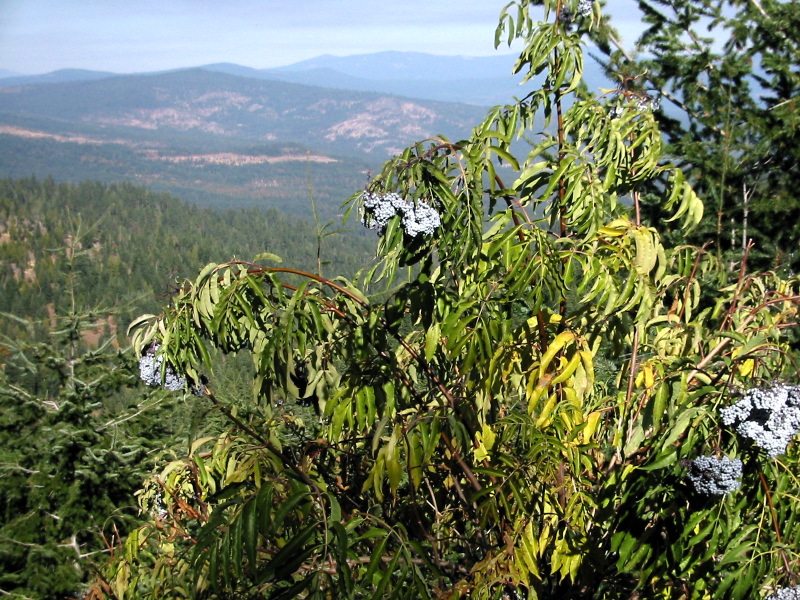
blue elderberry
Sambucus cerulea
⚠ MUST BE COOKED — raw berries, leaves and stems are toxic. Native to the western US; the berries carry a powdery, glaucous bloom that gives them a dusty blue color over black skin, and are considered the sweetest-tasting of the North American elders. Taxonomically unsettled: also published as "Sambucus caerulea" (an orthographic variant of the same name) and as "Sambucus nigra subsp. cerulea" (treating it as part of the wider black-elder complex rather than its own species) — all three names describe the same western blue elder.

European black elder
Sambucus nigra
⚠ MUST BE COOKED — raw berries, leaves and stems are toxic. Native across Europe and western Asia and naturalized well beyond it, this fast-growing hedgerow shrub bears flat-topped clusters of small, glossy black-purple berries — sweeter and less rank than some American elders — traditionally cooked down for cordial, wine and jam.

American elder
Sambucus nigra subsp. canadensis
⚠ MUST BE COOKED — raw berries, leaves and stems are toxic. This is the elder native to eastern North America, forming dense, fast-spreading thickets along streams and forest edges; its dark purple-black berries, borne in broad, flat clusters up to 25 cm across, are the type most widely grown for elderberry syrup, wine and jam in the US.

nannyberry
Viburnum lentago
Fruit ripens to a bluish-black, sweet, raisin-like pulp over a single flattened stone — good eaten fresh off the shrub once fully ripe, though the thick skin and large seed limit it mostly to jam, sauce, or leather.

Possumhaw
Viburnum nudum
Fruit ripens through a striking sequence of pink to blue to blackish-purple within the same cluster — edible and sweet once fully dark, with a raisin-like, slightly astringent flavor good fresh or cooked into preserves.

guelder rose
Viburnum opulus
Fruit is bitter and mildly toxic raw, causing nausea or stomach upset if eaten in quantity — it needs cooking (as jelly or sauce) to be palatable, unlike the unrelated Sambucus elderberry, and birds eat it untroubled straight off the bush. ⚠ Raw fruit is mildly toxic — cook it.

blackhaw
Viburnum prunifolium
Genuinely edible raw, unlike most viburnums in this catalog — no cooking required and no known toxicity. Quality varies by individual plant: the best have thin, sweet, date- or prune-like flesh with a faint smoky note, while others lean bitter and astringent and are better suited to preserves. Best picked after the first frost, which sweetens it. Leaves have also been used for tea.

perennial onions
Allium spp.
Onion/garlic flavour; leaf and bulb. Welsh onion, chives, ramps.

pistachio
Pistacia vera
Needs long, hot, dry summers to crop well — cool or humid summers give a poor or absent harvest even where winters are mild enough. The nut is enclosed in a fleshy hull that blushes rosy-pink to red as it ripens, then splits to reveal the familiar partly-opened shell.

fragrant sumac
Rhus aromatica
Sumac — a souring SPICE (lemony), not a dessert fruit. ⚠ Know your sumac: the red-fruited Rhus in this entry are safe, but poison sumac (Toxicodendron vernix) is a wetland shrub with drooping WHITE fruit and causes severe dermatitis. Red and upright, fine; white and drooping, leave it.

culinary sumac
Rhus coriaria
Sumac — a souring SPICE (lemony), not a dessert fruit. Care: Winter protection — mulch, fleece, or a warm wall. ⚠ Know your sumac: red upright fruit clusters are Rhus and safe; poison sumac (Toxicodendron vernix) has drooping white fruit and causes severe dermatitis.

smooth sumac
Rhus glabra
Sumac — a souring SPICE (lemony), not a dessert fruit. ⚠ Know your sumac: red upright fruit clusters are Rhus and safe; poison sumac (Toxicodendron vernix) has drooping white fruit and causes severe dermatitis.

staghorn sumac
Rhus typhina
Sumac — a souring SPICE (lemony), not a dessert fruit. Tart red drupes for 'sumac-ade'; suckers freely. ⚠ Know your sumac: red upright fruit clusters are Rhus and safe; poison sumac (Toxicodendron vernix) has drooping white fruit and causes severe dermatitis.
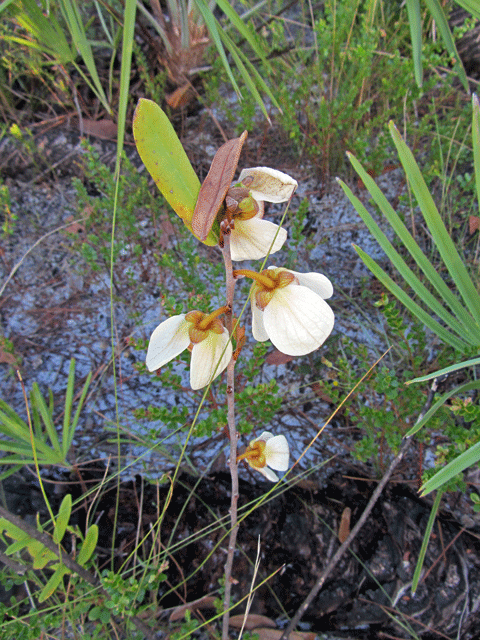
bigflower pawpaw
Asimina obovata
A Florida scrub and sandhill endemic (also called flag or scrub pawpaw) with a G3 vulnerable NatureServe rank — its fruit is edible but documented as mostly seed, with dry, bitter flesh carrying only a hint of mango and banana, nothing like the rich custard texture of A. triloba. It is grown far more for its large showy white flowers and as a zebra swallowtail host plant than for fruit. ⚠ As with all pawpaws, eat the flesh only — skin and seeds concentrate annonacin and are not food.

smallflower pawpaw
Asimina parviflora
A smaller-flowered, smaller-fruited understory relative of A. triloba found from Virginia to Texas — its cylindrical fruit reaches only about 2.5-7.5cm (1-3 inches), a fraction of common pawpaw size, so it is not grown for commercial fruit production even though the fruit itself is edible and sweet. ⚠ As with all pawpaws, eat the flesh only — skin and seeds concentrate annonacin and are not food.

dwarf pawpaw
Asimina pygmaea
Despite the common name 'dwarf pawpaw,' this is one of Florida's true pygmy pawpaws — a fire-adapted flatwoods shrub reaching only 20-30cm tall, not a significant source of edible fruit. Its small (3-4cm) yellow-green fruits are far smaller than A. triloba's and are not documented as a cultivated food crop; NatureServe rates the species G4 (apparently secure). ⚠ As with all pawpaws, eat the flesh only — skin and seeds concentrate annonacin and are not food.

netted pawpaw
Asimina reticulata
Florida's most widespread native pawpaw, occurring throughout the peninsula in fire-maintained flatwoods and scrub — NatureServe ranks it G4 (apparently secure). The fruit is edible, with a taste resembling mango and banana, but wildlife typically gets to it before people do, and the plant is grown chiefly as a native landscape and host/pollinator plant rather than for reliable fruit harvest. ⚠ As with all pawpaws, eat the flesh only — skin and seeds concentrate annonacin and are not food.
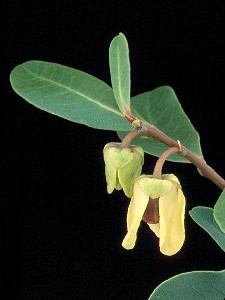
four-petal pawpaw
Asimina tetramera
A federally endangered species found nowhere outside a few sand pine scrub sites in Martin and Palm Beach Counties, Florida, with a wild population of roughly 1,400 plants as of the last federal review — its conservation status, not its fruit, is the defining fact about this species. Fruit and cultivation information is largely absent from the literature; what is documented focuses on habitat loss, fire ecology and recovery efforts rather than fruit quality. ⚠ As with all pawpaws, eat the flesh only — skin and seeds concentrate annonacin and are not food.

pawpaw
Asimina triloba
Custard texture; banana-mango-pineapple — excellent, but poor shelf life. ⚠ Eat the flesh only — the skin and seeds concentrate annonacin, a neurotoxic acetogenin, and are not food. A minority of people get stomach upset from the flesh too; try a little first.

American spikenard
Aralia racemosa
Ripe berries, cooked, are used for jam or wine — sources genuinely disagree on how palatable they are raw, and eating a quantity of them raw can cause digestive upset, so cook them. The heavily aromatic root is not a food; it's used medicinally and, historically, as a root-beer flavoring.

monkey puzzle
Araucaria araucana
The large seeds (piñones) are a staple food of Chile's Pehuenche people, roasted or boiled and tasting chestnut-like once cooked — raw seeds are not palatable. Each spherical female cone holds around 200 seeds and disintegrates at maturity in autumn to release them.
asparagus
Asparagus officinalis
Young emerging spears eaten raw or cooked — the entire crop; grassy-sweet. ⚠ The red berries on female plants are not edible (mildly toxic) — only the spears are food.

false Solomon's seal
Maianthemum racemosum
Ripe red berries edible in moderation, cooked or as jelly — raw berries have a laxative, cathartic effect in quantity. Young shoots are cooked and eaten like asparagus in some regions. ⚠ Also worth knowing: young shoots are easily confused with those of the toxic false hellebore (Veratrum) — check for the alternate, distinctly parallel-veined leaves before cutting anything.

chicory
Cichorium intybus
Roots roasted and ground as a coffee substitute; forced blanched shoots (chicons) and young leaves eaten as a bitter salad or cooked green; flowers edible.

sunchoke / Jerusalem artichoke
Helianthus tuberosus
Sunchoke — nutty, sweet, crisp. Excellent, but notoriously gas-forming.

dandelion
Taraxacum officinale
Whole plant edible — young leaves as a bitter salad or cooked green, roots roasted as a coffee substitute, flowers used for wine and syrup.

tall Oregon grape
Mahonia aquifolium
Sharp, tart — mostly for jelly; barberry dried as a spice.

Cascade Oregon grape
Mahonia nervosa
Sharp, tart — mostly for jelly; barberry dried as a spice.

creeping Oregon grape
Mahonia repens
Sharp, tart — mostly for jelly; barberry dried as a spice.

sweet / black birch
Betula lenta
Spring sap tapped for syrup, and classically for wintergreen-flavoured birch beer.

river birch
Betula nigra
⚠ Honestly: can be tapped, but sap sugar is lower than the other birches here — worth tapping only if it's what you already have; paper, yellow and silver birch are better choices.

American hazelnut
Corylus americana
A thicket-forming, multi-stemmed native shrub of eastern North America, valued both for small sweet nuts and as a key breeding source of eastern filbert blight resistance for cold-hardy hazelnut cultivars.

European hazelnut / cobnut
Corylus avellana
The classic European hazelnut/cobnut of commerce — the source of most culinary and orchard cultivars, cultivated for centuries across Europe for its rich, oily, sweet-flavored kernel eaten raw, roasted, or pressed for oil.

Chinese tree hazel
Corylus chinensis
The tallest-growing member of the genus in the wild — reported to reach 40 m in Chinese forests — now rare and vulnerable there, and grown in the West chiefly as an ornamental tree for its striking bark and reddish spring foliage rather than for nut production.
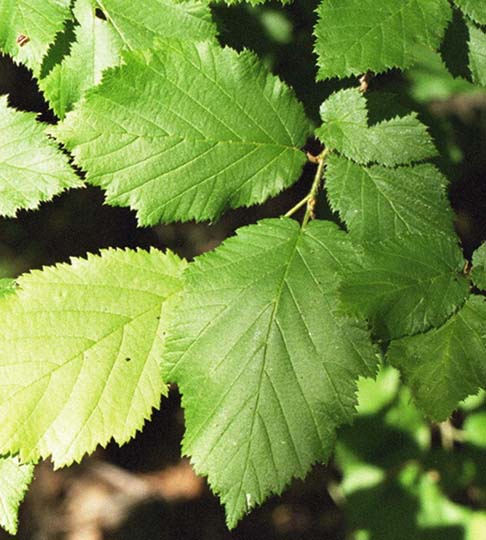
beaked hazelnut
Corylus cornuta
North America's wild 'beaked' hazelnut, named for the long, bristly, tubular husk that encloses the nut — smaller-nutted than European hazelnut, with a thin shell and sweet, well-flavored kernel.

Himalayan spiny hazel
Corylus ferox
A Himalayan mountain-forest hazel whose small, thick-shelled nuts are held in a husk armed with dense, many-angled spines — a trait unique among hazels — ripening from red to whitish in clusters of 4–6.

Indian tree hazel
Corylus jacquemontii
Grows as a single straight-trunked tree to about 25 m with pale, corky, deeply fissured bark — unlike the multi-stemmed, suckering habit of most hazels — and its thick-shelled nuts, smaller than the common hazelnut, are traditionally gathered wild in the Himalaya and sold in local markets.

filbert
Corylus maxima
Distinguished from common hazel by its long husk, which wholly encloses or forms a narrow tube beyond the nut; cultivars including 'Kentish Cob' and the purple-leaved 'Purpurea' have long been grown commercially for large, richly flavored nuts.

Japanese hazel
Corylus sieboldiana
A very cold-hardy shrub — with an even hardier northern variety extending across northeast China, Korea, Japan and eastern Siberia — bearing small egg-shaped nuts fully enclosed in a bristly, tubular husk two to three times the nut's length, and showing good field resistance to eastern filbert blight.

sea kale
Crambe maritima
Sea kale — blanched shoots, mild and nutty.

claret-cup hedgehog cactus
Echinocereus triglochidiatus
Small red-purple fleshy fruit, edible and among the better-flavoured hedgehog-cactus fruits — a trailside snack rather than a harvest crop. ⚠ Brush off the fine deciduous spines before handling. They are spines, not glochids — Echinocereus has none of the barbed bristles that make an Opuntia fruit a nuisance to pick.

beehive cactus
Escobaria vivipara
Small greenish fruit, edible but minor — grown mainly for the pink flowers rather than for the fruit.

golden prickly pear
Opuntia aurea
Golden prickly pear produces spineless, brownish-grey fruit that is edible but rarely harvested commercially — this species is grown mostly as a low, spring-flowering ornamental rather than for its fruit or pads. ⚠ Glochids.

beavertail cactus
Opuntia basilaris
Unlike most prickly pears, beavertail cactus fruit is dry and mealy rather than juicy and sweet, so it is far less commonly eaten than tunas from species like O. ficus-indica or O. engelmannii — some sources describe it as barely utilized as food at all. ⚠ Glochids — this species has no true spines, but its areoles carry an especially dense covering of fine, sharp glochids that penetrate skin easily.

Opuntia cespitosa
Opuntia cespitosa
A little-known, low-growing eastern relative of O. humifusa that was only re-recognized as a distinct species through genetic work in 2017 (Majure et al.); it is not a horticultural crop and detailed cultivation or culinary data specific to it are not well documented. ⚠ Glochids.

Engelmann's prickly pear
Opuntia engelmannii
One of the most commercially important wild prickly pears of the US Southwest and northern Mexico — its purple-red fruit is eaten fresh or made into juice and jelly, and its pads (nopales) are harvested as a vegetable and used as livestock fodder. ⚠ Glochids.

Indian fig cactus
Opuntia ficus-indica
This is the prickly pear of commerce worldwide — domesticated in central Mexico and grown at agricultural scale for its tuna fruit and nopales pads across Mexico, Sicily, other Mediterranean regions, and North Africa, with a culinary tradition going back centuries. ⚠ Glochids — both fruit skin and pads are covered in glochids that must be scraped or singed off before eating.

brittle prickly pear
Opuntia fragilis
Prickly-pear fruit sweet and seedy; young pads as a vegetable. ⚠ Glochids.

eastern prickly pear
Opuntia humifusa
The most cold-hardy and northerly-ranging Opuntia in eastern North America — remarkably for a cactus, it survives outdoors as far north as coastal Massachusetts and a small population at Point Pelee, Ontario, right on Lake Erie. Its red fruit is edible, used fresh or in jams and candies. ⚠ Glochids.

plains prickly pear
Opuntia macrorhiza
Named for its large, tuberous roots (macrorhiza, "big root"), which store water and let the plant survive extended drought and hard freezes on the open plains; its reddish-purple, spineless fruit is fleshy and edible. ⚠ Glochids.

tulip prickly pear
Opuntia phaeacantha
Called tulip prickly pear for its showy, often red-centered yellow flowers; it forms large dense thickets in the wild and its purplish, pink-fleshed fruit is fleshy and seedy. ⚠ Glochids.

hairspine prickly pear
Opuntia polyacantha
One of the most cold-hardy and widely distributed Opuntia in North America, ranging from Chihuahua, Mexico north through the Great Plains and Rocky Mountain states into Alberta and Saskatchewan, with a disjunct population found in Ontario's Thousand Islands in 2018 — it is one of only two cactus species native to Canada. ⚠ Glochids.

twisted-spine prickly pear
Opuntia tortispina
Despite its name, the spirally twisted spines implied by "tortispina" are not actually characteristic of this species; it appears to be of hybrid origin between O. macrorhiza and O. polyacantha, showing intermediate traits from both parents. ⚠ Glochids.

European nettle tree
Celtis australis
Hackberry — thin, sweet, date-like pulp on a hard seed.

sugarberry
Celtis laevigata
Hackberry — thin, sweet, date-like pulp on a hard seed.

common hackberry
Celtis occidentalis
Hackberry — thin, sweet, date-like pulp on a hard seed.
pink honeysuckle
Lonicera hispida
A high-altitude Central Asian and Himalayan honeysuckle, not a haskap. It carries ovoid yellowish-to-red berries, but its edibility is not well documented in the sources consulted — treat it as unverified rather than assume the blue-honeysuckle character of its cultivated relatives.

kousa dogwood
Cornus kousa
Not the tart cornelian cherry (that's C. mas and C. officinalis, a different genus member entirely) — kousa dogwood's compound, raspberry-like fruit is sweet and genuinely tropical-tasting, often compared to persimmon, mango or pumpkin. Best eaten fresh: pull off the stem and suck the flesh out through the hole it leaves, since the skin is edible but gritty and bitter.

cornelian cherry
Cornus mas
Tart — cranberry meets sour cherry; astringent unripe, best cooked.

Asiatic cornelian cherry
Cornus officinalis
Cornelian cherry: tart, cranberry-meets-sour-cherry — best cooked.

ironwood ebony
Diospyros ferrea
Diospyros ferrea ("ironwood ebony") is a small evergreen tree of Old World tropical forests and coastal thickets, grown mainly for its dense, dark heartwood and its use in bonsai rather than for its fruit — the berry is small (to about 15 mm), woody-shelled, and recorded mainly as a famine food in parts of its range rather than a dessert fruit like Diospyros kaki.

Japanese persimmon / kaki
Diospyros kaki
Diospyros kaki is the classic Japanese/Chinese persimmon, grown for its large fruit (to about 7.5 cm across, sometimes 500 g); cultivars split clearly into astringent types such as 'Hachiya', which must soften completely before their tannins subside, and non-astringent types such as 'Fuyu', which lose astringency while still firm and can be eaten crisp.
persimmon hybrids
Diospyros kaki × virginiana
This is a group of named hybrid cultivars rather than a single wild species — crosses such as 'Rosseyanka' and 'Nikita's Gift' combine the cold-hardiness of American persimmon with the larger, richer fruit of Japanese persimmon, typically producing nearly seedless fruit that is astringent until soft, then ripens to a smooth, custard-like texture.

date-plum
Diospyros lotus
Diospyros lotus produces small, cherry-sized fruit (about 1.5-2 cm) that starts yellow and ripens to blue-black with a waxy bloom — harsh and astringent until fully soft, at which point it turns rich and very sweet; dried fruit develops a date-like flavor, the source of the common name "date-plum".

monkey plum
Diospyros lycioides
Diospyros lycioides ("monkey plum" or bluebush) is a southern African shrub-to-small-tree grown mainly as a hardy, drought-tolerant garden and wildlife plant — its marble-sized berries ripen from red through reddish-brown to black with jelly-like, mildly sweet pulp that is eaten fresh or fermented into a traditional beer, quite unlike the large, soft-ripening fruit of the Asian and American persimmons.

Chinese date-plum
Diospyros rhombifolia
Diospyros rhombifolia ("diamond-leaf" or "princess" persimmon) is grown chiefly as an ornamental and bonsai subject for its small rhombic leaves — which color gold and red in autumn — and its miniature, dreidel-shaped orange fruit, rather than as a dessert fruit; the fruit is edible but small and mainly of curiosity value compared with Diospyros kaki.

Texas persimmon
Diospyros texana
Diospyros texana ("Texas persimmon" or "black persimmon") is a small, often multi-trunked tree grown as much for its smooth, pale gray-to-white peeling bark as for its fruit — small (about 2 cm), round, black, sweet fruit borne only on female trees, eaten fresh (a flavor often likened to prunes) or used in jams, quite different from the larger orange fruit of Diospyros kaki or Diospyros virginiana.

American persimmon
Diospyros virginiana
Diospyros virginiana ("American persimmon") is the cold-hardiest species in the genus, forming root-suckering colonies in the wild and bearing smaller fruit (2-6 cm) that is intensely harsh and astringent while green but turns rich and honey-sweet once fully soft — typically after autumn frost. Unlike Diospyros kaki, there are no widely grown non-astringent ("Fuyu"-type) American persimmon cultivars, so the astringent-until-soft pattern applies to essentially all of them.

goumi
Elaeagnus multiflora
Goumi/autumn olive — pleasantly tart-sweet when fully ripe; good for jam.

autumn olive
Elaeagnus umbellata
Goumi/autumn olive — pleasantly tart-sweet when fully ripe; good for jam.

evergreen silverberry
Elaeagnus × ebbingei / E. pungens
Genuinely juicy rather than dry and mealy like most of this genus — a rich flavor often compared to pineapple, with a pleasant acidity once the fruit is deep red and fully soft. Astringent if picked underripe.

willow-leaved sea buckthorn
Hippophae salicifolia
⚠ Intensely acidic — not for fresh eating; juice, oil and syrup. Very high vitamin C.

maqui
Aristotelia chilensis
Maqui — dark, mildly sweet 'superfruit' berry. Evergreen; low/none. Care: Winter protection — mulch, fleece, or a warm wall.

strawberry tree
Arbutus unedo
Strawberry tree — gritty and bland-sweet; for jam and liqueur.

wintergreen
Gaultheria procumbens
Wintergreen — medicinal/methyl-salicylate flavour; a curiosity. ⚠ The berries and a light leaf tea are fine, but wintergreen essential oil is a different matter: it is concentrated methyl salicylate and is genuinely toxic in small amounts, especially to children. Do not treat the oil as a flavouring.

salal
Gaultheria shallon
Not the medicinal wintergreen flavor of its genus-mate G. procumbens — salal berries are genuinely sweet, often compared to blueberry with a spicy, winey note, and were a First Food and one of the most heavily relied-on berries for many Pacific Northwest Coast peoples, eaten fresh, dried into cakes, or mixed with oolichan grease. Evergreen; low.

dwarf huckleberry
Gaylussacia dumosa
Blueberry sweet; lingonberry/cranberry tart (cook); bilberry intense but tiny.

dangleberry
Gaylussacia frondosa
Blueberry sweet; lingonberry/cranberry tart (cook); bilberry intense but tiny.

ʻōhelo kau laʻau
Vaccinium calycinum
Blueberry sweet; lingonberry/cranberry tart (cook); bilberry intense but tiny. Care: Winter protection — mulch, fleece, or a warm wall.

Azorean blueberry
Vaccinium cylindraceum
A minor, regionally endemic Azorean shrub with attractive urn-shaped flowers; the fruit is edible but mild — valued more for ornament than eating quality.

Cascade blueberry
Vaccinium deliciosum
A true wild huckleberry of high Cascade meadows, foraged rather than farmed — described by foragers as sugary sweet with a notably rich aroma when fully ripe.

evergreen huckleberry
Vaccinium ovatum
An evergreen Pacific Coast huckleberry grown as much for its glossy, long-lasting foliage — a major commercial cut-greenery crop for the floral trade — as for its tart, dark purple-black fruit.

Madeira blueberry
Vaccinium padifolium
A narrow Madeiran endemic, semi-evergreen and unusually tree-like for a Vaccinium (to 6 m); locally called "uva-da-serra" (mountain grape), it has essentially no presence in mainstream horticulture outside Madeira.

red huckleberry
Vaccinium parvifolium
Uniquely among the Pacific Northwest huckleberries, the ripe fruit is bright translucent red rather than blue or black — tart and less sweet than mountain huckleberry, traditionally used fresh or in jellies, and historically used as fish bait by coastal Indigenous peoples for its resemblance to salmon eggs. Often grows directly out of rotting logs and stumps.

ʻōhelo berry
Vaccinium reticulatum
A sacred Hawaiian shrub of high-elevation lava flows, traditionally offered to the volcano deity Pele before harvest; the tart-to-sweet berries (color varies widely and doesn't indicate ripeness) are used in jams, pies and increasingly in cocktails, and are a critical food source for the endangered nēnē goose.

rabbiteye blueberry
Vaccinium virgatum
Rabbiteye — named for the pinkish, rabbit-eye-like blush on unripe fruit; sweet and slightly thicker-skinned than highbush, and more heat- and drought-tolerant, making it the dominant commercial blueberry of the Deep South.

groundnut
Apios americana
Starchy tubers cooked (boiled, roasted, fried) — a nutty, potato-like staple with roughly three times potato's protein; young pods, shoots and flowers also edible cooked. Tubers best harvested autumn to spring after 2+ seasons; borne like beads strung along the rhizome.

honey locust
Gleditsia triacanthos
The crop is the sweet sticky pulp inside the long pods — chewed straight from the pod, or used to sweeten and flavour drinks. The hard seeds are not eaten. ⚠ Do not confuse this with Kentucky coffeetree (Gymnocladus dioicus), whose raw seeds are toxic. The wild type is savagely thorny; buy a named thornless form for a garden.

Japanese chestnut
Castanea crenata
A comparatively small, early-bearing chestnut from Japan and Korea that can produce nuts while still under 4 m tall — prized in breeding programs for its resistance to both chestnut blight and Phytophthora ink disease, though the nuts themselves are often coarser and more variable in quality than sweet chestnut.

American chestnut
Castanea dentata
Once a dominant eastern-US canopy tree reaching 30 m with the sweetest-tasting nuts of any chestnut species, American chestnut was reduced to near-extinction in the wild within a few decades of the early-1900s blight epidemic, and most survivors today are root-collar sprouts that die back long before they can bear fruit.

Henry's chestnut
Castanea henryi
A tall timber chestnut from central China that can reach 30 m at home but stays a stunted shrub for decades in cool climates — one Kew Gardens specimen remained only about 3 m tall after many years in the ground — and each spiny husk holds just a single small, cone-shaped nut rather than the two or three typical of most other chestnuts.

Chinese chestnut
Castanea mollissima
The most chestnut-blight-resistant species in the genus and the genetic backbone of modern American chestnut restoration breeding, forming a broad-crowned tree that begins bearing in 5-7 years and can yield roughly 25-60 kg of nuts a year once mature.

Ozark chinquapin
Castanea ozarkensis
A once-towering Ozark and Ouachita Mountains tree — historically reaching 18 m or more — reduced by chestnut blight to a shrubby, repeatedly resprouting form across most of its range, and now the focus of an active restoration breeding program built on surviving blight-tolerant individuals.

Allegheny chinquapin
Castanea pumila
A thicket-forming shrub or small tree of the eastern and southern US whose single-seeded, spiny burrs hold sweet, nutty kernels that many rate as better-flavored than true sweet chestnut — more blight-resistant than American chestnut but not immune, it survives largely by resprouting suckers rather than by any individual stem outliving the disease.

Seguin's chestnut
Castanea seguinii
A small, often dwarf chestnut relative from China, notable for bearing heavily at a young age and historically used as a blight-resistance breeding source — though its resistance proved less reliable than Chinese chestnut's, especially in colder climates — and it is deliberately planted today as a trap crop to lure gall wasps away from commercial chestnut orchards.
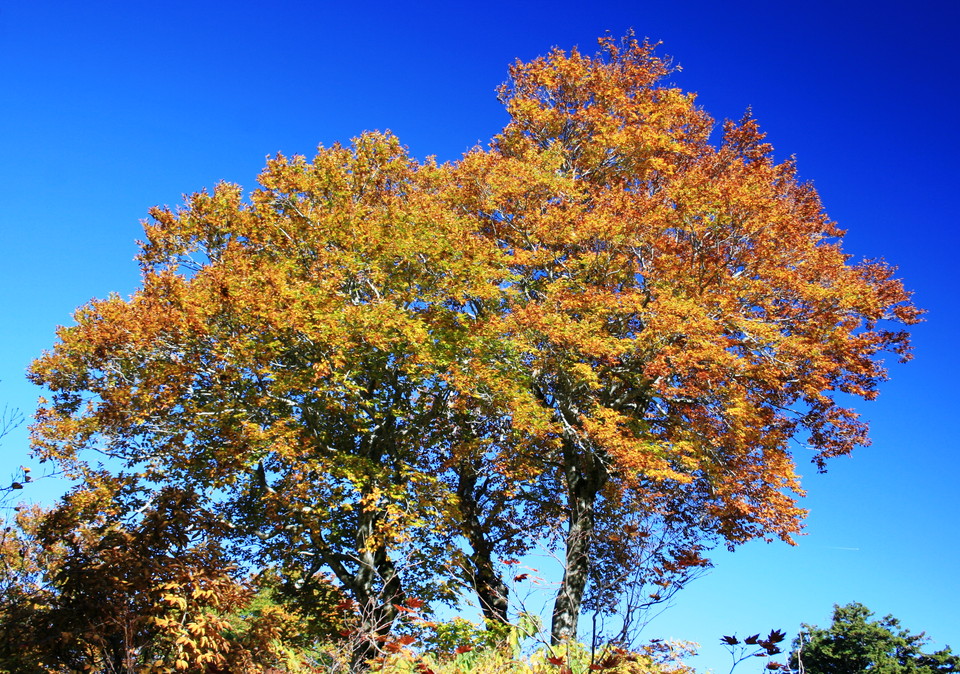
Japanese beech
Fagus crenata
Triangular beechnuts edible, sweet — best lightly roasted. ⚠ Raw beechnuts contain fagin and oxalic acid — eat only in moderation or roast.

American beech
Fagus grandifolia
Triangular beechnuts edible, sweet, between pine nut and almond — best lightly roasted; the oil can be pressed. ⚠ Raw beechnuts contain fagin and oxalic acid; eating many raw can cause headache and nausea — eat only in moderation or roast.

white oak
Quercus alba
Acorns edible after leaching out bitter tannins; white oak acorns are naturally sweeter and lower in tannin than red oaks, needing less leaching.

swamp white oak
Quercus bicolor
Acorns edible after leaching out bitter tannins; a white-oak-group acorn, comparatively sweet and easy to process.

bur oak
Quercus macrocarpa
Acorns edible only after leaching out bitter tannins in water, then ground into flour or roasted. Bur oak is in the low-tannin white-oak group and among the easiest, sweetest acorns.

English oak
Quercus robur
Acorns edible after leaching out bitter tannins, ground into flour or roasted — moderate tannin, needs thorough leaching.

golden currant
Ribes aureum
Showy, clove-scented yellow spring flowers as much as a fruit crop — sweet amber-to-black berries used historically for jam, jelly and pemmican.

stink currant
Ribes bracteosum
Named for its pungent, musky-skunky foliage smell. Small waxy blue-black berries in long hanging clusters were eaten fresh or dried by some Pacific Northwest Indigenous groups, but this is fundamentally a wild woodland species, not a refined eating currant.

wax currant
Ribes cereum
A tough, drought-adapted mounding shrub of the dry interior West; fruit used for jam, jelly, pie and historically pemmican.

coastal black gooseberry
Ribes divaricatum
PFAF calls it one of the finest wild North American gooseberries for eating — sweet-tart, thin-skinned, purple-black fruit, genuinely good rather than just edible.
winter currant
Ribes fasciculatum
Grown chiefly for its intensely fragrant spring flowers rather than its fruit, which PFAF calls unpalatable — an ornamental/fragrance shrub, not a fruit crop.
Himalayan currant
Ribes glaciale
⚠ The least-documented species in this catalog's Ribes entries — native high-Himalayan range is solid, but reliable flavor, fruit-quality and garden-performance information could not be confirmed against primary sources. Low-confidence secondary sources describe bitter purple berries and mostly ornamental use; treat that as unverified rather than fact.

prickly currant
Ribes lacustre
Dark purple-black fruit, tart and very juicy, described as having an "agreeable flavour when fully ripe" — but the crushed foliage and fruit have a distinctly skunky smell, and the densely bristly, prickly stems make this more of a wildlife thicket plant than a garden fruit crop.

laurel-leaved currant
Ribes laurifolium
An evergreen grown for its pendent late-winter flower racemes, not for fruit — one of the few Ribes species valued mainly as a winter-interest ornamental.

gummy gooseberry
Ribes lobbii
Grown mainly as a native/pollinator-garden ornamental for its large, showy, fuchsia-like maroon-and-white spring flowers, which draw bees and hummingbirds. Fruit is a sticky, dark purple, spiny berry — edible and good in jam, but secondary to the plant's ornamental value.

chaparral currant
Ribes malvaceum
Grown mainly as a California native/wildlife ornamental, notable for blooming in winter (October-March) when few other hummingbird nectar sources are available. Fruit is purple and edible but culinary use is thinly documented.
Korean currant
Ribes maximowiczianum
⚠ Genuinely under-documented — secondary sources describing this species may be conflating it with the closely related R. maximowiczii or R. ussuriense, and no reliable flavor or culinary information was found. One source notes Jeju Island (Korea) populations have been studied for antioxidant properties, but that's a research mention, not a garden fact. Native-range and cultivation claims here should be treated as tentative pending verification against a primary source like POWO or GBIF.

canyon gooseberry
Ribes menziesii
Purple, tart fruit that Wildflower.org describes as "mainly seeds and little fruit" and generally unpalatable — primarily a native wildlife/garden plant rather than an eating gooseberry, and its spines make hand-harvest difficult regardless.

buffalo / clove currant
Ribes odoratum
Grown as much for its clove-scented, bright yellow, tubular spring flowers and good fall color as for fruit. The named cultivar 'Crandall' produces large, glossy black berries that are notably sweeter and less musky than black currant — good fresh-eating as well as jam.

Sierra gooseberry
Ribes roezlii
A wild Sierra Nevada gooseberry that foragers rate genuinely excellent — sweet-tart, good fresh or for jelly and syrup — but very spiny stems make harvest slow going.

flowering currant
Ribes sanguineum
⚠ Primarily an ornamental, not a fruit crop — the fruit is technically edible but multiple independent sources (PFAF, Wikipedia, NC State Extension) describe it as insipid, sour, or "better left for the birds." It's grown for its spectacular early-spring flower clusters, a strong hummingbird draw, not for eating.

fuchsia-flowered gooseberry
Ribes speciosum
Grown for its striking red, fuchsia-shaped, hummingbird-pollinated spring flowers rather than its fruit — berries are small, glandular-bristly and tart, edible but a minor, incidental food rather than a dessert fruit. Extremely spiny stems.

gooseberry
Ribes uva-crispa
The classic European dessert and culinary gooseberry — tart to sweet depending on ripeness and cultivar, used underripe for cooking (pies, fools, sauces for oily fish) and fully ripe for fresh eating. Distinct from American gooseberry cultivars (bred mostly from R. hirtellum), which are smaller, hardier and milder-flavored.

evergreen currant
Ribes viburnifolium
Grown for its aromatic, glossy evergreen foliage and rare ability to thrive in dry shade under oaks, not for its fruit — the entire horticultural literature treats this as a native landscape/groundcover plant. Fruit is edible but small and incidental.

jostaberry
Ribes × nidigrolaria
A deliberately bred German hybrid — blackcurrant (R. nigrum) × European gooseberry (R. uva-crispa) × the wild American coastal black gooseberry (R. divaricatum), whose genes were key to overcoming the cross's initial sterility. Bred by Paul Lorenz from 1926 at Berlin's Kaiser Wilhelm Institute; Rudolf Bauer achieved a fertile line using colchicine-induced tetraploidy and released the first cultivar, 'Josta', in 1977 (the name is a portmanteau of German Johannisbeere/currant and Stachelbeere/gooseberry). Fruit is blackcurrant-sized or larger, dark purple-black, with a flavor between the two parents — less musky than blackcurrant, juicier and milder than gooseberry.

bitternut hickory
Carya cordiformis
Bitternut hickory lives up to its name — the thin-shelled nuts are notably bitter and astringent, so unpalatable that even squirrels often leave them uneaten. Historically the oil pressed from the nuts was burned in lamps rather than eaten, and the wood is prized for smoking ham and bacon, giving this species a real use but a poor reputation at the table compared with shagbark or shellbark hickory.

pignut hickory
Carya glabra
Pignut hickory nut quality is genuinely inconsistent — some trees produce sweet, pleasant nuts while others are bitter and astringent, and overall the species is considered inferior eating to shagbark or shellbark hickory. The nut is also small with a thick shell relative to the little kernel inside, so many foragers leave the crop for wildlife; a coastal variant (var. megacarpa) is reported to have a notably sweeter, better nut than the typical inland form.

pecan
Carya illinoinensis
The most cultivated and commercially important hickory by far — thin-shelled, sweet, oily kernels that need little processing compared with the thicker-shelled wild hickories, and the basis of a major US commercial nut crop across the South. Needs a long, hot growing season to ripen its nuts well and struggles in cool-summer climates outside its native and adapted range.

shellbark hickory
Carya laciniosa
Shellbark hickory produces the largest nut of any hickory — up to 5 cm long — with a genuinely sweet, well-regarded kernel, ranking alongside shagbark as one of the two best-eating hickories. The trade-off is a very hard, thick shell that cracks poorly, so getting the kernel out intact takes more effort than with shagbark.
nutmeg hickory
Carya myristiciformis
Nutmeg hickory nuts are genuinely sweet-tasting, but the shell is so thick relative to the small kernel that most nuts are left to rot where they fall, since neither people nor wildlife find them worth the effort of cracking. The species gets its common name from the nut's appearance — reddish-brown with silvery stripes, resembling the spice nutmeg — and its leaves have a striking silvery-scaled underside that flashes in the wind, considered by some foresters the most ornamentally attractive hickory foliage.

shagbark hickory
Carya ovata
Shagbark hickory is widely regarded as one of the two best-tasting hickories, alongside shellbark — the kernel is genuinely sweet and rich, and it's the wild hickory most often gathered and sold, even though thick native shells make cracking work; selected cultivars have been bred for thinner shells. Its shaggy, plate-like exfoliating bark, unique among the hickories, makes it easy to identify even from a distance.

black hickory
Carya texana
Black hickory nut quality is inconsistently documented — some sources describe the kernel as sweet, others as bitter, and the nuts are notably hard to crack given their thick shell relative to a small kernel, with little historical record of the species being cultivated or gathered for food the way shagbark or shellbark hickory are. It is best regarded as a marginal, unpredictable hickory for eating rather than a reliable food source.

mockernut hickory
Carya tomentosa
Mockernut hickory nuts have a genuinely delicious, sweet flavor, but the common name is apt — the shell is extremely thick and hard, and the kernel is quite small relative to the overall size of the nut, so extraction is difficult and the effort-to-reward ratio is poor compared with shagbark or shellbark hickory.

Japanese walnut
Juglans ailantifolia
The Japanese walnut is grown as much for its huge, bold, downy pinnate leaves and ornamental spring catkins as for its nuts, which form in clusters of 4–10 spherical fruits inside a green husk. Its heart-shaped-nut cultivar, the heartnut (var. cordiformis), cracks cleanly into two halves and is prized for eating fresh; the species is also notable as a low-juglone, canker-resistant genetic donor used to breed disease-tolerant hybrids with the endangered butternut.

southern California black walnut
Juglans californica
A shrubby to small tree endemic to a handful of southern California foothill ranges, it is unusual among walnuts for resprouting from the root crown after fire or cutting, often forming multiple trunks. Its riparian and oak-woodland habitat has been so reduced by urban development around Los Angeles that the species is assessed as Near Threatened.

northern California black walnut
Juglans hindsii
Northern California black walnut is grown less for its own small, thick-shelled nuts than as the classic rootstock underpinning the California walnut industry — it, and its Luther Burbank-bred hybrid with English walnut, 'Paradox,' support most commercial English walnut orchards worldwide thanks to their drought and nematode tolerance.
Hebei walnut
Juglans hopeiensis
Ma walnut is a narrow Chinese endemic of hybrid origin — molecular studies show it arose from crosses between English walnut and the Manchurian walnut — and its nuts are the classic 'wenwan' walnuts of Chinese folk tradition, hand-carried and worn smooth as meditation objects, with a well-matched pair of prized wild nuts reportedly selling for tens of thousands of dollars.

Texas black walnut
Juglans microcarpa
Texas black walnut (little walnut) is the smallest of the cultivated walnut species, a drought-adapted small tree or large shrub of the dry rocky ravines and river bottoms of the southwestern United States and northern Mexico, grown more for its toughness, shelterbelt value and use as rootstock than for its small, thick-shelled nuts.

black walnut
Juglans nigra
Black walnut is the classic North American nut-and-timber walnut, prized for its rich, bold, distinctly stronger-flavored oily kernel and dark cabinet-grade wood, but it is also the textbook case of juglone allelopathy — its roots, hulls and fallen leaves poison nearby tomatoes, apples and pines — and it is the species most severely threatened by thousand cankers disease.

Persian / English walnut
Juglans regia
Persian (English) walnut is the world's dominant commercial walnut — the species behind virtually every walnut sold in stores — grown on 'Paradox' rootstock across California and other Mediterranean-climate regions for its comparatively thin shell and mild, buttery-flavored kernel.

iron walnut
Juglans sigillata
Iron walnut is a Chinese endemic centered on Yunnan Province, cultivated for many centuries and named for its extremely hard, deeply pitted shell — it is closely related to, and possibly a landrace of, the Persian walnut, distinguished mainly by its higher leaflet count and far tougher shell.

Chinese artichoke / crosne
Stachys affinis
Crosne — crisp, nutty, water-chestnut-like.

long-racemed akebia
Akebia longeracemosa
Akebia: sweet but INSIPID pulp — in Japan the bitter RIND is the prized part. Decaisnea bland and watery.

chocolate vine
Akebia quinata
⚠ Pulp sweet but INSIPID/variable. In Japan the bitter RIND — stuffed and fried — is the prized culinary part.

three-leaf akebia
Akebia trifoliata
Akebia: sweet but INSIPID pulp — in Japan the bitter RIND is the prized part. Decaisnea bland and watery.

blue sausage fruit
Decaisnea fargesii
⚠ Honestly: bland, watery, mildly sweet — grown for the extraordinary blue pods, not the taste.

leatherleaf holboellia
Holboellia coriacea
Sweet-tasting purple-black pulp, but reports are mixed on the aftertaste — some sources describe it as pleasant, others as leaving an unpleasant, lingering bitterness even when the fruit is cooked. Grown at least as much for its evergreen foliage and fragrant spring flowers as for the fruit.
large-flowered holboellia
Holboellia grandiflora
Edible lilac-purple, sausage-shaped fruit — closely related Holboellia species range from sweet to unpleasantly bitter, and detailed flavor reports specific to this species are thin, so treat its eating quality as unconfirmed rather than assumed-good.

broadleaf holboellia
Holboellia latifolia
Creamy white, soft pulp — reports genuinely diverge, from sweet with a distinct aroma to mealy and insipid, and the fruit must be left to crack open on its own, since picked underripe it's hard and astringent. Care: Winter protection — mulch, fleece, or a warm wall.

Sinofranchetia chinensis
Sinofranchetia chinensis
Grape-sized blue-purple fruit, edible but insipid — similar in appearance to a small grape but less sweet, with a slightly leathery skin. Grown mainly for its ornamental blue-purple fruit clusters and large, three-leaflet foliage rather than for eating.

Stauntonia chinensis
Stauntonia chinensis
Edible fruit, but this species is far better documented as a traditional Chinese medicinal plant (root and stem used in decoctions) than as a food — flavor and eating-quality details specific to the fruit are thin in the sources available. Care: Winter protection — mulch, fleece, or a warm wall.

Stauntonia hexaphylla
Stauntonia hexaphylla
Unlike most of its Lardizabalaceae relatives, this one is genuinely good eating — a well-known Japanese dessert fruit with sweet, honey-flavored, watery pulp, eaten fresh out of hand or made into jam, jelly and wine.
Stauntonia obovatifoliola
Stauntonia obovatifoliola
Fully ripe fruit has a sweet flavor described as a cross between persimmon and lychee, with soft golden flesh — a genuinely good-eating relative within a genus where several other species are only mediocre.

spicebush
Lindera benzoin
Spicebush berries = an allspice-like SPICE; sassafras leaves = filé powder. Not dessert fruits. Dried drupes as an allspice-like spice.

sassafras
Sassafras albidum
Grown for two different things and neither of them the berry: the young leaves, dried and ground, are filé powder, the thickener that finishes a Louisiana gumbo, and the tree gives some of the finest autumn colour in North America. ⚠ Root and root bark are NOT safe to consume — they contain safrole, and the traditional sassafras root tea is no longer considered advisable.

pomegranate
Punica granatum
Juicy sweet-tart arils.

paper mulberry
Broussonetia papyrifera
Sweet orange-red fruit with a flavor similar to true mulberry, though there's not much flesh to it and it doesn't travel well — best eaten straight off the tree. ⚠ Caution: Legal note: illegal to cultivate, keep, trade or transport anywhere in the EU (Reg. 1143/2014, amended by (EU) 2025/1422, in force 7 Aug 2025) — EU readers cannot lawfully plant it.
Afghan fig
Ficus afghanistanica
A cold-hardy wild fig from the arid mountains of Afghanistan and Central Asia — quality varies notably by selection, from very sweet, rich-flavored forms to some that are merely ornamental, so seed-grown plants are a gamble on flavor compared with named cultivars.

Roxburgh fig
Ficus auriculata
Roxburgh fig bears large, fuzzy, yellow-to-purple syconia directly on the trunk and older branches (and sometimes even surface roots) in heavy clusters — eaten raw, cooked into curries and jams, or juiced, with a mild sweetness milder than F. carica.
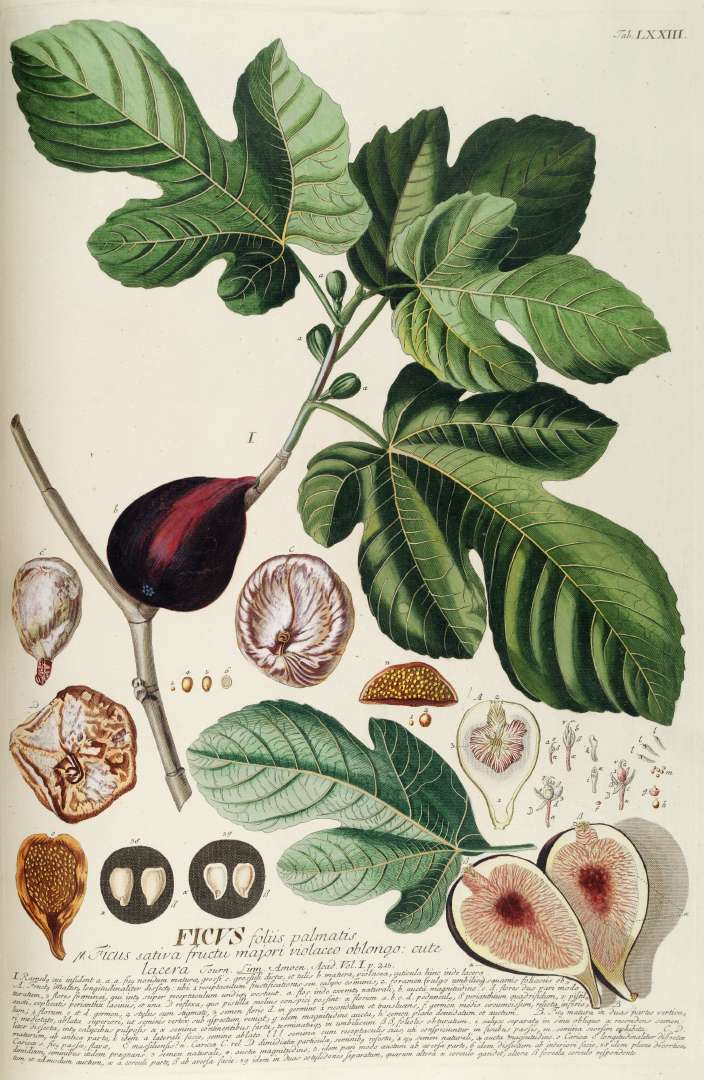
common fig
Ficus carica
Excellent fresh and dried.

Japanese fig
Ficus erecta
A cold-hardier East Asian wild fig bearing small, deep purple-blue figs dusted with a whitish bloom — edible fresh though noticeably smaller and less sweet than common fig, and more often grown for hardiness or ornamental interest than for a heavy edible crop.

Himalayan fig
Ficus palmata
The Himalayan wild fig produces small, succulent figs that darken from green to deep purple or near-black when ripe — sweet and edible fresh or dried, and prized regionally more for its extreme hardiness and rootstock use than for fruit quality on par with the common fig.
creeping fig
Ficus tikoua
An unusual low, creeping fig that hugs the ground rather than growing upright — its small yellowish figs form partly buried at the base of the plant (the Chinese name means roughly 'fruit from the soil'), and are edible though seedy and mild.

che / Chinese mulberry
Maclura tricuspidata
⚠ Honestly: mild, watermelon-ish but widely criticised as BLAND, insipid and seedy — a curiosity.

white mulberry
Morus alba
Morus alba is the classic white mulberry of the Old-World silk trade — its leaves are the preferred, most easily digested feed for the silkworm Bombyx mori, and its sweet but often mild-flavored fruit ripens white, pink, red, or near-black depending on the tree. In much of temperate North America it has also become a weedy, bird-spread colonizer that hybridizes with, and displaces, the native red mulberry, Morus rubra.

Korean / Asian mulberry
Morus australis
Morus australis, the Korean or Aino mulberry, is a smaller, fast-growing East Asian forest-margin tree bearing sweet but mild-flavored berries about a centimeter across that ripen from red to near-black. Unlike the strictly dioecious pattern typical of the genus, it is documented as self-fertile, able to set fruit without a separate pollinator tree.
Chinese mulberry
Morus cathayana
Morus cathayana, the Chinese or 'hua' mulberry, is an East Asian forest-margin tree distinguished by its broad, sometimes shallowly lobed leaves that are densely white- or yellowish-gray hairy beneath, bearing palatable berries that are eaten fresh or brewed into a leaf tea.

Indian mulberry
Morus indica
Morus indica, the Indian mulberry, is a Himalayan-origin tree cultivated across South and East Asia chiefly as silkworm fodder and in traditional glucose-regulating remedies, bearing small syncarps that ripen red to dark purple-black and resemble black mulberry fruit. Its taxonomy is notoriously tangled with other Asian mulberries, so plants sold under this name vary in identity.
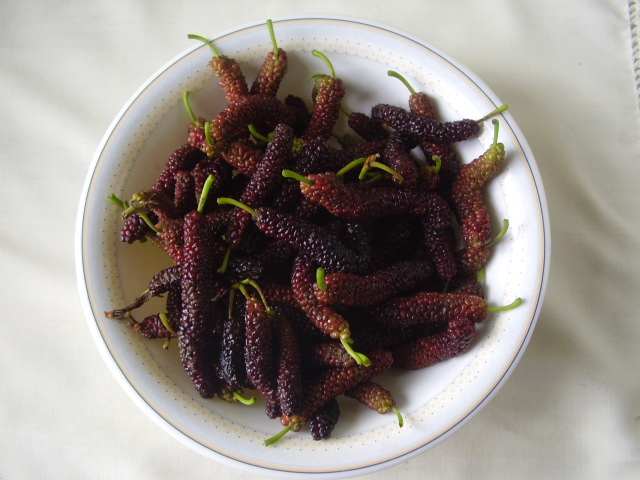
shahtoot mulberry
Morus macroura
Morus macroura, the shahtoot or king white mulberry, is a Himalayan-to-Southeast-Asian tree grown for its unusually elongated, honey-sweet aggregate fruit — up to 6–10cm long — that ripens from yellowish-white through pink to nearly black. It breaks dormancy very early, making its new growth highly vulnerable to late spring frost.

black mulberry
Morus nigra
Black mulberry — rich, sweet-tart, the best of the mulberries.
Mojo Berry dwarf mulberry
Morus rotundiloba
Small sweet-tart dark mulberries over a long season; a true patio mulberry.

red mulberry
Morus rubra
Red mulberry — sweet, good-flavored fruit from a fast-growing native tree of eastern North American woodlands; the species is increasingly threatened in the wild by hybridization with introduced white mulberry (Morus alba), which is genetically swamping it across parts of its range.
Himalayan mulberry
Morus serrata
Himalayan mulberry — a little-grown, high-altitude species from the Himalaya and southwest China; the mucilaginous fruit is sweet but not very fleshy, generally considered milder and less rich in flavor than black mulberry.

yangmei / Chinese bayberry
Myrica rubra
Yangmei, or Chinese bayberry — a genuinely good fruit, sweet-tart and juicy, and a major commercial crop in Zhejiang. The catch is that it will not keep: the fruit bruises as it is picked and lasts only a few days, which is why it is almost never seen fresh outside China and is usually met dried, candied or steeped in liquor. Nitrogen-fixing, and needs an acid soil.

feijoa / pineapple guava
Acca sellowiana
Feijoa — aromatic pineapple/guava with wintergreen notes; granular pulp. Very good (better flavoured in cool regions) Care: Winter protection — mulch, fleece, or a warm wall.

luma
Amomyrtus luma
Aromatic berries, red ripening to black, with a flavor reminiscent of blueberry and myrtle — genuinely good eating, used fresh and in jams, juices and fermented drinks in its native Chile and Argentina. Care: Winter protection — mulch, fleece, or a warm wall.

grey myrtle / cinnamon myrtle
Backhousia myrtifolia
A LEAF crop — warm cinnamon-anise aroma, used as a spice. ⚠ Fruit is a dry capsule, not eaten. Care: Winter protection — mulch, fleece, or a warm wall.

gabiroba
Campomanesia adamantium
Small yellow-green aromatic fruit — sweet-tart with a resinous guava note; eaten fresh and made into liqueur in Brazil. Care: Winter protection — mulch, fleece, or a warm wall.
gabiroba
Campomanesia pubescens
Yellow aromatic fruit, sweet-tart — close to C. adamantium in use; juice and jam. Care: Winter protection — mulch, fleece, or a warm wall.
guabiroba
Campomanesia xanthocarpa
Yellow-orange fruit — sweet, aromatic, guava-meets-lime. Among the hardiest useful Myrtaceae and the best bet in this group for a cool climate. Care: Winter protection — mulch, fleece, or a warm wall.

pear Eugenia / pêra-do-cerrado
Eugenia klotzschiana
⚠ Large velvety pear-shaped yellow fruit — strongly aromatic but sharply acidic; for juice, jam and liqueur rather than fresh eating. Care: Winter protection — mulch, fleece, or a warm wall.

ubajay
Eugenia myrcianthes
Orange-yellow fruit, sweet-tart and aromatic with a faint apricot note; fresh and preserved. One of the more cold-tolerant Eugenias. Care: Winter protection — mulch, fleece, or a warm wall.

muntries / emu apple
Kunzea pomifera
Small green-to-red berries tasting of spiced apple with a resinous edge — a genuine commercial Australian bush food, eaten fresh and in sauces. Care: Winter protection — mulch, fleece, or a warm wall.

Chilean myrtle
Luma apiculata
Black to purple berries with an intense, aromatic flavor reminiscent of blueberry and myrtle, sometimes described as having a slightly resinous finish — eaten fresh, though reported quality varies from plant to plant, ranging from merely fair to genuinely excellent.
cranberry-myrtle
Myrteola nummularia
Despite the name, tastes nothing like a true cranberry — small pink-to-white pearly berries with a sweet, floral, almost perfumed flavor, described by early botanists as fleshy and agreeably flavored. A genuine curiosity from Patagonia's rocky outcrops rather than a substantial crop, given its tiny groundcover stature.

common myrtle
Myrtus communis
Small blue-black berries with a resinous, herbal, slightly astringent flavor — closer to a savory spice (notes of juniper and allspice) than a dessert fruit, traditionally cooked into sauces for meat and fish or dried and used like a peppercorn rather than eaten raw.

boxleaf myrtle
Ugni candollei
Dark red-purple berries, aromatic and sweet — close to Chilean guava but less intensely strawberry-scented; fresh and preserved. Care: Winter protection — mulch, fleece, or a warm wall.

Chilean guava
Ugni molinae
Chilean guava — small, sweet, intensely strawberry-scented. Excellent.
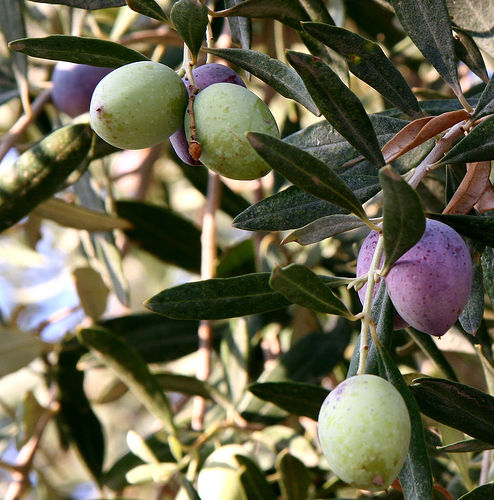
olive
Olea europaea
⚠ Raw olives are INEDIBLE until cured/brined. Care: Winter protection — mulch, fleece, or a warm wall.

hardy fuchsia
Fuchsia magellanica
Fuchsia berries edible — mild-sweet to bland; flowers edible. Edible berries and flowers.

climbing fuchsia
Fuchsia regia
Fuchsia berries edible — mild-sweet to bland; flowers edible. Larger edible berries.

blue passionflower
Passiflora caerulea
Ornamental passionflower — fruit small and largely insipid. ⚠ Ripe fruit only, and not much of it — unripe fruit and the foliage of this species contain cyanogenic glycosides.

maypop
Passiflora incarnata
Maypop — tart, apricot-like; quality below true passionfruit.

yellow passionflower
Passiflora lutea
Ornamental passionflower — fruit small and largely insipid.

curuba
Passiflora tarminiana
Ornamental passionflower — fruit small and largely insipid. Care: Winter protection — mulch, fleece, or a warm wall.

banana passionfruit
Passiflora tripartita var. mollissima
Ornamental passionflower — fruit small and largely insipid. Care: Winter protection — mulch, fleece, or a warm wall.

Chinese white pine
Pinus armandii
Chinese white pine nuts are large (10–16 mm), rich and resinous, and eaten as a delicacy across central China — but the species carries a well-documented catch: it is the recognized trigger behind 'pine mouth,' the bitter, metallic taste disturbance reported after eating pine nuts (often Chinese-sourced blends) sold in the West.

Mexican pinyon
Pinus cembroides
Mexican pinyon produces small, thick-shelled seeds (10–12 mm) that are the principal wild-harvested pine nut of Mexico's high desert — gathered, roasted, and ground into bread or eaten straight, much as Colorado pinyon is used farther north.

Colorado pinyon
Pinus edulis
Colorado pinyon is the classic wild-harvested piñón of the American Southwest — thin, wingless seeds about 1–1.5 cm long, sweet and oily, that were a winter staple for Southwestern Indigenous peoples and are still gathered commercially each autumn by Navajo and Hispano families.

chilgoza pine
Pinus gerardiana
Chilgoza pine produces the largest pine nut of any commercial species — thin-shelled kernels 17–23 mm long — prized across Afghanistan, Pakistan and northwest India, but wild populations are now IUCN-listed Near Threatened after decades of unsustainable cone harvesting that leaves too few seeds for natural regeneration.
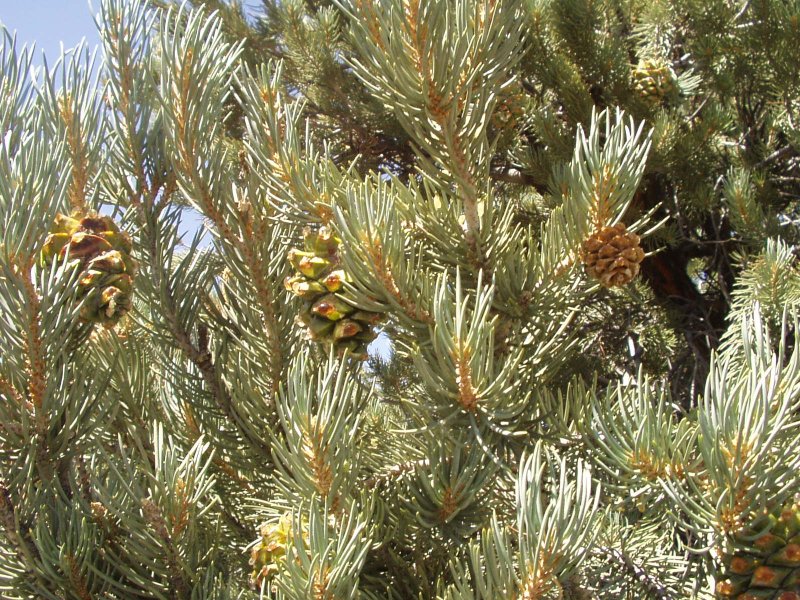
single-leaf pinyon
Pinus monophylla
Pine nuts — rich, oily, excellent.

Italian stone pine
Pinus pinea
Italian stone pine is the definitive commercial pine nut of Mediterranean cuisine — the large (2 cm), sweet, buttery kernel used in pesto and countless Italian dishes — and pine kernels rank among the most expensive nuts on the market because of the tree's slow, unpredictable bearing and labor-intensive harvest.

rhubarb
Rheum rhabarbarum
⚠ STALKS ONLY — the leaf blades are toxic (soluble oxalates and anthraquinone glycosides) and must never be eaten; only the leaf stalks (petioles) are food, and they are cooked. Sharp and superb. Herbaceous, and its vernalization requirement differs from fruit-tree chill.

perennial sorrel
Rumex acetosa
Sharp, lemony leaves eaten raw in salad when young or cooked into soups and sauces — the acidity is oxalic acid, the same compound that makes rhubarb stalks sharp. Fine in normal culinary amounts; worth moderating if you are prone to kidney stones, and not a green to eat by the bowlful. Cooked sorrel collapses to a khaki purée in seconds, which is normal.

Chilean hazelnut
Gevuina avellana
Nut between hazelnut and macadamia — creamy and oily (a true macadamia relative, not a hazel) Evergreen; no chill requirement. Care: Winter protection — mulch, fleece, or a warm wall.
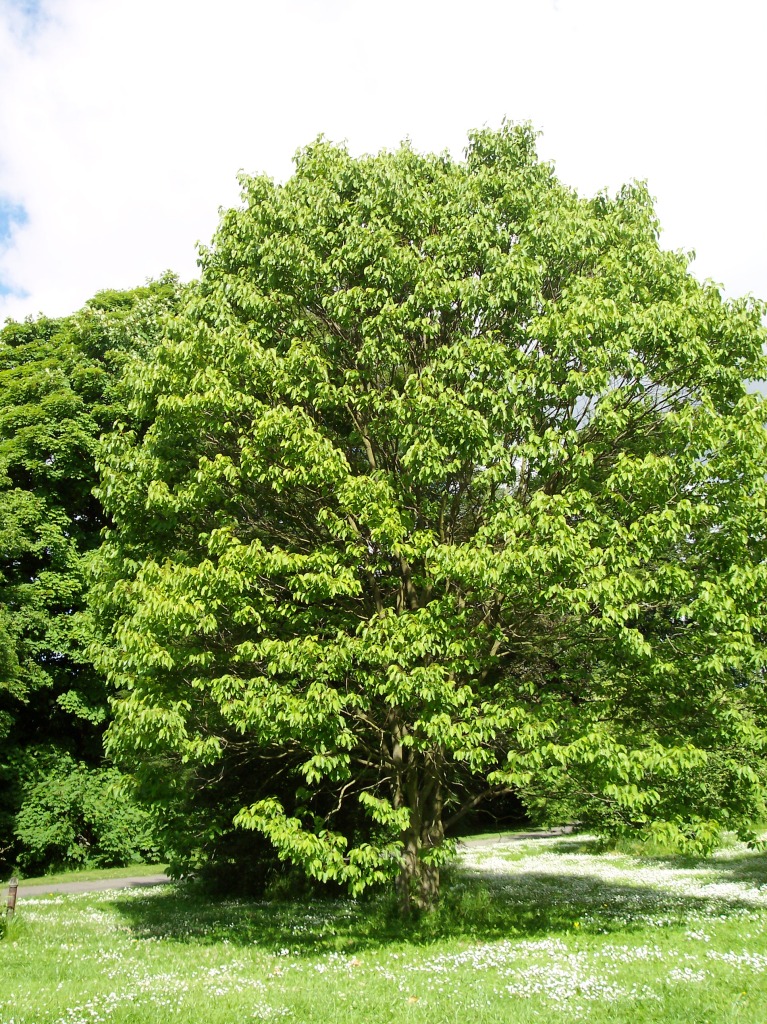
Japanese raisin tree
Hovenia dulcis
⚠ The edible part is the swollen PEDUNCLE (stalk), not the fruit — raisin/pear-like with clove notes. Often fails to ripen in cool summers.
mock buckthorn
Sageretia thea
Small sweet drupes; leaves used for tea. Care: Winter protection;* tender evergreen.

Chinese jujube / red date
Ziziphus jujuba
Crisp and apple-like fresh; sweet, wrinkled and DATE-LIKE when dried. Very high vitamin C.

downy serviceberry
Amelanchier arborea
Amelanchier arborea is the tallest and most tree-like of the widespread North American serviceberries, capable of reaching 12m (40ft) in the wild though usually seen as a large multi-stemmed shrub or small single-trunk tree in cultivation — it produces some of the earliest white blossom of the eastern forest understory, opening before the leaves emerge in early spring.
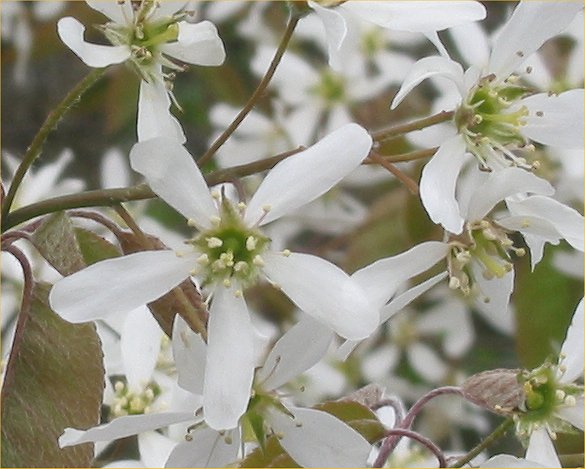
Canadian serviceberry
Amelanchier canadensis
Amelanchier canadensis is a wetland-adapted, strongly colony-forming shrub of the Atlantic coastal plain, distinct from the more upland, tree-form A. arborea and A. laevis it is frequently confused with in the nursery trade — its vigorous suckering habit makes it especially useful for naturalizing along pond and stream margins.

Allegheny serviceberry
Amelanchier laevis
Amelanchier laevis produces some of the largest and best-tasting fruit in the genus — up to 18mm across, succulent and sweet — and is notable in the botanical literature as one of the species in which apomixis (asexual seed production without fertilization) was specifically documented, a phenomenon central to the genus's famously tangled taxonomy. Seedlings are slow to bear, reaching fruiting age around 12 years from seed.

snowy mespilus / juneberry
Amelanchier lamarckii
A shrub or small tree of genuinely unsettled taxonomic status — likely a natural hybrid of eastern North American parentage (A. arborea/canadensis × A. laevis) that may no longer exist in an identifiable wild form — Amelanchier lamarckii has nonetheless become one of the most widely planted ornamental Amelanchier in European gardens, prized for coppery-bronze spring foliage, abundant white blossom, and reliable red-orange autumn color, and carries the RHS Award of Garden Merit.

European serviceberry
Amelanchier ovalis
The classic wild serviceberry of European mountains, found from Spain to the Caucasus and North Africa on rocky, often limestone slopes — a slow-growing, sun-loving shrub valued in gardens chiefly for its abundant white spring blossom rather than for its fruit, which is edible but noticeably drier and blander than that of the North American species.

running serviceberry
Amelanchier stolonifera
Named for its stoloniferous, thicket-forming habit — running serviceberry is a low eastern North American shrub that spreads by underground stolons and root suckers to colonize an area rather than stay put as a discrete clump, making it well suited to naturalizing, erosion control on banks, and native hedgerows.

Utah serviceberry
Amelanchier utahensis
A dryland-adapted serviceberry of the Intermountain West and desert Southwest, ranging from Washington and Montana south to Baja California and Texas on dry, rocky slopes — its deep, spreading root system makes it noticeably more drought-tolerant once established than its eastern North American and European relatives.
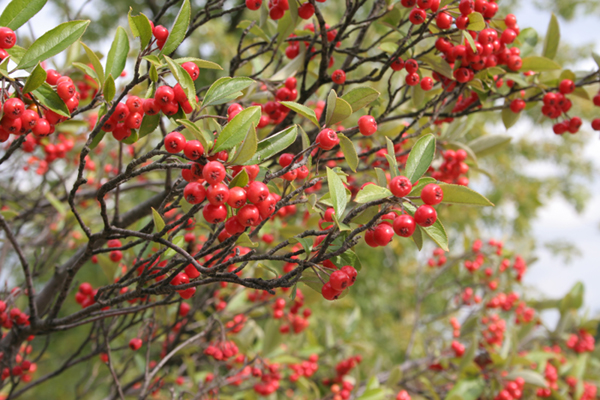
red chokeberry
Aronia arbutifolia
Tart and astringent raw — more palatable fresh than black chokeberry, but still best cooked with sugar into jams, jellies, syrup or juice, where the abundant pectin gives a heavy, vibrant-red set.

black chokeberry
Aronia melanocarpa
⚠ Very astringent raw — best processed into juice, wine or jam.
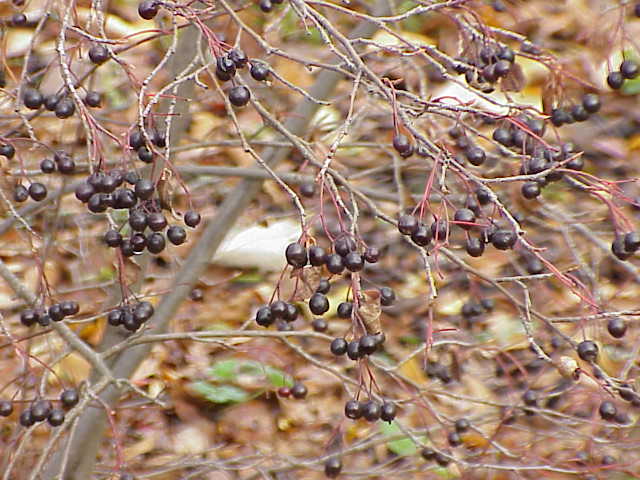
purple chokeberry
Aronia × prunifolia
A natural hybrid between red and black chokeberry (A. arbutifolia × A. melanocarpa), with dark purple-black fruit intermediate in astringency between its two parents — still best cooked with sugar into jam, jelly, syrup or juice rather than eaten raw in quantity.

Chinese flowering quince
Chaenomeles cathayensis
The largest-fruited of the flowering quinces, with hard, sour, strongly astringent fruit unfit for eating raw — like true quince, it needs cooking, and is used for jelly, preserves and as an aromatic, tart lemon substitute.

Japanese quince
Chaenomeles japonica
Too hard, sour and astringent to eat raw, but aromatic and pectin-rich — sometimes called the 'northern lemon' for its use as a tart, floral substitute for lemon juice, and excellent cooked into jelly, jam or liqueur.

flowering quince
Chaenomeles speciosa
Grown mainly for its dramatic early spring blossom, with fruit that's hard, sour and astringent fresh off the shrub — cooked into jelly, jam or a sharp, quince-like preserve, closer to true quince than to an eating apple.

eastern mayhaw
Crataegus aestivalis
Eastern mayhaw is a swamp-dwelling small tree of the southeastern US coastal plain, often flowering and fruiting while standing in seasonally flooded ponds and river bottoms alongside bald cypress and tupelo. Its tart, cherry-red haws are the basis of a long-standing Southern tradition of mayhaw jelly, still commercially harvested and sold across Louisiana, Georgia and the Gulf states.

azarole
Crataegus azarolus
Azarole is the Mediterranean hawthorn long grown for its fruit — larger and better-flavored than most wild hawthorns — which is eaten fresh, dried or preserved across Italy, Greece, Cyprus, the Levant and North Africa, though it has faded from mainstream orchard cultivation in recent generations.
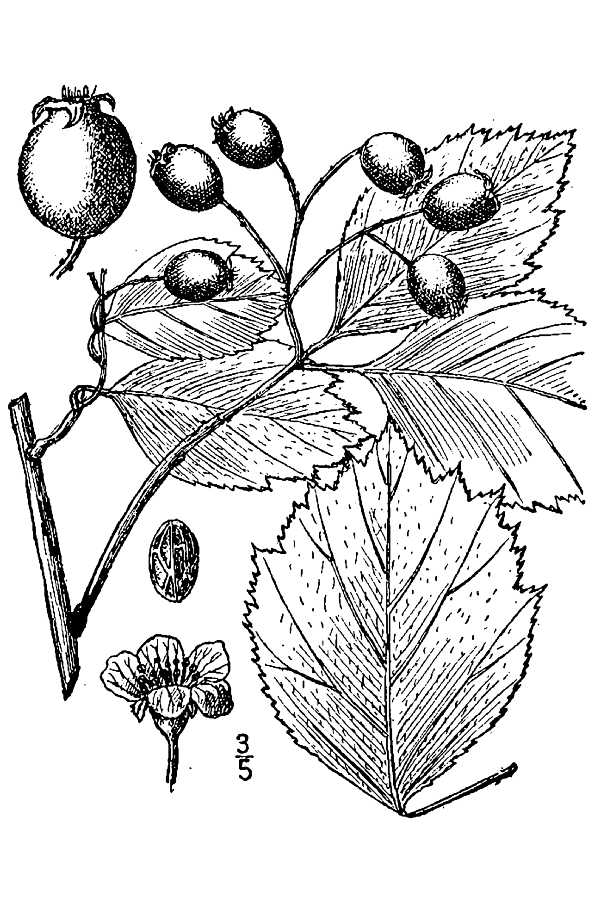
black hawthorn
Crataegus douglasii
Black hawthorn is the characteristic hawthorn of the Pacific Northwest and interior western mountains, ranging from southeastern Alaska to northern California and east into the Rockies — the only Crataegus native that far north on the West Coast. Unlike most other hawthorns in this group, it spreads by root suckering into dense thickets, and its dark purple-to-black fruit sets it apart from the typically red haws of related species.

midland hawthorn
Crataegus laevigata
Midland hawthorn is one of only two hawthorns native to Britain, where — alongside the more common Crataegus monogyna — it forms ancient woodland understorey and old hedgerows across central and southern England, distinguished by its shallowly lobed leaves (cut less than halfway to the midrib) and haws that contain two seeds rather than one.

Mexican hawthorn (tejocote)
Crataegus mexicana
Grown far more for cooking than fresh eating in most Western gardens, but in its home range the ripe fruit is also eaten out of hand — firm, aromatic and tart-sweet, closer to a small crabapple than a typical fresh-eating fruit. Its real importance is culinary: it is the defining fruit of ponche navideño and of candied Mexican dulces.

common hawthorn
Crataegus monogyna
⚠ Honestly: mealy and bland — for jelly, not fresh eating. Worth flagging too: outside its native European/W. Asian range it is a documented escapee — bird-spread seed has let it naturalize aggressively enough in parts of North America, Australia and New Zealand to be treated as invasive, so plant it with more caution there than the straightforward hedging reputation it has at home.

western mayhaw
Crataegus opaca
The classic Deep South 'mayhaw' — cranberry-red, tart fruit gathered from swamps and riverbanks each May and turned into the mayhaw jellies and syrups that are a genuine regional foodway across Texas, Louisiana and the Gulf Coast states, distinct from the culinary traditions of the Old World and Asian hawthorns.

Chinese hawthorn
Crataegus pinnatifida
Grown specifically for its tart, vitamin C- and pectin-rich fruit, which underpins real, still-thriving Chinese food traditions — tanghulu candy, shanzhagao fruit leather, haw flakes, jams and preserves — as well as traditional medicinal use as a digestive aid, distinguishing it sharply from the other hawthorns on this list.

common quince
Cydonia oblonga
⚠ MUST BE COOKED — hard and sour raw; superb as jelly/membrillo.
Assam apple
Docynia indica
Small apple-like fruit, slightly acid and refreshing once fully ripe (bland to sour when picked early) — eaten fresh, pickled, or made into jam, juice and wine in its native Northeast India and eastern Himalaya.

loquat
Eriobotrya japonica
Loquat — juicy, sweet-tart orange flesh with a flavor somewhere between apricot and mild citrus, eaten fresh out of hand or cooked into jam and pies; one of the earliest tree fruits to ripen each year. Care: Winter protection — mulch, fleece, or a warm wall.

beach / Chilean strawberry
Fragaria chiloensis
One of the two wild species — alongside Virginia strawberry — that hybridized to give rise to the modern garden strawberry; a coastal dune species native to both the Pacific coast of North America and Chile, prized for glossy foliage and large, sweet, succulent fruit.

Sikkim strawberry
Fragaria daltoniana
A diminutive Himalayan alpine strawberry, just 4–6 cm tall, native to elevations of 2,000–3,600 m from Nepal and Sikkim to Tibet and northern Myanmar, distinguished by small pink-to-white fruit that's edible but essentially flavorless.
Taiwan strawberry
Fragaria hayatae
A Taiwan-endemic wild strawberry distinguished by anthocyanin pigmentation throughout the plant — red leaf stalks, red runners, red fruit; used experimentally as a diploid breeding parent crossed with cultivated strawberry cultivars.
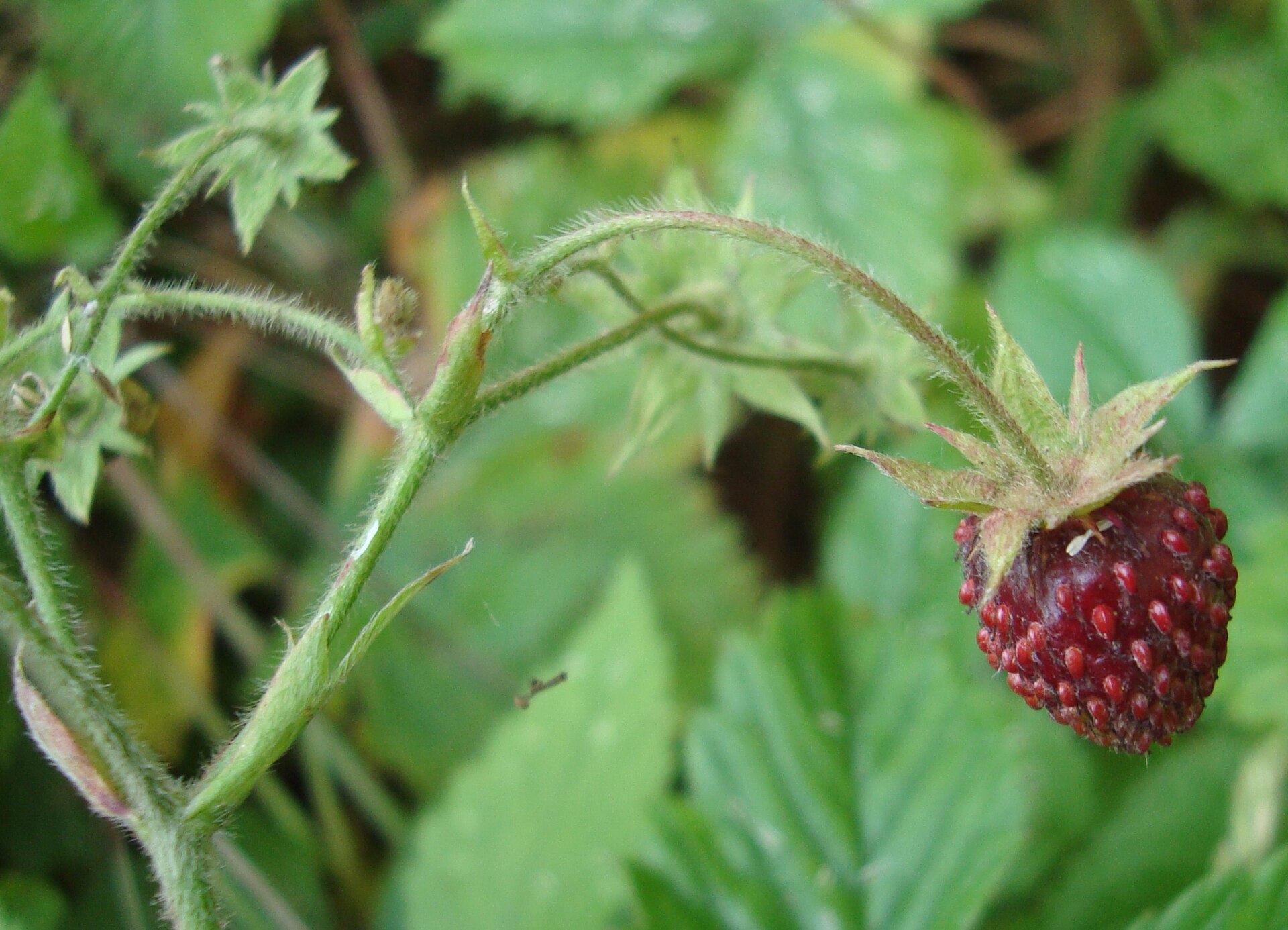
musk strawberry
Fragaria moschata
Historically the first strawberry to receive a cultivar name (France, 1576) and the dominant garden strawberry across much of Europe before being displaced by the modern garden strawberry in the 19th century — grown for a complex aroma blending strawberry, raspberry and pineapple notes rather than fruit size.

yellow/white-fruited strawberry
Fragaria nilgerrensis
Known as the peach strawberry — this Himalayan-to-south-central-China species produces small white-to-pale-pink fruit with a distinctive peach-like fragrance rather than typical strawberry flavor, making it valuable breeding material for flavor improvement in cultivated strawberries.

Himalayan strawberry
Fragaria nubicola
A high-altitude Himalayan wild strawberry ranging from Afghanistan to Tibet at elevations up to roughly 4,300 m, with a pleasantly flavored yellowish-white fruit blushed red at the tip; used in recent hybridization studies as a genetic resource for strawberry breeding.
five-leaf strawberry
Fragaria pentaphylla
One of the few Fragaria species with five leaflets rather than the typical three, native to montane forest clearings and scrub of west-central China; occurs in both red-fruited and white-fruited forms and is essentially unknown in cultivation, though of interest to breeders as a tetraploid genetic resource.
Tibetan strawberry
Fragaria tibetica
A tetraploid wild strawberry endemic to the Tibetan Plateau and adjoining Sichuan/northwest Yunnan, distinguished from its relatives by unusually pale, whitish fruit and large pollen grains and seeds; known almost exclusively from botanical field surveys rather than cultivation.

woodland / wild strawberry
Fragaria vesca
The woodland strawberry bears small (~15 mm) but intensely aromatic fruit and is the most widely naturalized wild strawberry species worldwide; cultivated in European gardens since at least Roman times, long before the modern garden strawberry existed.

Virginia strawberry
Fragaria virginiana
Native to eastern and central North America, and one of the two wild species — alongside the South American beach strawberry — whose 18th-century hybridization in Europe produced the modern garden strawberry.

creamy / green strawberry
Fragaria viridis
The green or creamy strawberry, native from western Europe across Russia and Central Asia to Turkey; its fruit often stays greenish-tinged even when ripe, with a distinctive rich, musky, pineapple-like flavor rather than typical strawberry aroma.

garden strawberry
Fragaria × ananassa
Not a wild species but an 18th-century hybrid of the South American beach strawberry and the North American Virginia strawberry, first arising in Brittany, France — virtually all commercial strawberries grown today descend from this original cross.

vesca × ananassa hybrid
Fragaria × vescana
A fertile hybrid combining a chromosome-doubled woodland strawberry with the garden strawberry, bred to merge the size and vigor of the garden strawberry with the intense aroma of the woodland strawberry; breeding began in 1918, with named cultivars following from the late 1970s onward.

sweet crabapple
Malus coronaria
Sweet crabapple is valued for its intensely fragrant, rose-pink spring blossoms and for fruit that — despite being harsh and acid off the tree — makes excellent jelly and cider once fully ripe; the fruit persists on the tree well after leaf-fall. It is one of only a few crabapple species native to eastern North America and has historically been used in regional folk horticulture for preserves.

apple
Malus domestica
The familiar eating apple is a hybrid-origin fruit tree descended mainly from the wild Central Asian apple Malus sieversii, refined over millennia of selection and grafting into thousands of named cultivars that vary enormously in flavor, texture, and use — from sharp cooking apples to sweet dessert varieties — with virtually all of that variation dependent on which cultivar is grafted rather than on the species itself.

Japanese flowering crabapple
Malus floribunda
Japanese flowering crabapple is grown almost entirely for its exceptional spring display — crimson buds opening to fragrant white or pale pink blossom on gracefully arching branches — and is agriculturally significant well beyond ornament: its Vf scab-resistance gene, taken from a single accession, underlies a large share of the scab-resistant apple cultivars bred over the past century.

Hupeh crabapple
Malus hupehensis
Tea crabapple is a vigorous, profusely flowering ornamental — pink buds opening to fragrant white blossom followed by abundant bright red, cherry-sized fruit — but its most distinctive biological trait is triploid apomixis: because its seed usually develops clonally rather than sexually, seedlings breed true to the mother tree, a rare trait among Malus that has made it valuable as a uniform seedling rootstock in Chinese apple production.

plum-leaf crabapple
Malus prunifolia
Known as plum-leaf or Chinese crabapple, this hardy small tree bears yellow-to-red pomes to about 2 cm across that are edible but typically mealy and astringent, though some forms and individual specimens have been recorded with a sweet, pleasant taste — it has long served in China as a rootstock for grafted apple.
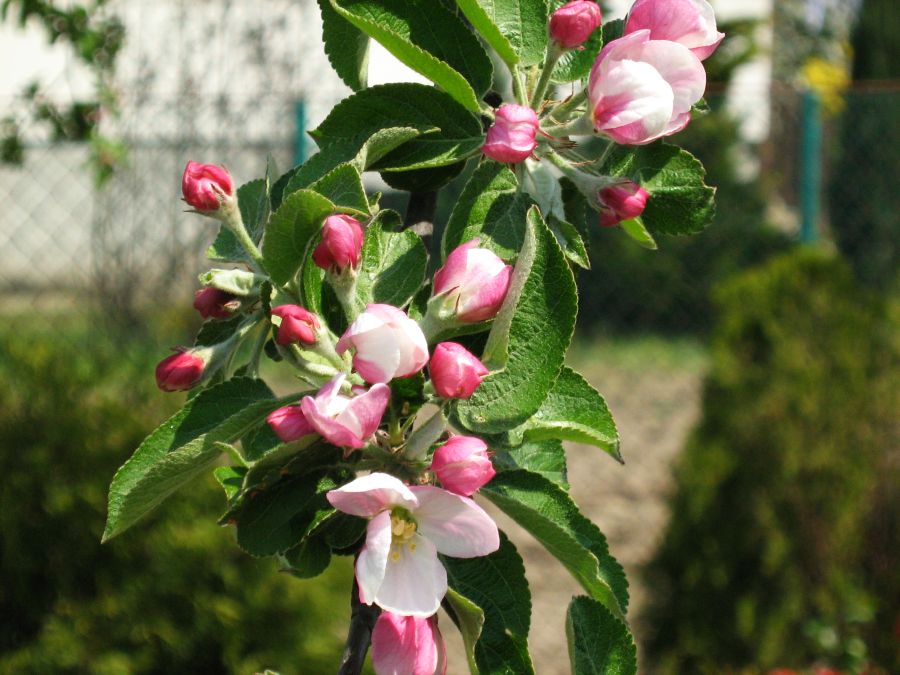
wild apple (crop ancestor)
Malus sieversii
This is the principal wild ancestor of the domesticated apple, native to the wild-apple forests of the Tian Shan in Kazakhstan and neighboring Central Asian countries — its fruit already shows the large size (up to 7–8 cm) and wide variation in flavor, color, and shape that breeders still mine today, and the species is now assessed as Vulnerable in the wild, making its native forests an active conservation priority.

toringo crabapple
Malus toringo
Known in Japan, Korea, and China as toringo or Siebold's crabapple, this compact species (to roughly 3–5 m) is among the most popular Malus for bonsai cultivation, valued for its dense, cloud-like spring blossom and small fruit that color well after frost.

common medlar
Mespilus germanica
⚠ Must be BLETTED (flesh browns and softens) — then like apple butter, dates and wine.

osoberry / Indian plum
Oemleria cerasiformis
Very bitter and almond-flavored until fully ripe, when it sweetens into something between cherry and cucumber — a thin layer of flesh around a large stone means it's a minor nibble rather than a real harvest, best picked only when fully dark and soft. ⚠ The almond note is the clue — the stone and the bark are cyanogenic, as elsewhere in the rose family. Eat the thin flesh, not the kernel.

ʻūlei
Osteomeles anthyllidifolia
Small white fruit, bland to mildly sweet with a flavor reminiscent of rose petals — a traditional Hawaiian nibbling fruit rather than a substantial crop, historically also used to dye kapa cloth lavender to purple. Care: Winter protection — mulch, fleece, or a warm wall.

wild crab apple
Peraphyllum ramosissimum
Sour and slightly bitter as it first ripens, mellowing to mildly sweet with a lingering bitter aftertaste when fully ripe — the fruits that ripen and dry on the shrub are the sweetest and most palatable, and good for jelly or spiced like preserved crabapples.

apricot
Prunus armeniaca
Sweet-tart, aromatic flesh eaten fresh, dried, or made into jams and liqueurs — the velvety orange-yellow skin blushes red where sun-exposed. ⚠ Kernels/pits cyanogenic.

sweet cherry
Prunus avium
Sweet, juicy fresh-eating flavor in cultivated forms — from firm and mild to deep and richly flavored — while the wild type's smaller, more bitter fruit is traditionally distilled into kirsch and maraschino liqueur. ⚠ Kernels/pits cyanogenic.

Taiwan cherry
Prunus campanulata
Small, shiny scarlet cherries are astringent and rarely eaten fresh — the tree is grown almost entirely for its early, bell-shaped, deep-pink blossom rather than for its fruit. ⚠ Kernels/pits cyanogenic.

cherry plum
Prunus cerasifera
Fruit ranges from sweet-tart to fully sweet depending on the seedling or cultivar and is eaten fresh or made into jam — though most garden forms, especially purple-leaved ones, are grown chiefly for foliage and blossom rather than for eating. ⚠ Kernels/pits cyanogenic.

Himalayan cherry
Prunus cerasoides
The small yellow-to-red fruit is sour and astringent, occasionally eaten raw but more often cooked or preserved — the tree is prized far more for its early pink blossom and its glossy, peeling reddish bark. ⚠ Kernels/pits cyanogenic.

sour / tart cherry
Prunus cerasus
Tart, acidic flavor unsuited to fresh eating for most people but prized for pies, preserves, juice, and dried cherries — Montmorency is the archetypal culinary sour cherry. ⚠ Kernels/pits cyanogenic.

European plum
Prunus domestica
Ripe fruit is sweet and rich — eaten fresh, dried into prunes, cooked into jam, or distilled into brandies such as slivovitz — with flavor and texture varying enormously between the many European plum cultivars. ⚠ Kernels/pits cyanogenic.

almond
Prunus dulcis
The crop is the kernel, not the fruit — the hull is leathery and is discarded. Sweet-cultivar almonds are eaten raw, roasted, or ground into flour and marzipan. ⚠ Bitter-almond kernels contain enough amygdalin to be toxic in quantity; the sweet cultivars are the edible ones.

bitter cherry
Prunus emarginata
Fruit is intensely bitter and essentially unpalatable to people — though it's an important food source for songbirds, bears, coyotes, and other wildlife. ⚠ Kernels/pits cyanogenic (seeds contain hydrocyanic acid).

Chinese bush cherry
Prunus humilis
Fruit is small and sour — described as acid but not unpalatable to very sour depending on the selection — and is eaten raw or, more often, cooked into preserves. ⚠ Kernels/pits cyanogenic.

Japanese bush cherry
Prunus japonica
The small cherry-like drupes have a sweet-tart flavor reminiscent of sour cherry and are eaten fresh, stewed, or made into pies and preserves — the flesh is pleasant but the seed kernels contain amygdalin. ⚠ Kernels/pits cyanogenic.

mahaleb cherry
Prunus mahaleb
The small black fruit is thin-fleshed and bitter, rarely eaten fresh — instead the fragrant kernels inside the stones are dried and ground into mahlab, a spice used in Middle Eastern and Mediterranean breads, cookies, and pastries. ⚠ Kernels/pits cyanogenic.

Japanese apricot (ume)
Prunus mume
The fruit is intensely sour and astringent when raw, so it is almost never eaten fresh — instead it is pickled into salty-sour umeboshi, brewed into umeshu plum wine, or simmered into syrups and sauces. ⚠ Kernels/pits cyanogenic.

peach
Prunus persica
The fruit is prized fresh for its juicy, aromatic, sweet flesh — yellow or white depending on cultivar — and is also canned, dried, and used widely in baking, preserves, and desserts. ⚠ Kernels/pits cyanogenic.

rock cherry
Prunus prostrata
The small cherries are edible but mealy and not very palatable raw, occasionally cooked, and the species is grown mainly for its spring flowers rather than for fruit. ⚠ Kernels/pits cyanogenic.

Japanese plum
Prunus salicina
⚠ Fresh fruit is juicy and sweet-tart, with skin ranging from red to purple-black over amber-yellow flesh; eaten fresh, dried, or made into jams and Asian-style plum sauces — kernels inside the pit are cyanogenic and should not be eaten.

black cherry
Prunus serotina
⚠ Ripe black cherries are bittersweet with thin skin and dark juicy flesh, traditionally used to flavor whiskey (cherry bounce) and in jams, syrups, and baking — wilted leaves, bark, and seeds are cyanogenic (the ripe flesh itself is edible).

Japanese flowering cherry
Prunus serrulata
Grown almost exclusively as an ornamental for its profuse spring blossom; the small blackish fruits are technically edible but sparse and astringent, so they are left for birds rather than harvested for eating. ⚠ Kernels/pits cyanogenic.

blackthorn / sloe
Prunus spinosa
⚠ The sloe is intensely astringent and essentially inedible raw off the bush, but once the first frosts soften its tannins it is traditionally used to make sloe gin, jellies, and preserves — kernels are cyanogenic like other Prunus stones.

higan cherry
Prunus subhirtella
Grown as an ornamental for its very early, prolific pink or white blossom; the small black cherry-like fruits are edible but tiny and sparse, mostly left for birds rather than harvested for eating. ⚠ Kernels/pits cyanogenic.

Yoshino cherry
Prunus × yedoensis
Grown almost exclusively as an ornamental for its profuse, faintly fragrant white-to-pale-pink spring blossom (famous in Washington, D.C. and Tokyo); the classic 'Somei-Yoshino' clone is a sterile interspecific hybrid that sets little to no viable fruit, so it is not grown for eating. ⚠ Kernels/pits cyanogenic.

Chinese quince
Pseudocydonia sinensis
Intensely tart, astringent and hard raw, but sweetly and spicily fragrant — cooked into a soft, mellow-sweet, red-pink preserve, jam or liqueur, and often kept whole in a bowl just for its scent.
Pyrus × Cydonia quince-pear ('Daniellii')
Pyrocydonia danielii
Between pear and quince — aromatic; usually cooked.
Pyrus × Cydonia hybrid ('Veitchii')
Pyronia veitchii
Quince-pear; aromatic, usually cooked.
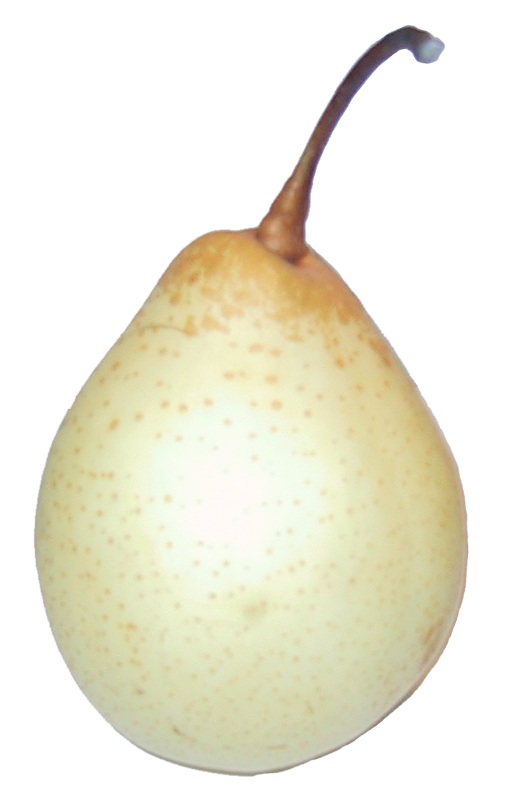
Chinese white pear
Pyrus bretschneideri
The 'Chinese white pear' — juicy, white-to-light-yellow-fleshed pears shaped more like a European pear (narrowing toward the stem) than the round nashi/Asian pears also grown in East Asia. Unlike buttery European pear cultivars, the flesh stays crisp and high in water content even fully ripe, with a mild, subtly floral sweetness — it's eaten fresh rather than bletted.
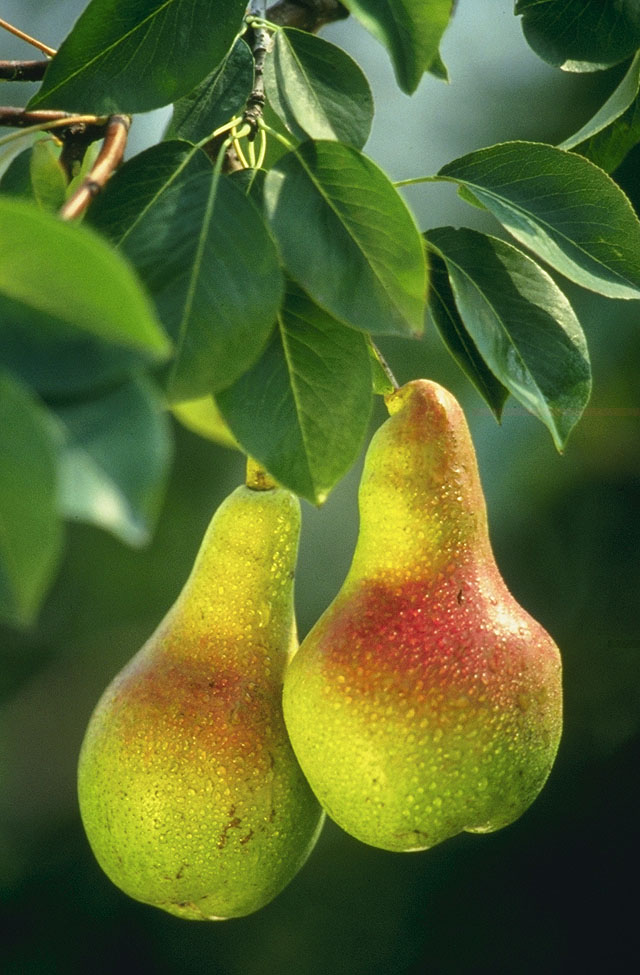
European pear
Pyrus communis
Best ripened off the tree.

central Asian pear
Pyrus korshinskyi
The Kazakh or Bukharan pear — a wild, Critically Endangered Central Asian species from mountain habitats between roughly 1000 and 2600 m. It's grown far more for its drought and disease tolerance as breeding/rootstock material than for its fruit, which is described in the literature as yellowish-green and only sparsely documented for eating quality.

Himalayan pear
Pyrus pashia
The wild Himalayan pear — a small to medium montane tree with a rounded crown, valued in its native range both as a wild-harvested food and, increasingly, as breeding and rootstock material for cultivated pear. Its small, russet-apple-like fruit is astringent when unripe but sweetens with bletting.

Asian pear / nashi
Pyrus pyrifolia
Pyrus pyrifolia is the wild ancestor of the Asian, nashi or 'apple pear' — grown and selected for centuries across China, Japan and Korea into today's many nashi cultivars. Its fruit is what most distinguishes it in the kitchen: crisp, juicy and apple-textured rather than soft and buttery like a European pear.

Xinjiang pear
Pyrus sinkiangensis
Pyrus sinkiangensis, the Xinjiang pear, is a genuinely obscure taxon in Western references — a probable complex hybrid grown almost exclusively in Xinjiang, China, best known through the 'Korla fragrant pear,' a geographically-protected local delicacy cultivated along the Silk Road for well over a millennium. Cultivars vary widely, some needing an after-harvest ripening period like European pears and others eaten crisp off the tree like Chinese white pears.

prairie rose
Rosa arkansana
Prairie rose is a small, tough, deep-rooted species of the North American plains, dying back to the crown each winter. Its hips are small and thin-fleshed compared with rugosa or villosa — closer in character to arctic rose's — valued historically more for jelly, tea, and wildlife forage than for thick preserving flesh. ⚠ Deseed the hips before eating: the ring of stiff hairs around the seeds is a gut and skin irritant, and is what old-fashioned itching powder was made from. Strain it out of any purée or syrup.

sweet briar
Rosa rubiginosa
Sweet briar (eglantine) is, alongside dog rose, one of the two classic European wild sources of vitamin-C-rich rosehip syrup, but is most easily told apart in the garden by its apple-scented foliage. Outside Europe it has become a documented invasive weed in parts of South America, Australia, New Zealand, and South Africa, a genuine caution for anyone growing it outside its native range. ⚠ Deseed the hips before eating: the ring of stiff hairs around the seeds is a gut and skin irritant, and is what old-fashioned itching powder was made from. Strain it out of any purée or syrup.

apple rose
Rosa villosa
Apple rose bears some of the largest, fleshiest, most vitamin-C-rich hips of any wild rose — genuinely excellent for jam, jelly, and tea, on a par with rugosa in fruit quality — and its apple-scented foliage is a real, identifying trait rather than a marketing claim. ⚠ Deseed the hips before eating: the ring of stiff hairs around the seeds is a gut and skin irritant, and is what old-fashioned itching powder was made from. Strain it out of any purée or syrup.

Allegheny blackberry
Rubus allegheniensis
One of the best wild American blackberries — sweet, aromatic, good fresh and cooked.

sawtooth blackberry
Rubus argutus
Sweet-tart wild blackberry, good fresh; a parent of several southern US cultivars.

Himalayan giant blackberry
Rubus armeniacus
Large, sweet, heavy-cropping — the commercial-scale wild blackberry.

New Zealand bush lawyer / tātarāmoa
Rubus australis
A vigorous, viciously hooked forest-margin and swamp climber rather than a garden fruiting bramble — the small, blackberry-shaped fruit ripens yellow to red and is edible, though most sources describe the flavor as mild to insipid rather than genuinely sweet; early European settlers nonetheless used it for jams and jellies. Being dioecious, both a male and a female plant are needed for any fruit at all, so yields stay sparse even in ideal conditions.
creeping bramble
Rubus buergeri
An evergreen, mat-forming bramble of East Asian forest floors rather than an upright cane fruit — slender, mostly thornless stems creep and root at the nodes, throwing out stolons up to 2 m long to knit into a dense groundcover. The fruit is a purplish-black, roughly 25 mm sphere, edible raw or cooked, though it's harvested from the wild for local use rather than grown as a dedicated fruit crop.

European dewberry
Rubus caesius
Few large drupelets under a waxy blue bloom; sharper and more acidic than blackberry — better cooked than fresh.
Rubus calophyllus
Rubus calophyllus
Grown chiefly as a foliage plant rather than for its fruit — an arching evergreen Himalayan shrub with large, glossy, deep-green leaves that are silvery beneath and finely veined. Claret-red flowers in summer are followed by orange-red fruit in autumn; it benefits from shelter from cold winds at the cooler edge of its range.
fu pen zi / Chinese raspberry
Rubus chingii
Ripe fruit is a decent orange-red raspberry — sweet-tart, small, pleasant fresh. The dried unripe fruit (fù pén zǐ) is a traditional Chinese materia medica item, not an eating fruit — sour and astringent.
Chinese sweet tea / sweet leaf raspberry
Rubus chingii var. suavissimus
A LEAF crop first — leaves are intensely sweet (rubusoside, a diterpene glycoside) and used dried as a sugar-free tea in Guangxi. Fruit is an ordinary orange-red raspberry, edible but minor.

New Zealand bush lawyer
Rubus cissoides
New Zealand's most widespread bush lawyer — an aggressive, self-supporting climber that hooks its way up through the forest canopy on backward-pointing red prickles borne on very long, wiry stems. The small red-to-orange aggregate fruit, produced December to April, is edible but most sources describe it as mild to bland rather than genuinely sweet; it was nonetheless eaten by Māori and used by early European settlers for jams and stews.

Chinese bramble
Rubus cockburnianus
Grown almost entirely as a winter-stem ornamental rather than for its fruit — the arching, biennial canes are coated in a thick, waxy white bloom that gives the plant its "ghost bramble" nickname, most dramatic once the leaves drop in autumn. The small purple-black berries are technically edible but widely described as unpalatable, so this is a structural garden shrub, not a fruiting crop; hard, near-annual pruning keeps a supply of fresh, brightly coated young canes.

Korean black raspberry
Rubus coreanus
Known in Korea as bokbunja, the fruit is traditionally fermented into bokbunja-ju, a sweet fruit wine, and used in traditional Korean medicine — though much of the fruit sold commercially under the bokbunja name is actually the related North American black raspberry, Rubus occidentalis, rather than true R. coreanus.

Korean raspberry
Rubus crataegifolius
A wild East Asian raspberry used in traditional Korean medicine — unripe fruit is sold dried as 'Bok Bun Ja' (Rubi Fructus) in Korean herbal markets — with fresh fruit described as sweet and agreeably flavoured, similar in size to a small garden raspberry.

boulder raspberry
Rubus deliciosus
Grown almost exclusively as an ornamental for its large white rose-like flowers rather than for its fruit — sources consistently describe the berries as dry, seedy and only sparingly fleshed. PFAF and other references note the flavour is pleasant but the fruit itself is 'rather on the dry side' with 'lots of seeds to very little flesh,' and wild forms are generally considered to have unappealing fruit — this is a flowering shrub first, an edible second.

yellow Himalayan raspberry
Rubus ellipticus
Golden-yellow raspberry — genuinely sweet and good, among the better Asian species. Care: Winter protection — mulch, fleece, or a warm wall.

northern dewberry
Rubus flagellaris
Sweet-tart, blackberry-like, seedy; good fresh, small crop.

Formosan raspberry
Rubus formosensis
Grown chiefly as an ornamental foliage and erosion-control plant — its small orange-red berries are edible but secondary in size and flavor to the plant's glossy, evergreen, deeply veined leaves and restrained climbing habit.

European blackberry (aggregate)
Rubus fruticosus agg.
The familiar blackberry — sweet-tart, excellent fresh and cooked; quality varies enormously between microspecies. An aggregate of hundreds of apomictic microspecies, not a single species.

Japanese bramble
Rubus hirsutus
Small raspberry-like fruit 1–2cm across, edible raw or cooked and traditionally used in pies and preserves — a genuine minor edible rather than a commercial-quality raspberry.
Chinese raspberry
Rubus ichangensis
Bright red, good-flavored berries on long arching canes — historically rated one of the finest-fruiting Chinese Rubus species, though grown today mainly as an ornamental groundcover or trained over a wall.

red raspberry
Rubus idaeus
Excellent fresh.

strawberry-raspberry
Rubus illecebrosus
Large red fruit resembling a strawberry-raspberry — honestly bland and seedy, better cooked.
evergreen Chinese bramble
Rubus irenaeus
Small red berries; mild — grown mainly as groundcover.

cutleaf / evergreen blackberry
Rubus laciniatus
Rich, aromatic, among the best-flavoured blackberries; deeply dissected leaves make it ornamental too.

whitebark raspberry
Rubus leucodermis
A wild western black raspberry — closely related to the cultivated black raspberry R. occidentalis — valued in its native range for well-flavoured black-to-dark-purple fruit used fresh, in pies and jams, or dried; young peeled spring shoots can also be eaten raw or cooked like asparagus, and the leaves make a vitamin C-rich tea.

Himalayan bramble
Rubus lineatus
Grown mostly as a foliage ornamental for its striking silvery-silky leaf undersides — the small red or yellow berries that follow its white flowers are edible but incidental to the plant's appeal.

Nepalese creeping bramble
Rubus nepalensis
A creeping, weed-suppressing groundcover whose fruit is a well-flavored, appropriately-sized raspberry with just a little sourness — better eating than most groundcover brambles, though some plants fruit unevenly or sparsely.

Mysore raspberry
Rubus niveus
A vigorous, thorny raspberry grown for its sweet purple-black fruit in its native range, but classed among the world's worst invasive weeds where introduced — in the Galápagos it forms dense thickets that displace native Scalesia forest, and in Hawaii it carries a High Risk noxious-weed rating.

black raspberry
Rubus occidentalis
The 'blackcap' — readily told apart from other brambles by canes coated in a powdery, whitish-blue bloom and by fruit that ripens through white, then red, before finally turning black-purple. Flavor is rich and more intense than red raspberry, good fresh but especially prized for jams, syrups, and pies. Unusual among brambles for tolerating black walnut's juglone. The trade-off is disease susceptibility — it is markedly more vulnerable than red raspberry to both orange rust and verticillium wilt, so site it away from old bramble patches and recent nightshade-family beds.

Japanese raspberry
Rubus palmatus
Grown as much for its maple-like, deeply lobed foliage and drooping white flowers as for its fruit — the aggregate berries turn a luminous, translucent yellow-orange when ripe and are juicy and edible, though the plant is used ornamentally at least as often as it is grown for fruit.

thimbleberry
Rubus parviflorus
Produces a soft, thimble-shaped aggregate fruit — the ripe drupelets lift off the receptacle as a hollow cap, giving the fruit (and the plant) its name — that is tart to pleasantly sweet but very seedy and too soft to ship, so it is grown as a garden or native/restoration plant rather than for commercial fruit.

Japanese / small-leaf raspberry
Rubus parvifolius
Small red raspberry-type fruit — mildly sweet, pleasant, low-yielding.

Pennsylvania blackberry
Rubus pensilvanicus
Ordinary wild blackberry — sweet-tart, variable between clones.

Japanese wineberry
Rubus phoenicolasius
Instantly identifiable by its densely red-glandular-hairy canes and by the hairy calyx that fully encloses the ripening fruit like a husk until just before harvest. Fruit is smaller and seedier than most cultivated raspberries but sweet-tart and pleasant; the species is documented as invasive in parts of the eastern US, where it is legally restricted in some states.

creeping raspberry
Rubus rolfei
A low, mat-forming groundcover raspberry — still widely sold under its older names Rubus calycinoides and R. pentalobus — whose small golden-to-salmon berries are edible but only mildly flavored, grown chiefly for its crinkled, felted foliage rather than for fruit.

Mauritius raspberry / roseleaf bramble
Rubus rosifolius
⚠ Honestly: large, showy, hollow scarlet fruit that is watery and near-tasteless — grown for looks, poor eating. Care: Winter protection — mulch, fleece, or a warm wall.
Sichuan blackberry
Rubus setchuenensis
Black, well-flavored, raspberry-like berries are wrapped in a persistent calyx that shields them from insects — but this thornless, fast-growing Chinese shrub is planted at least as much for its huge, maple-like, felted leaves and architectural, arching stems as for the fruit itself.

salmonberry
Rubus spectabilis
A distinctive Pacific Northwest native — among the first brambles to flower each spring, with fruit that ranges from salmon-orange to deep red depending on the individual plant. Historically an important indigenous food source, eaten fresh (the berries are too watery to dry) often alongside dried salmon roe or oolichan grease; the young peeled shoots were also gathered in spring and eaten raw or cooked, and were traded fresh among some coastal peoples.

leafless bramble
Rubus squarrosus
Famous among brambles for its near-total loss of leaves in the open — the yellow-prickled green stems take over photosynthesis while the leaves shrink to sparse, deeply toothed remnants (or vanish entirely). This New Zealand endemic bears small red-to-orange fruit that is edible but insipid; it's grown for its curiosity value and wiry, scrambling form rather than for eating.
Sumatran raspberry
Rubus sumatranus
A warm-climate Asian raspberry with pleasant-tasting, orange-red fruit — but native to equatorial highlands from Sumatra to southern China and Japan, it has limited cold tolerance and needs sustained warmth to perform well outside subtropical or mild maritime climates.

ghost bramble
Rubus thibetanus
Grown almost entirely for its ghostly, white-powdered (pruinose) winter canes and fern-like foliage — much like its close relative R. cockburnianus — the small black fruit that follows the purple summer flowers is essentially an afterthought and not considered palatable.

creeping bramble
Rubus tricolor
Mild, sweet, small — low yield; grown mainly as a shade groundcover.

Japanese / three-lobed raspberry
Rubus trifidus
Orange-red raspberry-type fruit; mild, edible.

southern dewberry
Rubus trivialis
Sweet-tart, blackberry-like; earliest of the group, worth growing for season extension.

elmleaf blackberry / Mediterranean blackberry
Rubus ulmifolius
A true blackberry — sweet-tart, good fresh and cooked. Better flavoured than most wild brambles.

California blackberry
Rubus ursinus
The wild trailing blackberry of the U.S. West Coast, and a plant with an outsized role in berry-breeding history — crossed with a red raspberry, it produced the loganberry in 1880s Santa Cruz, and its genes run on through the boysenberry, youngberry and marionberry. Wild fruit quality is inconsistent — some clones are large and well-flavored, others large but sour or insipid — so seedling plants are something of a gamble compared with named cultivars bred from it.

yellow-fruited creeping raspberry
Rubus xanthocarpus
A low, spreading Chinese raspberry whose name (xanthocarpus, 'yellow-fruited') describes its orange-yellow berries, which have a good raspberry flavor and can be eaten fresh, made into jam or jelly, or fermented into wine; it has also escaped cultivation in parts of Central Europe, naturalizing in Poland and the former Czechoslovakia.
Shipova / Bollwiller pear (Sorbus × Pyrus)
Sorbopyrus auricularis
Sweet, soft pear-like flesh with a hint of rowan — a genuinely good, sought-after rarity.

whitebeam
Sorbus aria
Whitebeam produces mealy, dry-textured berries that are inedible fresh off the tree — they are traditionally left to blett, softening in storage until almost overripe, at which point old foraging accounts describe the flavor as surprisingly rich and fruity; the berries can also be dried and ground into a meal mixed with cereal flour. ⚠ Not just astringent: raw fruit in this group contains parasorbic acid, which causes vomiting, stomach cramps and diarrhoea if you eat any quantity of it. Cooking, freezing, drying or a hard frost converts it to harmless sorbic acid — which is exactly why every traditional recipe cooks it and why the fruit is picked after the first frosts.

service tree
Sorbus domestica
Service tree bears the largest fruit in the genus — apple- or pear-shaped 'sorbs' that are hard and astringent when freshly picked and are traditionally bletted (stored until almost overripe) to become sweet and richly flavored, much like a medlar; in parts of France, especially Normandy and the historic Maine region, small amounts of tannin-rich sorb juice have long been blended into cider, and a dedicated sorb cider called cormé is still produced and celebrated there today. ⚠ Not just astringent: raw fruit in this group contains parasorbic acid, which causes vomiting, stomach cramps and diarrhoea if you eat any quantity of it. Cooking, freezing, drying or a hard frost converts it to harmless sorbic acid — which is exactly why every traditional recipe cooks it and why the fruit is picked after the first frosts.

Chinese rowan
Sorbus scalaris
Grown chiefly for its fern-like foliage and dense clusters of small bright red fruit, which color the tree late into autumn — the fruit itself is astringent like other rowans and would need cooking into jelly to be palatable, but it's mostly left for birds rather than harvested. ⚠ Not just astringent: raw fruit in this group contains parasorbic acid, which causes vomiting, stomach cramps and diarrhoea if you eat any quantity of it. Cooking, freezing, drying or a hard frost converts it to harmless sorbic acid — which is exactly why every traditional recipe cooks it and why the fruit is picked after the first frosts.

Sitka mountain ash
Sorbus sitchensis
A Pacific Northwest and Alaska mountain native — adapted to cold, wet, subalpine-to-montane conditions and often found on rocky slopes near snowmelt. The fruit is mealy and astringent raw but sweetens after frost and can be cooked into pies and preserves, as with other rowans. ⚠ Not just astringent: raw fruit in this group contains parasorbic acid, which causes vomiting, stomach cramps and diarrhoea if you eat any quantity of it. Cooking, freezing, drying or a hard frost converts it to harmless sorbic acid — which is exactly why every traditional recipe cooks it and why the fruit is picked after the first frosts.

wild service tree
Sorbus torminalis
Also called the chequers or checker tree — its fruit gave certain old English pubs the name 'The Chequers' and was historically used to flavor beer and ale before hops became standard. The fruit needs bletting (softening after frost or storage) before it is palatable, much like a medlar. ⚠ Not just astringent: raw fruit in this group contains parasorbic acid, which causes vomiting, stomach cramps and diarrhoea if you eat any quantity of it. Cooking, freezing, drying or a hard frost converts it to harmless sorbic acid — which is exactly why every traditional recipe cooks it and why the fruit is picked after the first frosts.

partridgeberry
Mitchella repens
⚠ Honestly: bland, nearly tasteless — a curiosity. Evergreen groundcover.
Ichang papeda
Citrus cavaleriei
Citrus cavaleriei (Ichang papeda) is a slow-growing, evergreen wild citrus from the mountains of central China, valued less for its bitter, seedy fruit than as a parent of yuzu and other cold-hardy hybrid citrus.

kumquat
Citrus japonica
Citrus japonica (kumquat) is a compact evergreen citrus grown for its small, sweet-skinned fruit, which — unlike almost every other citrus — is eaten whole, peel and all.

yuzu
Citrus junos
Citrus junos (yuzu) is an aromatic, exceptionally cold-hardy citrus grown almost entirely for its fragrant zest and juice rather than for fresh eating, and is a cornerstone flavoring in Japanese and Korean cuisine.
trifoliate hybrid
Citrus polytrifolia
Citrus polytrifolia (Poncirus polyandra) is an extremely rare, evergreen trifoliate citrus endemic to a single limestone area of Yunnan, China — extinct in the wild since 2023 and now surviving only in protected cultivation, where it is valued as a dwarfing, cold-hardy rootstock.

trifoliate orange
Citrus trifoliata
Citrus trifoliata (trifoliate orange, hardy orange) is a deciduous, extremely thorny, cold-hardy citrus relative grown chiefly as rootstock and as an ornamental or security hedge — its fruit is bitter and essentially inedible fresh, and the plant has naturalized in parts of the southeastern United States.

Meyer lemon
Citrus × meyeri
Citrus × meyeri (Meyer lemon) is a naturally occurring Chinese hybrid — likely lemon crossed with a mandarin or pomelo — valued for fruit that is sweeter and less acidic than a true lemon, though it is markedly less cold-hardy than the other citrus catalogued on this wiki.

Japanese sansho
Zanthoxylum piperitum
Citrus as familiar. ⚠ Zanthoxylum = a numbing SPICE (husks), not a fruit.

broadleaf prickly-ash
Zanthoxylum schinifolium
Citrus as familiar. ⚠ Zanthoxylum = a numbing SPICE (husks), not a fruit.

Sichuan pepper
Zanthoxylum simulans
Citrus as familiar. ⚠ Zanthoxylum = a numbing SPICE (husks), not a fruit.

iigiri tree
Idesia polycarpa
⚠ Honestly: sources conflict. Some list the small berries as edible raw or cooked, but older horticultural accounts describe the fruit as bitter and disagreeable. Best regarded as an ornamental/bird-food berry and oilseed tree rather than a dessert fruit. Edible oil seeds · Needs summer heat to ripen.

red maple
Acer rubrum
Spring sap tapped for syrup, sweeter than the birches but less sweet than sugar maple.

sugar maple
Acer saccharum
Spring sap boiled down to maple syrup — the classic sugar maple, all-sucrose and among the sweetest tappable saps.

chal-chal
Allophylus edulis
Small red-orange berries, sweetish, eaten fresh and in drinks in South America. Care: Winter protection — mulch, fleece, or a warm wall.
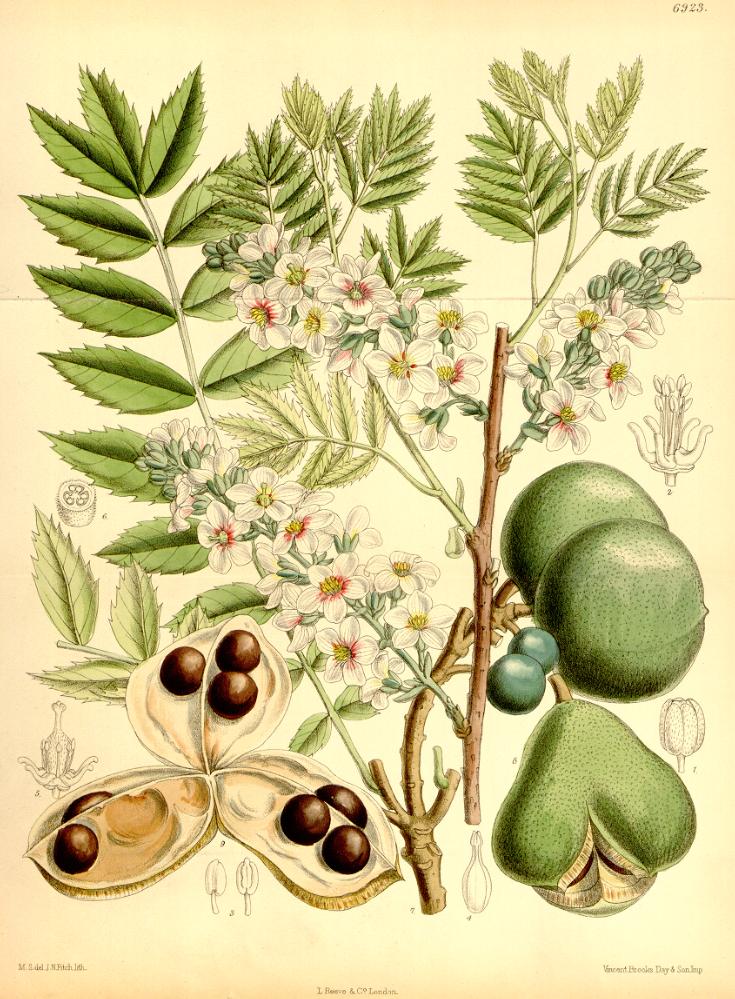
yellowhorn
Xanthoceras sorbifolium
Pea-sized seeds edible cooked — sweet, likened to sweet chestnut or macadamia; a genuine Chinese edible-oil crop. Young leaves and flowers also cooked. Edible seeds & flowers; ⚠ seed oil contains erucic acid (~9%) — consume in moderation.

crimson kadsura
Kadsura coccinea
Unlike its harsh, medicinal relative Schisandra chinensis, this is a genuinely sweet dessert fruit — sourish-sweet with a citrus-like, grapefruit-or-langsat flavor and a faint floral aroma, sold in local markets in southern China and Southeast Asia and eaten fresh raw.

scarlet kadsura
Kadsura longipedunculata
Unlike its harsh, medicinal relative Schisandra chinensis, this is a genuinely sweet dessert fruit — subtle mild-grape, lychee, peach or cherry notes, floral and juicy, eaten fresh raw or cooked.

southern schisandra
Schisandra sphenanthera
⚠ Five-flavour berry — MEDICINAL/adaptogenic, tart and harsh; NOT a dessert fruit.

goji berry
Lycium barbarum
Goji — sweet-tart and faintly tomato-like fresh, but the berries bruise and blacken within hours of picking, which is why the crop is almost always sold dried.

Chinese wolfberry
Lycium chinense
The leaf goji: grown across southern China as the vegetable gau gei choi, its young shoots cooked in soups. The berries are edible but smaller and more bitter than L. barbarum's, which is the species the dried-goji trade is built on.

cape gooseberry
Physalis peruviana
Sweet-tart golden fruit inside a papery husk — eaten fresh, dried like a raisin, or in desserts and preserves. ⚠ Eat only the ripe husked fruit — unripe fruit and foliage contain solanine. Care: Winter protection — mulch, fleece, or a warm wall.

pepino melon
Solanum muricatum
Sweet, juicy, mild flesh eaten fresh as a dessert fruit — a cross between melon and cucumber; skin and soft seeds edible. Care: Winter protection — mulch, fleece, or a warm wall. ⚠ Ripe fruit only — like its tomato and potato relatives, unripe fruit and the foliage contain solanine.

European bladdernut
Staphylea pinnata
Pistachio-like edible seeds in papery rattling pods.

American bladdernut
Staphylea trifolia
Pistachio-like edible seeds in papery rattling pods.

tea-oil camellia
Camellia oleifera
The tea-oil camellia — grown across southern China for the oil pressed from its seed, not for tea leaves. Camellia oil is a mild, high-smoke-point cooking oil and a staple of Hunan and Jiangxi kitchens; the plant is one of the world's major woody oil crops, with millions of hectares under it. Handsome white autumn flowers into the bargain.
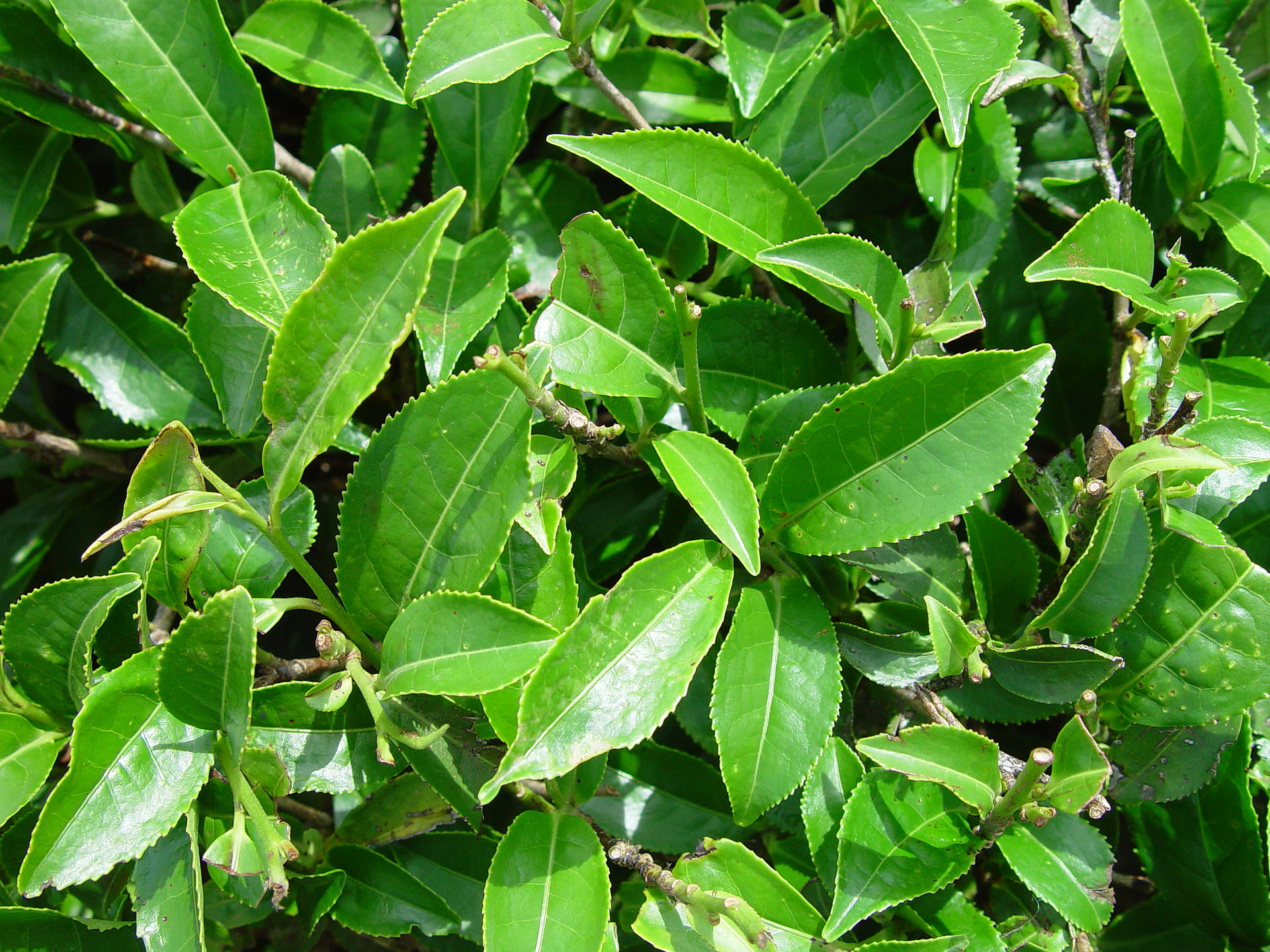
tea
Camellia sinensis var. sinensis
A LEAF crop. Shading before harvest raises umami (matcha/gyokuro) — a quality technique, not a need.

Yunnan / wild tea
Camellia taliensis
A LEAF crop (tea), not a fruit; shading before harvest raises umami (matcha) Care: Winter protection — mulch, fleece, or a warm wall.

summer grape
Vitis aestivalis
Summer grape is one of the few wild American grapes valued for its own fruit and wine rather than only as rootstock — it is the wild parent behind 'Norton'/'Cynthiana', a Missouri-bred cultivar still made into serious dry red wine, and its high sugar and good winemaking qualities set it apart from most other wild Vitis. ⚠ Know the look-alike: across eastern and central North America, moonseed (Menispermum canadense) twines alongside wild grapes, carries similar dark hanging clusters, and is potentially fatal. Three checks — a grape has 2–4 rounded, pear-shaped seeds while moonseed has ONE flat crescent seed; a grape climbs by forked tendrils and moonseed has none; a grape's leaves are toothed and moonseed's are not. Open a berry and look at the seed before eating any wild grape.

Amur grape
Vitis amurensis
Amur grape is grown mainly as a genetic source of extreme cold hardiness and disease resistance for grape breeding rather than as a fresh-eating fruit — its wild-tart, deep blue-black berries are more often pressed for juice, wine or preserves than eaten out of hand.

Texas grape
Vitis berlandieri
Texas grape is grown almost exclusively for its genetics, not its fruit — its unusual tolerance of alkaline, lime-rich soil made it the essential parent, crossed with V. riparia and V. rupestris, behind the SO4, 5BB, 1103 Paulsen and 110 Richter rootstocks that let the world's Vitis vinifera vineyards be replanted on phylloxera-proof roots after the Great French Wine Blight. ⚠ Know the look-alike: across eastern and central North America, moonseed (Menispermum canadense) twines alongside wild grapes, carries similar dark hanging clusters, and is potentially fatal. Three checks — a grape has 2–4 rounded, pear-shaped seeds while moonseed has ONE flat crescent seed; a grape climbs by forked tendrils and moonseed has none; a grape's leaves are toothed and moonseed's are not. Open a berry and look at the seed before eating any wild grape.

California wild grape
Vitis californica
California wild grape is a genuinely edible streamside native — its small, tart, purple, slip-skin berries are used fresh, dried or cooked into jelly by foragers — but in gardens it is grown at least as much for fall color and habitat value, and its natural hybrid selection 'Roger's Red' (crossed with feral V. vinifera) is a popular ornamental.

graybark grape
Vitis cinerea
Wild grape — foxy, acidic and seedy; mainly a rootstock or for jelly. ⚠ Know the look-alike: across eastern and central North America, moonseed (Menispermum canadense) twines alongside wild grapes, carries similar dark hanging clusters, and is potentially fatal. Three checks — a grape has 2–4 rounded, pear-shaped seeds while moonseed has ONE flat crescent seed; a grape climbs by forked tendrils and moonseed has none; a grape's leaves are toothed and moonseed's are not. Open a berry and look at the seed before eating any wild grape.

crimson glory vine
Vitis coignetiae
Crimson glory vine is grown almost entirely as an ornamental foliage plant rather than for its fruit — prized in Japanese and Korean gardens and an RHS Award of Garden Merit holder for its huge, heart-shaped leaves that turn spectacular scarlet-crimson in autumn — while its small, sour berries are edible but rarely eaten fresh.

David's grape
Vitis davidii
David's grape (Chinese bramble grape) is a genuinely fruiting wild grape of southern China's subtropical hills, distinctive for its bristly, spine-covered young shoots, and it is actively used as a table, juice and wine grape locally as well as a breeding parent (e.g. crossed with Muscat varieties to create cultivars like Beifeng and Beizi) for disease resistance in hot, humid climates.

Asian wild grape
Vitis flexuosa
Asian wild grape is a minor foraged fruit across China, Japan and Korea — its small, acidic, pea-sized berries are eaten locally and used in traditional medicine — but unlike V. amurensis or V. coignetiae it has not been taken up for breeding or ornamental cultivation to any significant degree.
Chinese wild grape
Vitis heyneana
Chinese wild grape (also called the 'wool grape' for its felted young leaves) is a genuine subsistence fruit across its wide Asian range — fresh berries, boiled roots and young shoots are all eaten locally — and it is also studied as a genetic resource for cold, drought and disease resistance in grape-breeding programs.

fox grape
Vitis labrusca
Fox grape is the wild ancestor behind most classic American juice and table grape cultivars — Concord, Catawba, Delaware, Niagara and Isabella all descend from it — prized for its musky, aromatic 'foxy' flavor and slip-skin berries that pop free of their flesh, though the species itself is a coarse, seedy wild vine rather than a refined dessert fruit. ⚠ Know the look-alike: across eastern and central North America, moonseed (Menispermum canadense) twines alongside wild grapes, carries similar dark hanging clusters, and is potentially fatal. Three checks — a grape has 2–4 rounded, pear-shaped seeds while moonseed has ONE flat crescent seed; a grape climbs by forked tendrils and moonseed has none; a grape's leaves are toothed and moonseed's are not. Open a berry and look at the seed before eating any wild grape.
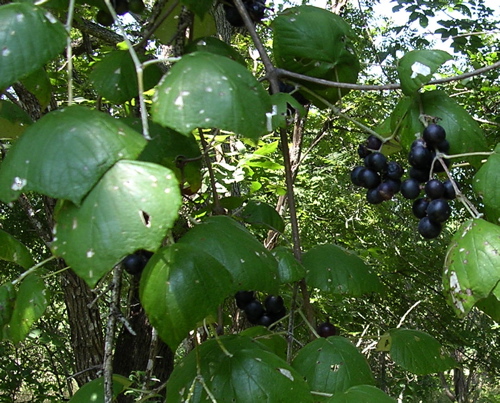
mustang grape
Vitis mustangensis
A tough Texas-to-Louisiana native whose grapes ripen to soft, dark purple berries with thick, tough skin around four heart-shaped seeds — the raw juice is so acidic it can irritate skin and lips, so the fruit is almost always cooked down into jelly, pie filling or wine rather than eaten fresh. ⚠ Know the look-alike: across eastern and central North America, moonseed (Menispermum canadense) twines alongside wild grapes, carries similar dark hanging clusters, and is potentially fatal. Three checks — a grape has 2–4 rounded, pear-shaped seeds while moonseed has ONE flat crescent seed; a grape climbs by forked tendrils and moonseed has none; a grape's leaves are toothed and moonseed's are not. Open a berry and look at the seed before eating any wild grape.

catbird / red grape
Vitis palmata
A slender wetland-edge vine best known for its bright red young stems and palmately lobed leaves — the pea-to-marble-sized berries are sweet once fully ripe but sparse and seedy, so it's grown more for its ornamental red bark than for its fruit. ⚠ Know the look-alike: across eastern and central North America, moonseed (Menispermum canadense) twines alongside wild grapes, carries similar dark hanging clusters, and is potentially fatal. Three checks — a grape has 2–4 rounded, pear-shaped seeds while moonseed has ONE flat crescent seed; a grape climbs by forked tendrils and moonseed has none; a grape's leaves are toothed and moonseed's are not. Open a berry and look at the seed before eating any wild grape.

riverbank grape
Vitis riparia
One of the most cold-hardy grape species on Earth — some vines survive to about -57°C (-71°F) — and thanks to that hardiness plus resistance to phylloxera and powdery mildew, it has been the key rootstock and breeding parent behind cold-climate hybrid wine grapes such as Frontenac, Marechal Foch and Baco Noir. ⚠ Know the look-alike: across eastern and central North America, moonseed (Menispermum canadense) twines alongside wild grapes, carries similar dark hanging clusters, and is potentially fatal. Three checks — a grape has 2–4 rounded, pear-shaped seeds while moonseed has ONE flat crescent seed; a grape climbs by forked tendrils and moonseed has none; a grape's leaves are toothed and moonseed's are not. Open a berry and look at the seed before eating any wild grape.
Romanet grape
Vitis romanetii
A Chinese wild grape grown almost entirely as a curiosity — its young shoots and stems are covered in thick, rust-red woolly bristles and the leaf undersides are coated in dense grey felt, an ornamental trait that easily outweighs its small, unremarkable fruit.

muscadine grape
Vitis rotundifolia
The classic Southeastern US table grape — a genuinely distinct, thick-skinned species, not a "foxy" wild grape — producing large, individually picked bronze or black berries with a sweet, musky flavor, embodied in heritage cultivars like 'Scuppernong' (North Carolina's state fruit) and 'Carlos'. ⚠ Know the look-alike: across eastern and central North America, moonseed (Menispermum canadense) twines alongside wild grapes, carries similar dark hanging clusters, and is potentially fatal. Three checks — a grape has 2–4 rounded, pear-shaped seeds while moonseed has ONE flat crescent seed; a grape climbs by forked tendrils and moonseed has none; a grape's leaves are toothed and moonseed's are not. Open a berry and look at the seed before eating any wild grape.

sand grape
Vitis rupestris
A small, drought-tough vine of gravelly Ozark riverbanks whose main legacy isn't its very sweet but small, seedy berries — it's the phylloxera-resistant parent behind 'Rupestris St. George' (Rupestris du Lot), one of the rootstocks that saved European viticulture after the 19th-century phylloxera epidemic.

Japanese wild grape
Vitis thunbergii
A wild vine of Japanese, Korean, Chinese and Taiwanese hill thickets — traditionally fermented into simple home 'mountain grape' wine and, more recently, studied for the resveratrol content of its small, dark, tart berries.
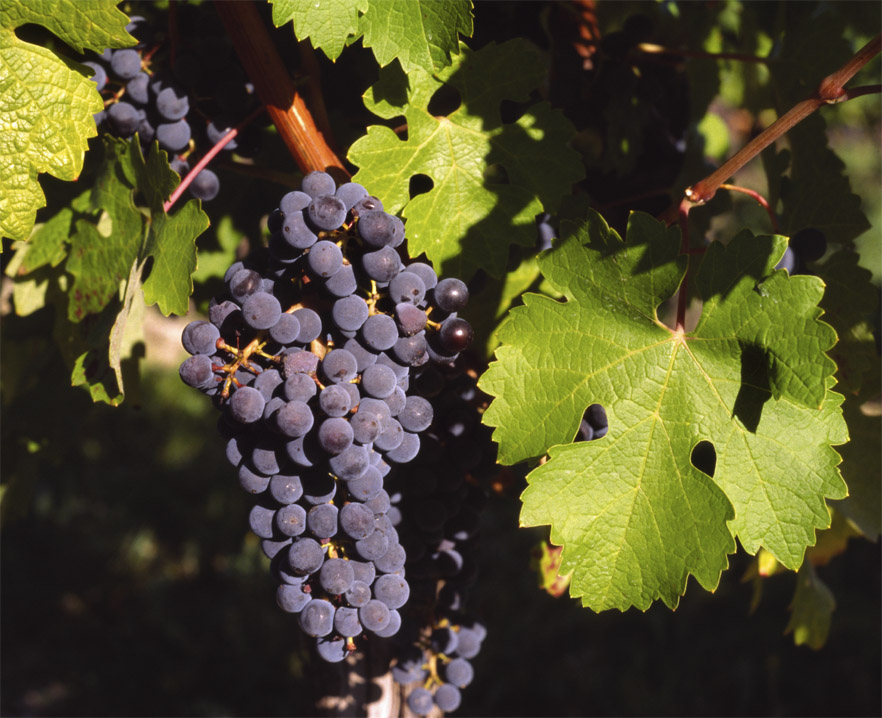
European grape
Vitis vinifera
The species behind essentially all classic wine and table grapes — from Cabernet Sauvignon and Chardonnay to Thompson Seedless — domesticated roughly 6,000–8,000 years ago in the South Caucasus/Western Asia region from its wild ancestor Vitis vinifera subsp. sylvestris, with thousands of named cultivars now grown worldwide for wine, fresh eating and raisins.

frost grape
Vitis vulpina
A tall-climbing eastern US vine whose small, tart black berries are notoriously sour until touched by frost — after which they turn sweet enough for jelly and homemade wine, hence the common name. ⚠ Know the look-alike: across eastern and central North America, moonseed (Menispermum canadense) twines alongside wild grapes, carries similar dark hanging clusters, and is potentially fatal. Three checks — a grape has 2–4 rounded, pear-shaped seeds while moonseed has ONE flat crescent seed; a grape climbs by forked tendrils and moonseed has none; a grape's leaves are toothed and moonseed's are not. Open a berry and look at the seed before eating any wild grape.

Mountain serviceberry
Amelanchier bartramiana
The odd one out in the genus: its fruit is oval to pear-shaped rather than round, up to 15mm long, and borne singly or in twos rather than in the usual raceme. Sweet, though accounts split on whether it is juicy or dry. A boreal bog-and-mountain species, and the hardiest serviceberry here.

Low serviceberry
Amelanchier humilis
One of the best-flavoured serviceberries: juicy, sweet, with a distinct hint of apple and only a few soft seeds. Naturally a plant of calcareous shores and banks, so it is one to reach for where the soil is limy and blueberries are hopeless.

Inland serviceberry
Amelanchier interior
Once treated as a variety of Saskatoon (A. alnifolia); a hairy ovary (bald in most look-alikes) is the surest field mark. Sweet and juicy even before fully ripe, one of the better-flavoured serviceberries.

Roundleaf serviceberry
Amelanchier sanguinea
A dry-ground serviceberry of rocky and calcareous sites, named for the reddish young growth. Sweet, blueberry-like fruit, popular with birds as much as people.

Running serviceberry
Amelanchier spicata
Small purple-black fruit about 8mm across, sweet and juicy and good fresh. The plant runs: it suckers freely into low thickets, which makes it a hedge or bank plant rather than a specimen, and it is naturalised well outside its range in parts of northern Europe.

Canadian barberry
Berberis canadensis
America's own barberry, and a rarer plant in the wild than its Eurasian and Japanese relatives. Fruit is agreeably acid — sharp raw, better as jelly or in preserves; the young leaves are a pleasant sour trailside nibble and the flowers are edible too.

Japanese barberry
Berberis thunbergii
⚠ Listed here for completeness, not as a recommendation. The small red berries are edible raw or cooked and the leaves can be cooked, but this is one of the most damaging invasive shrubs in eastern North America — shade-tolerant, prolifically bird-sown, and prohibited in Massachusetts and Michigan.

Netleaf hackberry
Celtis reticulata
A desert-country hackberry with sweet, fleshy fruit that dries well and keeps through winter; long used both fresh and pounded into a seasoning for savoury food. Genuinely drought-hardy once established, and untroubled by poor, rocky, alkaline ground.

Dwarf hackberry
Celtis tenuifolia
The dwarf hackberry: sweet, mealy fruit, but so little flesh around such a large stone that gathering it in quantity is not worth the effort. Grown more for its toughness on dry, gravelly, alkaline ground than for the crop.

Pear hawthorn
Crataegus calpodendron
Named for its pear-shaped fruit — larger and more thin-fleshed than most hawthorn fruit, sweet and succulent enough to eat out of hand rather than only cooked.

Yellow-fruited hawthorn
Crataegus flava
The summer haw, unusual for its yellow, pear-shaped fruit up to 16mm across. The flesh is dry and mealy rather than juicy, but the flavour is well thought of and it makes a good jelly. A south-eastern species happy on poor sandy ground.

Copenhagen hawthorn
Crataegus intricata
A shrubby hawthorn with unusually large fruit for its size — up to 14mm — and a pleasant sweet flavour, though the flesh is hard and dry and wraps up to five stones. Ripens early September, ahead of most of the genus.

Big-seed hawthorn
Crataegus macrosperma
The large seeds that give it its name often stick together inside the fruit, so it eats like a single-stoned cherry rather than the usual several-seeded haw. Quality varies by individual plant — some are thin-fleshed, juicy and acid, others thicker-fleshed and mealy but better flavoured.

Downy hawthorn
Crataegus mollis
The downy hawthorn carries the biggest fruit of the North American haws grown here — 20–25mm, thick-fleshed, sub-acid and mealy rather than juicy. Poor fresh, very good as jelly or preserve, and easy to gather in quantity.

Oriental hawthorn
Crataegus orientalis
The odd one out among the hawthorns here: nearly unarmed, with few thorns, and grown as much for its downy coral-red fruit and deeply cut, grey-backed leaves as for eating. Long in cultivation — introduced to Britain by 1810.

Scarlet hawthorn
Crataegus pedicellata
The scarlet haw, and one of the better hawthorns to eat: 10–20mm fruit that in good forms is juicy with an excellent flavour when fully ripe, though bitter if picked early. Quality varies a lot between individual trees, so taste before you plant.

Black hawthorn
Crataegus pentagyna
Fruit ripens black, sometimes a handsome purple, in clusters that eat like a single-stoned cherry since the several large seeds stick together. Tolerates wind well but dislikes maritime exposure.

Frosted hawthorn
Crataegus pruinosa
Named for the waxy bloom on the unripe fruit, which frosts it a pale blue-green. Ripens sweet and yellow, about 1cm across with up to five large stones — a pie and preserve fruit that also dries well.

Dotted hawthorn
Crataegus punctata
The dotted hawthorn carries the largest fruit of any hawthorn here — around 25mm, genuinely apple-like, dull-dotted and good in jelly and preserves. The horizontal branching makes it one of the more striking small trees in the genus.

Quebec hawthorn
Crataegus submollis
The Quebec hawthorn is among the most practical of the haws to pick: fruit about 20mm with thick, sweet, reasonably juicy flesh and a nice flavour, carried in large clusters that come off easily by the handful.

Fleshy hawthorn
Crataegus succulenta
The most wide-ranging hawthorn in North America, from southern Canada south to Arizona and New Mexico — a testament to how adaptable it is. Unlike several relatives here, it doesn't sucker or colonize, staying a well-behaved single clump.

Green hawthorn
Crataegus viridis
One of the most disease-resistant hawthorns, and nearly thornless — an easier tree to work around than most of the genus. Fruit is technically edible but usually left for the birds, who strip it through winter.

Red crowberry
Empetrum rubrum
Also called diddle-dee in the Falkland Islands, where it's the dominant species across large areas of dwarf shrub heath. A Southern Hemisphere counterpart to black crowberry, from Chile's alpine tree line to Cape Horn. DIOECIOUS — needs a male and female plant to fruit.

Box huckleberry
Gaylussacia brachycera
The box huckleberry: a low evergreen carpet with box-like leaves and blue fruit about 12mm across — edible, but bland enough that nobody plants it for the crop. Its real distinction is age; a single clonal colony in Pennsylvania has been estimated at several thousand years old, spreading entirely by rhizome.

Hairy huckleberry
Gaylussacia tomentosa
A coastal-plain huckleberry of the southeastern US, found in moist pine flatwoods, savannas and blackwater floodplain margins. Dark blue or occasionally white fruit, sweet and juicy, good in jams and pies.

Bear huckleberry
Gaylussacia ursina
A narrow endemic of the southern Appalachians — found only in a small area of southwestern North Carolina, northwestern South Carolina, northeastern Georgia and southeastern Tennessee, plus one disjunct population in Kentucky. Fruit is black, sweet and juicy, good raw or cooked.

Pondberry
Lindera melissifolia
Federally listed as endangered in the United States — fewer than 40 wild populations remain, concentrated around pond margins and depression wetlands in the southeastern coastal plain, threatened mainly by wetland drainage and fire suppression. The bright red, spicy-aromatic fruit is not typically eaten by people; historically the twigs were brewed into a spring tonic tea. Grow only from nursery-propagated stock, never wild-collected material.

Black wolfberry
Lycium ruthenicum
The black cousin of the more familiar red goji berry (L. barbarum), colored by an exceptionally high concentration of anthocyanins rather than the carotenoids that make red goji red. Sold dried as "black goji" and steeped for a color-changing tea (purple in acidic water, blue in alkaline).

Chinese pearleaf crabapple
Malus asiatica
Grown across northeastern China and Korea for its apple-like but small, tart fruit — usually cooked into jellies and preserves rather than eaten raw. Like the rest of the genus, self-incompatible: a second, unrelated apple or crabapple is needed for fruit.

Chinese flowering apple
Malus spectabilis
Grown for centuries in China as an ornamental — the double-flowered forms are among the showiest crabapples in spring. The 2–3cm fruit is bitter and harsh straight off the tree but becomes edible after storing and bletting in a cool dry place.

Mongolian mulberry
Morus mongolica
A hardy mountain mulberry from China and Korea, growing wild on cliffs and in ravines up to 3500 m. Fruit to 25mm, sweet but rather insipid — pleasant enough fresh, unremarkable beside black mulberry. Dioecious, so a crop needs both a male and a female tree.
Chinese mulberry
Morus notabilis
A wild mountain mulberry mainly of genetic and research importance — its genome was the first published for the genus, and its unusually low chromosome count (2n=14, versus 2n=28 in most cultivated mulberries) marks it as basal to the rest of Morus. Fruit follows the usual mulberry pattern (juicy, sweet with tartness while under-ripe) but is not commercially grown; no verified figures on cultivated size or crop performance were found for this species specifically, so treat this as a wild botanical entry rather than a garden recommendation.

Allegheny plum
Prunus alleghaniensis
The Allegheny plum: dark purple fruit up to 2cm with thick, juicy, pleasantly acid flesh — good fresh and better in preserves. A scarce plant in the wild, restricted to the Appalachians and a disjunct population in Michigan.

American plum
Prunus americana
The American plum — the hardiest plum in this catalogue and the backbone of prairie shelterbelts. Fruit about 25mm, succulent and juicy but rather acid with a tough skin; the better selections are pulpy and genuinely pleasant fresh, and all of it cooks and preserves well.

Desert peach
Prunus andersonii
A true desert-mountain wild peach of the Great Basin, growing among sagebrush, pinyon and juniper at 900–2,400 m. Rarely more than 2.5 cm across, but considered a genuine delicacy — peach-like fuzz and flavour in miniature. ⚠ Kernels/pits cyanogenic; avoid if bitter-tasting.

Chickasaw plum
Prunus angustifolia
The Chickasaw plum, and one of the best of the American plums to eat out of hand: large for a wild plum at about 18mm, thin-skinned, with soft juicy sweet pulp. It also ripens early — June and July, well ahead of most plums.

Briancon apricot
Prunus brigantina
Also called Alpine apricot — a mountain species of the French and Italian Alps, smooth-skinned unlike the fuzzy common apricot. Historically important for its seed oil, 'huile de marmotte', once used as an olive-oil substitute in French Alpine cooking and for lamp fuel. ⚠ Kernels/pits cyanogenic — the oil is a processed product, not raw eating.

Desert apricot
Prunus fremontii
The fruit is a marginal food source at best — scanty, semi-dry pulp that's often unpleasantly bitter, only occasionally sweet. Native Americans traditionally processed the kernels, but that took real preparation; modern foragers shouldn't expect a good peach substitute here. ⚠ Kernels/pits cyanogenic — raw consumption is inadvisable.

Hortulan plum
Prunus hortulana
A genuinely good-eating wild plum, unlike some of its drier-fruited desert relatives — sweet, juicy flesh popular for jelly, jam and wine. Widely used in reforestation and conservation plantings for its drought tolerance and soil adaptability. ⚠ Kernels/pits cyanogenic.

Hollyleaf cherry
Prunus ilicifolia
Unusual among the Prunus here for being evergreen, with dark, spiny-toothed, holly-like leaves that give it its name. Fruit is mostly skin and stone with a thin, sweet-musky pulp — a traditional food source for California's Indigenous peoples, who processed the seed kernels much like acorns. ⚠ Kernels/pits cyanogenic.

Damson / Bullace
Prunus insititia
Damson and bullace — the old kitchen plums of British and northern European orchards, about 3cm across and sharper than a dessert plum. Acceptable raw when dead ripe and better still after a frost, but this is fundamentally a cooking and preserving fruit, and it makes the best plum jam there is.
Wild goose plum
Prunus munsoniana
One of the better-flavoured wild plums — thin-skinned, juicy, aromatic flesh often good enough for fresh eating, not just preserves. Reaches flowering and fruiting age within 3 years from seed, fast even by the standards of a genus known for quick fruiting. ⚠ Kernels/pits cyanogenic.

Canada plum
Prunus nigra
Extremely cold-hardy, one of the toughest plums here. Fruit is small, thick-skinned and sour off the tree — a few hard frosts improve the flavour tremendously, so this is a plum worth leaving on the tree into late season. ⚠ Kernels/pits cyanogenic.

Sand cherry
Prunus pumila
A genuine dune and beach plant, native almost exclusively to sandy, gravelly ground around the Great Lakes. Rich, pleasantly acid flavour once fully ripe, sometimes slightly bitter — good eaten out of hand as well as preserved. ⚠ Kernels/pits cyanogenic.

Creek plum
Prunus rivularis
A southern-range wild plum of excellent flavour, unlike some of its more marginal desert relatives — one large seed per fruit, good raw or cooked. ⚠ Kernels/pits cyanogenic.

Klamath plum
Prunus subcordata
Considered one of the best-flavoured wild fruits of the Pacific Northwest — pleasantly acid, with the best individual trees carrying a distinctive slight astringency prized for culinary use. Also called Pacific plum or Sierra plum. ⚠ Kernels/pits cyanogenic.

Birchleaf pear
Pyrus betulifolia
Named for its birch-like leaves. So cold-hardy (to about -20°C dormant) and disease-resistant that orchardists use it as rootstock for cultivated pears more often than they grow it for its own small fruit, which in China is used to flavour rice wine.

Callery pear
Pyrus calleryana
Better known by its ornamental cultivar name, Bradford pear. The fruit is edible only in the loosest sense — hard, gritty and astringent raw, and even after bletting and cooking (as it's traditionally used in China, for fruit wine and medicine) it stays bland; nobody grows this for the eating. ⚠ Seeds mildly poisonous in quantity — cyanogenic like most Rosaceae pips. ⚠ Aggressively invasive: established outside cultivation in 25+ US states, forms dense thickets, and its sale is now banned or being phased out in several (including Ohio, South Carolina and Pennsylvania). Site with real caution, or avoid.

European wild pear
Pyrus pyraster
A wild ancestor of the cultivated pear. Hard and astringent straight off the tree, but bletts (softens and sweetens) within days of falling, at which point it's genuinely good eating rather than merely edible.

Hillside gooseberry
Ribes californicum
A California chaparral and woodland endemic, found from sea level to nearly 1,800 m. Red berries about 1 cm across, covered in stiff spines like a true gooseberry — eaten raw or cooked, or made into preserves.

White-flowered currant
Ribes indecorum
Fragrant white flowers in pendulous sprays from late autumn into winter, an unusually early bloomer. Exceptionally drought-tolerant. Fruit is a hairy, sticky purple berry, edible, under 1 cm across.

Sierra redcurrant
Ribes nevadense
Also called mountain pink currant. Notably tolerant of seasonal flooding and a wide range of soils — an easy, adaptable currant of Sierra Nevada mountain streambanks and moist sites, 1,400–2,300 m elevation. Fruit is bluish-black, waxy, and studded with glandular hairs.
Pine currant
Ribes pinetorum
Also called orange gooseberry — a high-elevation species of Arizona/New Mexico coniferous forest, hardy to about -20°C. Fruit has an agreeable gooseberry flavour but is densely covered in spines, so is more work to harvest than most currants here.

Field rose
Rosa arvensis
Rose hips are eaten cooked (jam, syrup) or infused for tea rather than raw — the fine hairs around the seeds are an irritant unless strained out. A vigorous rambler, sometimes called Shakespeare's musk rose.

Carolina rose
Rosa carolina
Also called pasture rose — a low, easy species of dry, open ground rather than a formal garden setting. Small, pear-shaped hips hold their colour well into winter and are a significant food source for game birds.

Cabbage rose
Rosa centifolia
Also called the Provence rose — a garden hybrid of uncertain origin with no wild populations, closely related to R. damascena and R. gallica. One of the classic perfume roses; petals are the historically important part here, flavouring tea, candied, or distilled for rosewater, more than the fruit itself. ⚠ Deseed the hips before eating: the ring of stiff hairs around the seeds is a gut and skin irritant, and is what old-fashioned itching powder was made from. Strain it out of any purée or syrup.

Damask rose
Rosa damascena
An ancient artificial hybrid (R. gallica x R. moschata, itself likely crossed with R. centifolia) never found truly wild, despite the Damascus-suggesting name — probably fixed in cultivation somewhere in ancient Persia. The source of attar of roses and rosewater: petals are the historically important harvest, distilled for perfume and used to flavour drinks, sweets, baked goods and ice cream. ⚠ Deseed the hips before eating: the ring of stiff hairs around the seeds is a gut and skin irritant, and is what old-fashioned itching powder was made from. Strain it out of any purée or syrup.

Gallic rose
Rosa gallica
Unlike its own descendants R. centifolia and R. damascena, this one is a true wild species, and one of the very first roses ever brought into cultivation. Most modern rose cultivars carry at least some of its genes. ⚠ Deseed the hips before eating: the ring of stiff hairs around the seeds is a gut and skin irritant, and is what old-fashioned itching powder was made from. Strain it out of any purée or syrup.

Nootka rose
Rosa nutkana
A Pacific coast species reaching from Alaska to California. Big, purplish, pear-shaped hips that persist into winter — good frost-sweetened wildlife food, and improve in flavour for people the same way. ⚠ Deseed the hips before eating: the ring of stiff hairs around the seeds is a gut and skin irritant, and is what old-fashioned itching powder was made from. Strain it out of any purée or syrup.

Cluster rose
Rosa pisocarpa
Named for its hips, which are small (about 1 cm), pear- or egg-shaped, and borne in clusters rather than singly — showy red to reddish-purple through fall and early winter. A Pacific Northwest species of moist ground. ⚠ Deseed the hips before eating: the ring of stiff hairs around the seeds is a gut and skin irritant, and is what old-fashioned itching powder was made from. Strain it out of any purée or syrup.

Burnet rose
Rosa spinosissima
Distinctive among roses for its round, deep purple-black hips rather than the usual red or orange. A tough coastal and heathland species — genuinely drought- and salt-tolerant — also known as Rosa pimpinellifolia and, in Scotland, Scotch or Scottish rose. ⚠ Deseed the hips before eating: the ring of stiff hairs around the seeds is a gut and skin irritant, and is what old-fashioned itching powder was made from. Strain it out of any purée or syrup.

Downy rose
Rosa tomentosa
Named for its densely hairy, felted foliage on both leaf surfaces — the softest-leaved rose here. Best suited to the wilder parts of a planting rather than a formal bed; grown as much for its bright red autumn hips as anything else. ⚠ Deseed the hips before eating: the ring of stiff hairs around the seeds is a gut and skin irritant, and is what old-fashioned itching powder was made from. Strain it out of any purée or syrup.

Virginia rose
Rosa virginiana
One of the better roses for eastern North American gardens generally, not just for the hips — foliage turns purple to red-orange to yellow in fall, unusually good color for the genus. Also salt-tolerant enough for coastal planting. ⚠ Deseed the hips before eating: the ring of stiff hairs around the seeds is a gut and skin irritant, and is what old-fashioned itching powder was made from. Strain it out of any purée or syrup.

Wood's rose
Rosa woodsii
One of the most widely distributed roses in North America, reaching from Alaska to northern Mexico. Forms dense, thorny thickets by suckering — good wildlife cover and erosion control, less good in a small garden. ⚠ Deseed the hips before eating: the ring of stiff hairs around the seeds is a gut and skin irritant, and is what old-fashioned itching powder was made from. Strain it out of any purée or syrup.

North American blackberry
Rubus alumnus
Also called Kittatinny or oldfield blackberry. An abundant fruiter from small, inconspicuous white-pink flowers. In rich soil it can spread aggressively and crowd out neighbouring plants — better sited where it can be contained.

Smooth blackberry
Rubus canadensis
Also called American dewberry — unusual among brambles for being genuinely thornless, with almost completely smooth stems. One of the most highly regarded wild blackberries for flavour: sweet, juicy, richly flavoured, up to 2.5 cm long.

Swamp dewberry
Rubus hispidus
Also called bristly dewberry — a true creeping groundcover rather than an upright bramble, semi-evergreen and rooting wherever the stem tips touch soil. Fruit is edible but sour, better cooked than eaten fresh.

Roundleaf buffaloberry
Shepherdia rotundifolia
Starts sweet on the tongue but finishes bitter — the aftertaste comes from saponins in the skin, and it's rarely eaten fresh as a result, though historically used in small amounts for food and medicine and reportedly needs a lot of added sugar to be palatable in any quantity. Grown far more for its striking silvery, evergreen foliage than for the crop.

Japanese rowan
Sorbus commixta
Also called nanakamado in Japan. Compound pinnate leaves turn a striking deep purple to red in autumn — showier fall colour than most rowans. Fruit is astringent like other Sorbus and best cooked rather than eaten raw. ⚠ Not just astringent: raw fruit in this group contains parasorbic acid, which causes vomiting, stomach cramps and diarrhoea if you eat any quantity of it. Cooking, freezing, drying or a hard frost converts it to harmless sorbic acid — which is exactly why every traditional recipe cooks it and why the fruit is picked after the first frosts.

Greek whitebeam
Sorbus graeca
One of the most widely-ranging whitebeams, from central Europe to North Africa. More sharply toothed leaves than the common whitebeam (S. aria) are the easiest field mark. ⚠ Not just astringent: raw fruit in this group contains parasorbic acid, which causes vomiting, stomach cramps and diarrhoea if you eat any quantity of it. Cooking, freezing, drying or a hard frost converts it to harmless sorbic acid — which is exactly why every traditional recipe cooks it and why the fruit is picked after the first frosts.

Swedish whitebeam
Sorbus intermedia
Possibly of hybrid origin, and apomictic like several whitebeams here — seeds are clones of the parent rather than the product of sexual reproduction. Tolerant of maritime exposure and pollution, which along with dense foliage makes it a common street and coastal tree in its native region. ⚠ Not just astringent: raw fruit in this group contains parasorbic acid, which causes vomiting, stomach cramps and diarrhoea if you eat any quantity of it. Cooking, freezing, drying or a hard frost converts it to harmless sorbic acid — which is exactly why every traditional recipe cooks it and why the fruit is picked after the first frosts.

Farkleberry
Vaccinium arboreum
Also called sparkleberry — the largest-growing, most tree-like Vaccinium here, and unusually tolerant of alkaline, calcareous ground where the rest of the genus struggles. Grown mostly for showy flowers, exfoliating bark and fall colour rather than the bland (if historically pie-worthy) berries.

Darrow's blueberry
Vaccinium darrowii
A true Florida native, found nearly statewide in flatwoods and pine forest. Sweet, juicy berries good for fresh eating — and hybridizes with V. ashei, giving it a role in southern blueberry breeding programs; some named edible cultivars exist.

Evergreen blueberry
Vaccinium myrsinites
Also called shiny blueberry — a low, sand-loving evergreen of Deep South scrub, sandhills and pine flatwoods. Juicy, fair-quality black berries, smaller (about 6 mm) than most cultivated blueberries.

Hillside blueberry
Vaccinium pallidum
Also called early lowbush blueberry — a dry-woodland species of rocky or sandy, acidic ground. Berry is edible and sweet but regarded as somewhat bland and mealy compared to cultivated blueberries.

Deerberry
Vaccinium stamineum
Also called highbush huckleberry — unusually widespread for a Vaccinium, native across some two dozen eastern US states. Unlike most blueberries, the fairly large fruit ripens through green, pink, dusky purple or brown rather than straight to blue-black; edible but somewhat astringent, more valuable to deer and other wildlife than as a dessert fruit.

Smallflower blueberry
Vaccinium tenellum
The most compact Vaccinium in this catalog. Small, shiny black berries, juicy but plain — edible rather than delicious, smaller than a typical commercial blueberry.

Mapleleaf viburnum
Viburnum acerifolium
Fruit is thin-fleshed and mostly seed — edible and historically eaten by Indigenous peoples and early settlers, but sparse and not a substantial food source; grown more for understory cover and fall color than for the crop.

Wild raisin
Viburnum cassinoides
The common name is literal: as the fruit dries on the shrub in autumn it shrivels and sweetens like a raisin, with a date-like flavor once fully ripe. Now treated by many taxonomists as Viburnum nudum var. cassinoides, a variety of the wider-ranging possumhaw viburnum rather than a fully distinct species.

Arrowwood
Viburnum dentatum
Fruit is bitter and dry-fleshed, eaten mainly by birds — not a species grown for the crop, though historically the straight young stems (hence "arrowwood") were used by Indigenous peoples for arrow shafts.

Rusty blackhaw
Viburnum rufidulum
The largest and most tree-like of the North American viburnums in this catalog, sometimes grown as a small ornamental shade tree. Fruit is sweet and grape-like once fully ripe, with a waxy blue bloom similar to a small plum.

Arizona grape
Vitis arizonica
Small, tart-sweet fruit, good fresh once fully ripe and popular for jelly and wine among wild grapes. Highly valued in viticulture as rootstock — its drought and alkaline-soil tolerance, and resistance to phylloxera and Pierce's disease, make it a parent of several commercial rootstock cultivars.
Champin's grape
Vitis champinii
Believed to be a natural hybrid of V. candicans and V. rupestris. Fruit is edible but thick-skinned and often astringent, of secondary interest for eating fresh — this species is grown almost exclusively for its rootstock value, since it's exceptionally resistant to phylloxera and Pierce's disease and tolerant of drought and alkaline soil, underlying the widely used commercial rootstocks Dog Ridge and Ramsey/Salt Creek.

Desert wild grape
Vitis girdiana
Small, sweet-tart black grapes, good fresh and traditionally used for jelly and raisins by Indigenous peoples of the region. Closely related to V. californica, with which it hybridizes readily where their ranges overlap.

Sweet mountain grape
Vitis monticola
One of the smallest-statured wild American grape vines, with small but sweet, good-flavored black fruit — the species name and common name both point to its true-to-flavor sweetness among wild grapes, most of which run tart. Also valued as a rootstock parent for its limestone-soil and drought tolerance.

Caloosa grape
Vitis shuttleworthii
Fruit is sweet and good fresh once fully ripe, among the best-flavored of Florida's native wild grapes, and used locally for jelly and wine. Distinctively felted, silvery-white new growth and leaf undersides make it easy to identify even before fruiting.

Lotus jujube
Ziziphus lotus
Small, mealy fruit, edible fresh but not comparable in size or sweetness to the cultivated Chinese jujube (Z. jujuba) — eaten locally and traditionally ground into a flour-like paste, and the plant this catalog's Rhamnaceae section is named for: ancient Greek writers' "lotus" of the mythical Lotus-eaters is widely identified as this species.
Udo
Aralia cordata
A commonly cultivated food crop in Japan, grown for its young shoots rather than any fruit — the taste is often described as a lemony asparagus. Traditional Japanese cultivation forces roots in dark, humid underground pits ("udo muro") to blanch the shoots pale and mild before harvest.

Japanese angelica tree
Aralia elata
The young spring shoots (taranome) are a well-known Japanese and Korean wild food, most often tempura-fried or blanched. A pioneer species in its native range, colonizing cleared forest ground quickly.

Devil's club
Oplopanax horridus
Only the very youngest spring shoots are edible, peeled and cooked — the window closes within days as the plant's dense spines harden. The bright red late-season berries are conspicuous but not edible to people, though bears eat them freely.

Siberian ginseng
Eleutherococcus senticosus
Better known as a root used in traditional medicine and supplements than as food, though young shoots are eaten locally as a spring green and the small dark berries are edible. Not a true ginseng (Panax) despite the common name — a different genus in the same family.
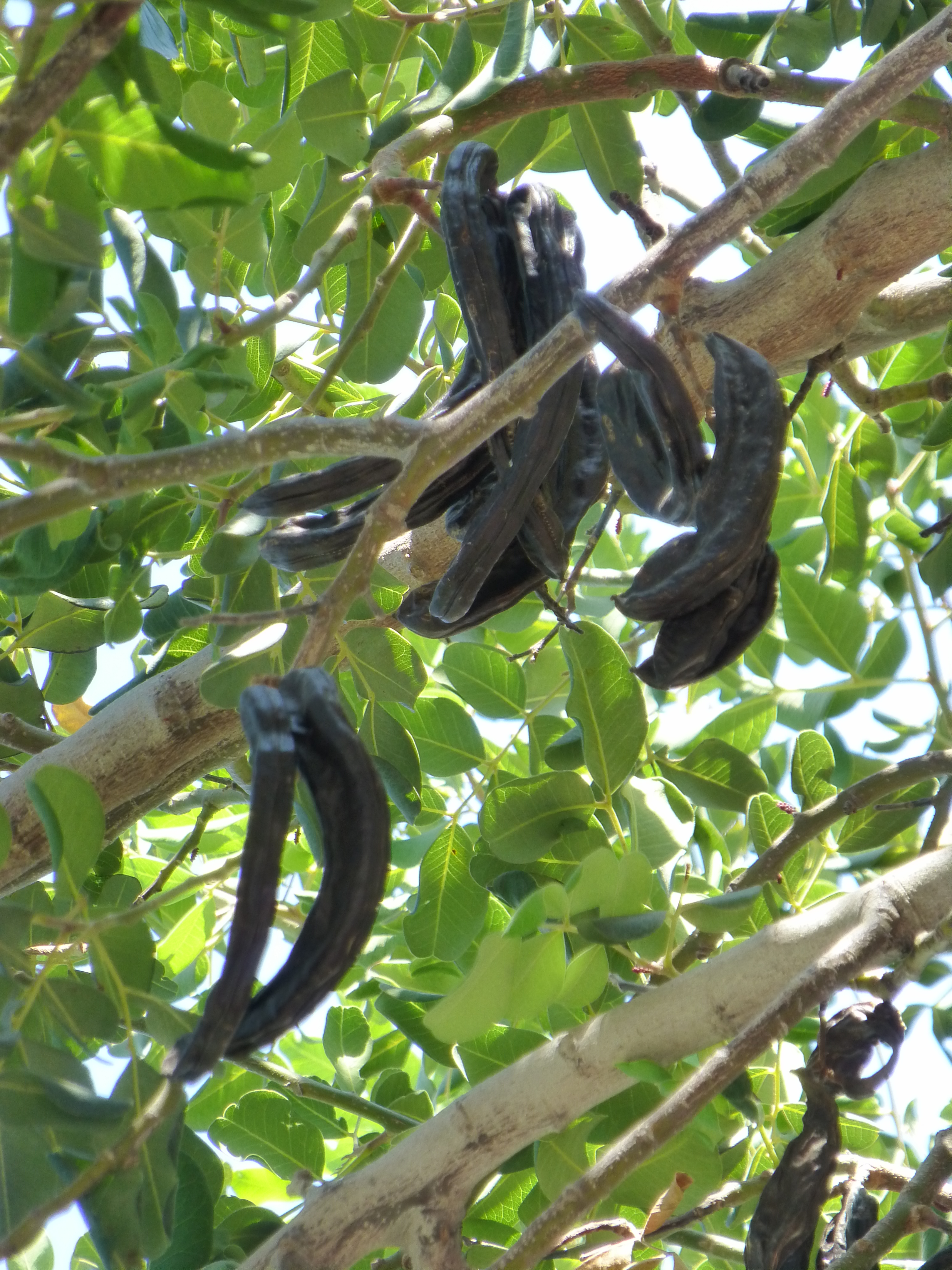
Carob
Ceratonia siliqua
The sweet, dried pod pulp is ground into carob powder, a caffeine-free substitute for cocoa in baking. The seeds inside are famously uniform in weight — historically used as the original unit behind the "carat" used for gemstones.

Water caltrop
Trapa natans
Grow this one only where it is legal to. In the United States it is a federal noxious weed — sale, purchase and interstate transport are illegal under federal law, and most states go further: Massachusetts bans possession, transport and cultivation outright, New York, Vermont and Connecticut require a permit even to grow it, and roughly 35 states list it as noxious. The seed itself is what people eat, floury and sweet-chestnut-like once cooked, but it also concentrates heavy metals from the water it grows in, so the water source matters. In the UK and continental Europe it is a long-cultivated pond plant with no comparable restriction. If you are in the US, check your state's noxious-weed list before sourcing seed — this entry documents the plant, not a recommendation to plant it there. ⚠ Always cook it. Raw or undercooked water caltrop is a documented route for the intestinal fluke Fasciolopsis buski, whose cysts sit on the surface of the nut and are destroyed by cooking.
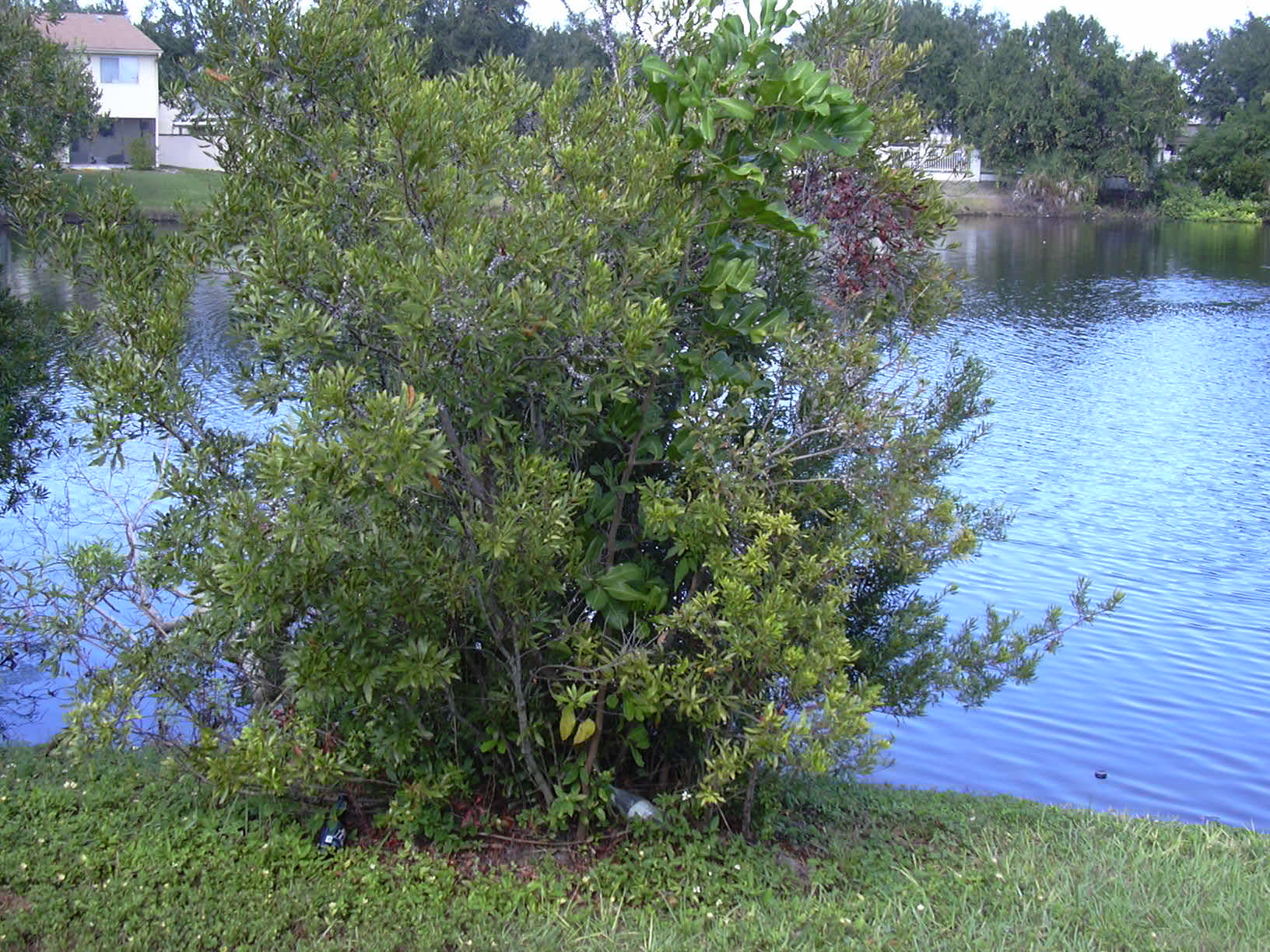
Wax myrtle
Morella cerifera
Grown far more for the leaves than the fruit — dried and used exactly as a bay leaf, which they closely resemble in flavor, and a genuine, documented substitute rather than a stretch. The small grey-blue, wax-coated berries are edible too, traditionally ground and used sparingly like pepper, but they are what candle and soap makers have always wanted the plant for, not what people eat by the handful — birds, especially yellow-rumped warblers, do that instead.

French sorrel
Rumex scutatus
A milder, less acidic sorrel than common garden sorrel (R. acetosa), with an intense lemony tang most cooks prefer for sauces and salads. Low and creeping rather than upright, and self-seeds readily.

Buckwheat
Fagopyrum esculentum
Not a true cereal grass despite the name and use — a relative of rhubarb and sorrel, grown for its starchy, gluten-free triangular seeds, ground into flour for soba noodles, blini and buckwheat pancakes. Also grown as a fast, weed-smothering cover crop and bee forage.
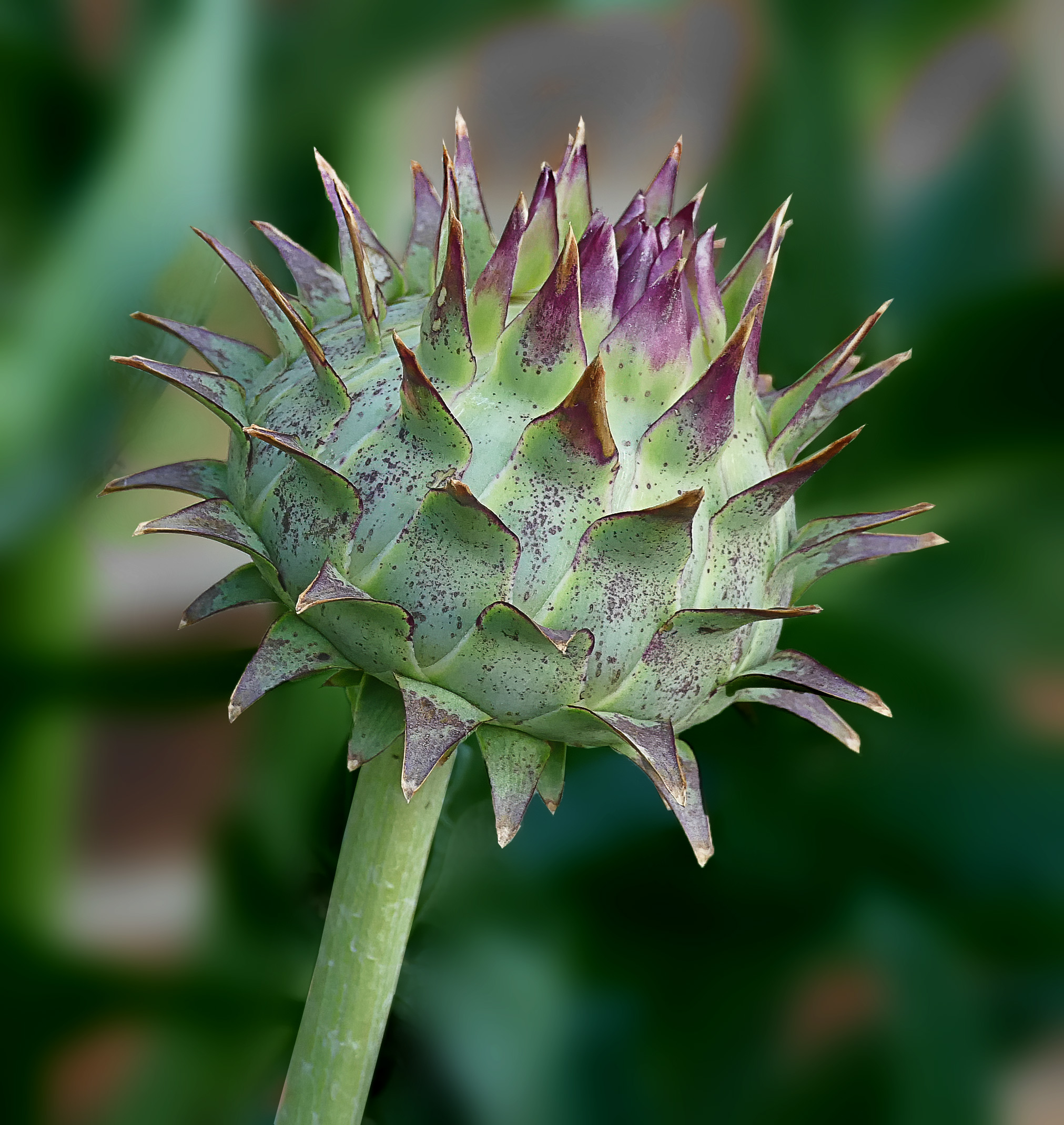
Cardoon
Cynara cardunculus
Grown for its thick leaf stalks (not the flower bud, which is smaller and less developed than its close relative the globe artichoke) — blanched by wrapping to exclude light in the weeks before harvest, then boiled or braised with a mild artichoke flavor. A large, architectural, thistle-like plant popular in Mediterranean cuisine since antiquity.

Globe artichoke
Cynara scolymus
Grown for the immature flower bud, harvested before it opens — the fleshy base of each bract and the heart at the center are eaten, steamed or boiled. A close relative of cardoon (some treatments place it as a cultivar group of Cynara cardunculus rather than a fully separate species), selected over centuries for a larger, more tender bud rather than the stalks.
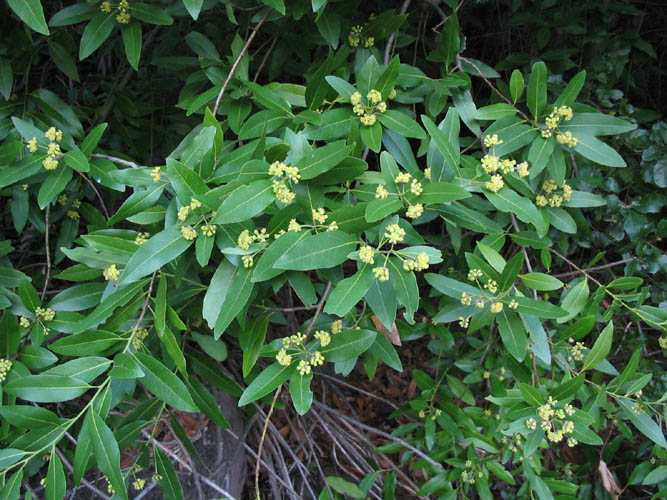
California bay laurel
Umbellularia californica
The leaf is a stronger, more pungent stand-in for bay laurel (Laurus nobilis) — use less of it. Roasted seeds can be ground into a bitter flour once the raw bitterness is cooked out; the USDA specifically flags caution with any part of this tree as food or medicine given its strong volatile-oil content, so use sparingly and know what you're working with before eating it.
Horseradish
Armoracia rusticana
Grated fresh root is intensely pungent — the sharp, sinus-clearing heat comes from the same class of compounds (glucosinolates) as mustard and wasabi, and fades quickly once cut or ground, so it's prepared close to serving. Extremely persistent once planted: even a small piece of root left in the ground will regrow.
Wasabi
Eutrema japonicum
The true source of Japanese wasabi paste — most of what's served as "wasabi" outside Japan is actually dyed horseradish, since real wasabi is slow-growing, exacting to cultivate and expensive. Grated fresh rhizome loses its sharp, complex heat within about 15 minutes, unlike horseradish's more stable pungency.

Sweet woodruff
Galium odoratum
The fragrance is barely there in the fresh leaf and develops only once cut and dried, as the coumarin compound responsible is released by wilting — the classic use is Germany's May wine (Maiwein), where dried sprigs are steeped in young white wine. Large quantities of coumarin are best avoided; this is a flavoring herb used in modest amounts, not a leafy green.

Buddhist pine
Podocarpus macrophyllus
The genuinely edible part is not the seed. It's the swollen, fleshy stalk (the receptacle) the seed sits on, which turns purplish-red and sweet as it ripens, almost like a small plum. The blue-black waxy seed itself contains toxic compounds and is not eaten — picking the receptacle off and discarding the seed is standard practice, the same relationship yew (Taxus) has between its sweet red aril and its poisonous seed. One of the most widely planted hedging and topiary conifers in warm-climate gardens and city landscaping (kusamaki in Japan), which makes it an easy plant to find even though it is rarely grown for its fruit.

California nutmeg
Torreya californica
The seed is roasted and eaten like a true nut, rich in oil, with a resinous, pungent flavor that gave the tree its common name — it smells of nutmeg when the foliage or wood is crushed, though it is unrelated to true nutmeg. Rare and local in the wild, confined to shaded canyons and streambanks of California's Coast Ranges and Sierra Nevada foothills, where old trees survive fire by resprouting from the root crown even though the top growth is easily killed. Slow to reach seed-bearing size and slower still to ripen a crop: the seed takes two full growing seasons to mature, so a bearing tree can carry two overlapping generations of developing seed at once.

Chinese torreya
Torreya grandis
The seed, sold in China as xiangfei or 'fei nuts', is roasted and eaten as a delicacy with a rich, nutty flavor, and its oil is pressed separately for cooking — a genuine, centuries-old commercial nut crop rather than a foraging curiosity. Some individual cultivated trees in China have been harvested for over 1,000 years, among the longest-lived nut trees anywhere. Like the rest of the genus, the seed takes two full years to mature after pollination, so a bearing tree carries two overlapping generations of developing seed. Grafted cultivars fruit in 5–8 years; seed-grown trees can take 15–20 years or more.

Japanese torreya
Torreya nucifera
Known in Japan as kaya, the seed can be eaten raw, roasted, or made into confectionery, with an agreeable sweet, slightly resinous flavor — the highest edibility rating of any species in this genus. A cooking oil is also pressed from the seed, historically valued enough that kaya orchards were deliberately planted and maintained. Eating a large quantity of the raw seed has a mild laxative effect, so moderation is the practical guidance rather than any real toxicity concern. Like its relatives, the seed takes about two years to fully mature after pollination.