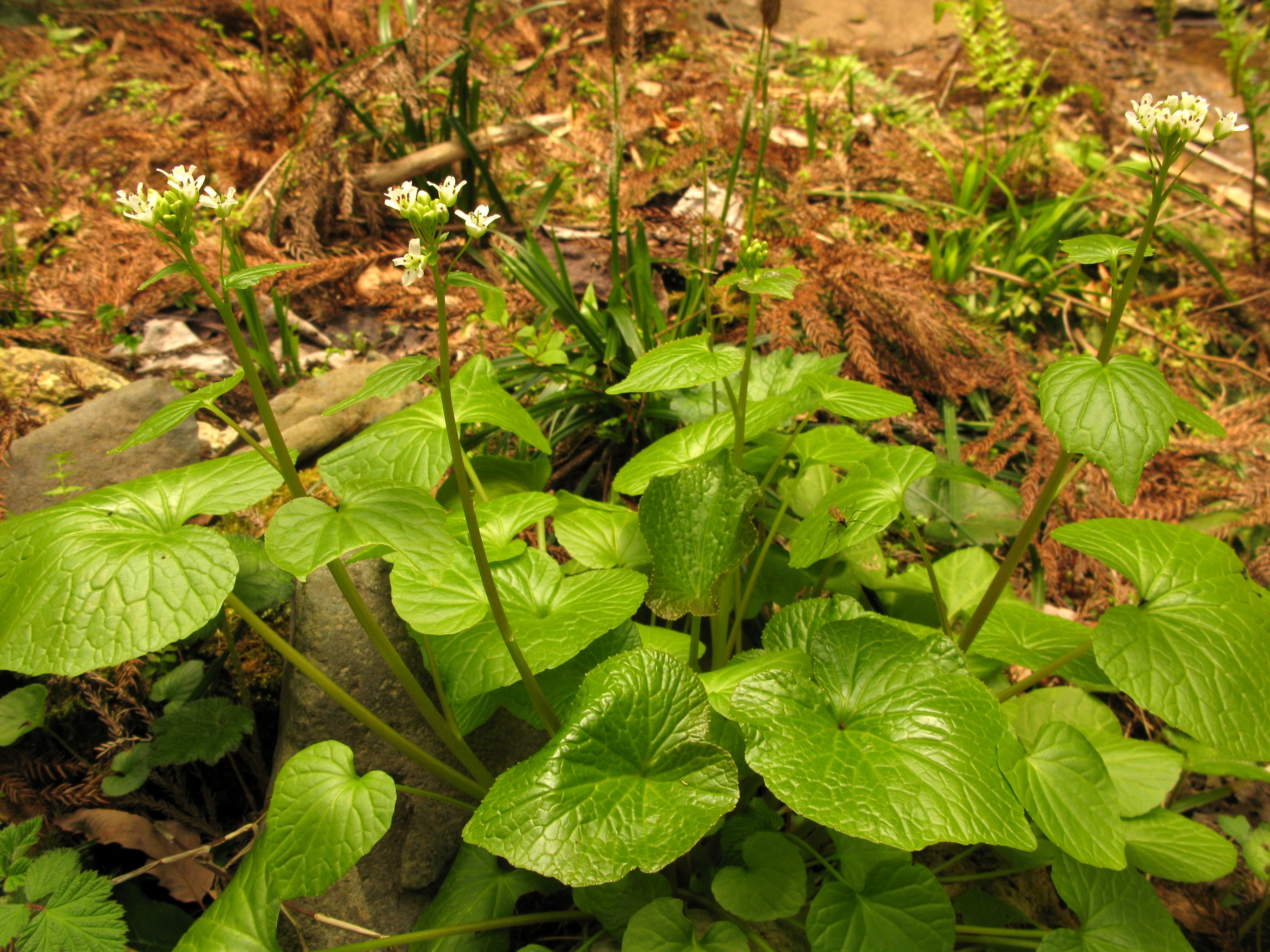
Photo: Qwert1234 — CC BY-SA 3.0 · source
Survives zone 7 through 9
Harvest calendar
Ripens: Rhizome takes 2–3 years to reach harvestable size
Best planted in early spring after your last frost, or in fall before the ground freezes, depending on your climate.
The true source of Japanese wasabi paste — most of what's served as "wasabi" outside Japan is actually dyed horseradish, since real wasabi is slow-growing, exacting to cultivate and expensive. Grated fresh rhizome loses its sharp, complex heat within about 15 minutes, unlike horseradish's more stable pungency.
- Hardiness
- Zone 7–9
- Habit
- Herb
- Edible part
- Root, Leaf
- Ripens
- Rhizome takes 2–3 years to reach harvestable size
- Mature size
- Low clump to about 30–45 cm
- Light
- Deep to part shade
- Soil pH
- 6.0–7.0
- Environment
- Cool montane stream banks
- Native range
- Cool, shaded mountain valleys of Japan and Korea, growing wild in the gravel beds of fast-moving streams and in shaded forest seeps.
- Status
- Both wild and cultivated
- Years to fruit
- 2–3 yrs
- Growth speed
- Very slow — the defining fact about the crop, and the reason for its price
- Spacing
- 30 cm (12 in) apart — about 11 per m² (10 per 10 sq ft)
- Leaf shape
- Long-stalked, rounded to kidney-shaped bright green blades 8–20 cm across with finely scalloped edges, in a loose rosette — the leaves and stalks are edible and pleasantly hot, and are sold in Japan in their own right.
- Root system
- Slow-growing rhizome, the part harvested, taking 2–3 years to reach usable size.
- Fruit description
- Not a fruit crop. Small white cress flowers on a spring spike give slender pods; the flowering stalk is itself eaten pickled. The crop is the thick green rhizome, grated fresh — and it loses its heat within about fifteen minutes of grating, which is why real wasabi is grated at the table.
- Propagation
- Division of the offset plantlets that form around the base of an established plant, or rhizome division.
- Pollination
- Insect-pollinated and self-compatible, but irrelevant to growing it: the crop is a rhizome, and plants are propagated clonally from offsets to keep the type.
The edible parts listed above are a starting point, not a field guide. Identify a plant with certainty — ideally against a local authority — before eating any part of it, and read the full disclaimer. Spotted something wrong? Report it.
Growing guide
Growing tips. Wants exactly what its native streambanks provide: constant moisture, cool temperatures (roughly 8–21°C), deep shade and excellent drainage all at once — traditionally grown in shallow running water. Difficult outside a carefully managed bog bed or stream-side planting.
Grow journal
Sign in to keep a dated log of when you planted, bloomed and harvested this plant.