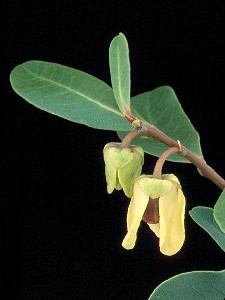
Photo: Steve Shirah — Public domain · source
Survives zone 8 through 9
Harvest calendar
Best planted in early spring after your last frost, or in fall before the ground freezes, depending on your climate.
A federally endangered species found nowhere outside a few sand pine scrub sites in Martin and Palm Beach Counties, Florida, with a wild population of roughly 1,400 plants as of the last federal review — its conservation status, not its fruit, is the defining fact about this species. Fruit and cultivation information is largely absent from the literature; what is documented focuses on habitat loss, fire ecology and recovery efforts rather than fruit quality. ⚠ As with all pawpaws, eat the flesh only — skin and seeds concentrate annonacin and are not food.
- Hardiness
- Zone 8–9
- Habit
- Shrub
- Edible part
- Fruit
- Ripens
- Sept–Oct
- Mature size
- Large shrub or small tree 1–3 m, with one or more main stems
- Light
- Partial to full sun
- Soil pH
- 5.5–7.0 (slightly acid)
- Environment
- Subtropical, fire-adapted scrub
- Native range
- An extremely narrow endemic restricted to the Atlantic Coastal Ridge in Martin and Palm Beach Counties, Florida — known from only a handful of sand pine scrub sites near Jensen Beach, Jonathan Dickinson State Park and the Juno Dunes area.
- Status
- Wild
- Years to fruit
- 3–5 yrs grafted, 4–8 from seed
- Growth speed
- Slow
- Spacing
- 200 cm (79 in) apart — about 4 m² (43 sq ft) per plant
- Leaf shape
- Alternate, spirally arranged, oblong leaves 5-10cm long with rolled-under margins; young leaves are reddish-spotted, maturing dark green above with gray-green, net-veined undersides.
- Root system
- Deep taproot that allows the plant to resprout after fire or other damage to top growth.
- Fruit description
- Yellow-green, banana-scented fruit; beyond this, flavor and texture are poorly documented in the literature — most published material on this species concerns its conservation status and habitat rather than its fruit.
- Propagation
- Seed propagation requires a two-stage stratification process to break double dormancy, and germination is erratic, taking several months to over a year; cutting and root-cutting propagation have also been used in ex situ conservation efforts. As in other Asimina species it forms a deep taproot early, making transplanting of established plants difficult.
- Pollination
- Primarily pollinated by beetles, especially the zebra longhorn beetle, with flies and wasps as secondary visitors — the flowers emit a foul, fermentation-and-carrion-like odor as they mature. Genus-wide, Asimina relies on flies and beetles rather than bees.
The edible parts listed above are a starting point, not a field guide. Identify a plant with certainty — ideally against a local authority — before eating any part of it, and read the full disclaimer. Spotted something wrong? Report it.
Growing guide
Fertilizing. Adapted to excessively well-drained, nutrient-poor quartz sand in open coastal scrub — growing guidance specifically warns against heavy or clay soils, which cause waterlogging and root rot. This species needs very lean, fast-draining, sandy conditions, the opposite of what A. triloba wants.
How it spreads. Grows as a single- or multi-stemmed shrub or small tree from a deep taproot and can resprout from intact roots if top growth is destroyed, e.g. by fire. No rhizomatous colony-forming spread comparable to A. triloba's root-suckering thickets is documented.
Growing tips. Federally listed as Endangered under the U.S. Endangered Species Act since 1986, and rated Endangered by the IUCN and by the state of Florida. As of the 2022 federal five-year review, only about 1,400 individuals remained across 9 populations, none exceeding 150 plants, and the species' range has contracted roughly 7.5 miles northward as its southernmost population disappeared. It depends on periodic wildfire (historically every 10-50 years) to maintain the open scrub gaps it needs, and fire suppression plus habitat loss to development are its major ongoing threats. It is a subtropical South Florida scrub species with no cold-hardiness beyond roughly zone 9-10 and is entirely unsuited to a cold-hardy wiki's colder zones. Given its conservation status, any cultivation should rely on nursery-propagated, conservation-sourced stock rather than wild-collected material.
Grow journal
Sign in to keep a dated log of when you planted, bloomed and harvested this plant.