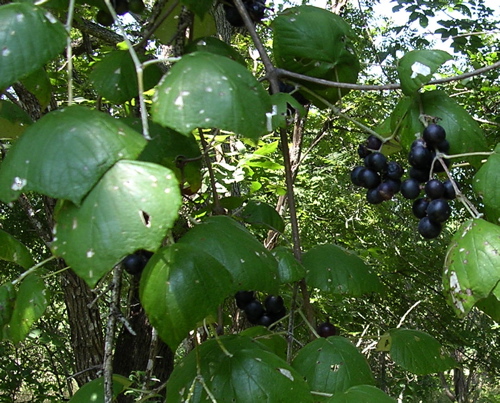
Photo: Ddal — CC BY-SA 3.0 · source
Survives zone 6 through 9
Harvest calendar
Best planted in early spring after your last frost, or in fall before the ground freezes, depending on your climate.
A tough Texas-to-Louisiana native whose grapes ripen to soft, dark purple berries with thick, tough skin around four heart-shaped seeds — the raw juice is so acidic it can irritate skin and lips, so the fruit is almost always cooked down into jelly, pie filling or wine rather than eaten fresh. ⚠ Know the look-alike: across eastern and central North America, moonseed (Menispermum canadense) twines alongside wild grapes, carries similar dark hanging clusters, and is potentially fatal. Three checks — a grape has 2–4 rounded, pear-shaped seeds while moonseed has ONE flat crescent seed; a grape climbs by forked tendrils and moonseed has none; a grape's leaves are toothed and moonseed's are not. Open a berry and look at the seed before eating any wild grape.
- Hardiness
- Zone 6–9
- Habit
- Vine
- Edible part
- Fruit
- Ripens
- Sept–Oct
- Mature size
- Vine 10–20 m
- Light
- Full sun
- Soil pH
- 6.0–7.0
- Environment
- Temperate
- Native range
- South-central US — Arkansas and southern Oklahoma south through Louisiana and Texas, with disjunct populations in Mississippi and Alabama
- Status
- Wild
- Years to fruit
- 2–3 yrs
- Growth speed
- Medium, climbing to about 10 m
- Spacing
- 200 cm (79 in) apart — about 4 m² (43 sq ft) per plant
- Leaf shape
- Broadly lobed, cordate leaves with a dense white, velvet-like tomentum on the underside; young stems and shoots are likewise densely hairy
- Root system
- Deep and strongly drought-tolerant, adapted to central Texas summers; hard to transplant once established because of it.
- Fruit description
- Berries about 2 cm (3/4 in) across, ripening from hard green to soft dark purple in relatively small clusters; thick-skinned with roughly four heart-shaped seeds; bitter and very acidic raw, mainly used cooked for jelly, pie filling or wine
- Propagation
- Seed (fresh-sown, or about 6 weeks cold stratification if stored), hardwood cuttings taken December/January, or layering
- Pollination
- ⚠ DIOECIOUS — needs male + female (a vigorous fruitless wild vine is usually a lone male)
The edible parts listed above are a starting point, not a field guide. Identify a plant with certainty — ideally against a local authority — before eating any part of it, and read the full disclaimer. Spotted something wrong? Report it.
Growing guide
How it spreads. High-climbing, tendril-climbing woody vine; functionally dioecious, so only female (pistillate) vines set fruit
Growing tips. Functionally dioecious — a nearby male vine is needed for female vines to set fruit. Thrives on rich, damp woodland soils, often over limestone. Hardy to USDA zones 4–8. The dense white, velvet-like undersides of the leaves and shredding reddish-brown bark on older vines are the easiest field marks.
Grow journal
Sign in to keep a dated log of when you planted, bloomed and harvested this plant.