Photo: The original uploader was G716 at English Wikipedia. — Public domain · source
Survives zone 4 through 8
Harvest calendar
Best planted in early spring after your last frost, or in fall before the ground freezes, depending on your climate.
Black hawthorn is the characteristic hawthorn of the Pacific Northwest and interior western mountains, ranging from southeastern Alaska to northern California and east into the Rockies — the only Crataegus native that far north on the West Coast. Unlike most other hawthorns in this group, it spreads by root suckering into dense thickets, and its dark purple-to-black fruit sets it apart from the typically red haws of related species.
- Hardiness
- Zone 4–8
- Habit
- Tree
- Edible part
- Fruit
- Ripens
- Summer–autumn
- Mature size
- Large shrub or small tree 3–10 m, often thicket-forming along streams
- Light
- Full sun to partial
- Soil pH
- 6.0–7.0 (near-neutral)
- Environment
- Temperate
- Native range
- Native to western North America, most widespread in the Pacific Northwest — from southeastern Alaska south through British Columbia, Washington and Oregon to northern California — and also found inland through Idaho, Montana, Alberta, Utah, Nevada, Colorado and Wyoming, with disjunct populations around the western Great Lakes (Minnesota, northern Michigan, Ontario, Saskatchewan).
- Status
- Wild
- Years to fruit
- 2–4 yrs
- Growth speed
- Slow to medium, typical of the genus; mature trees reach roughly 6-12m (20-40ft) over time, though size varies considerably with site conditions.
- Spacing
- 450 cm (177 in) apart — about 20 m² (218 sq ft) per plant
- Leaf shape
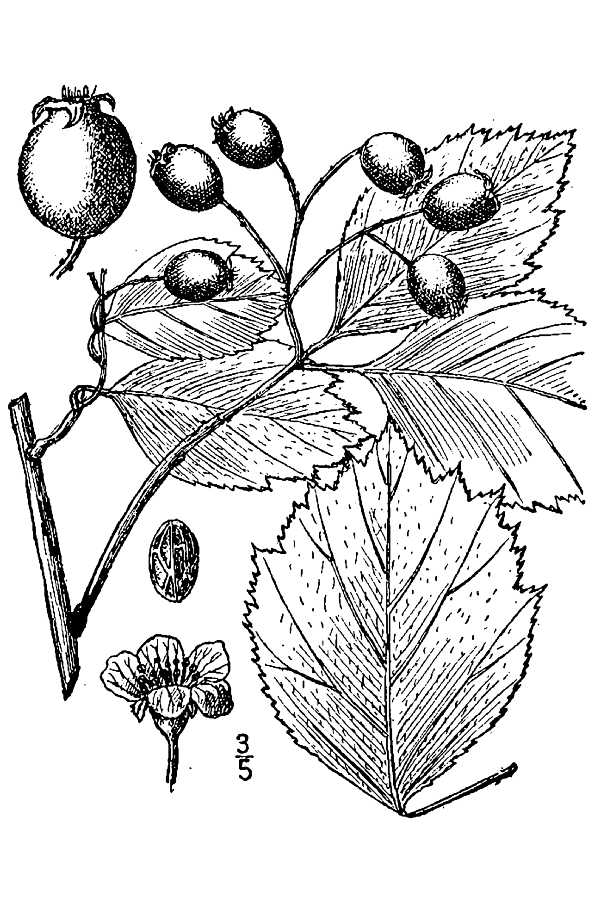
- Leaves are broadly obovate to ovate, about 2.5-5cm long and 1.5-4cm wide, wedge-shaped and untoothed near the base, doubly toothed above and often somewhat lobed near the tip; thin, glossy and smooth above, paler beneath.
- Root system
- Roots readily sucker to form thickets, spreading outward from the parent plant — the key rooting trait distinguishing it from most other Crataegus covered here — in addition to the taproot-plus-fibrous-root pattern typical of the genus. Its roots are valued in riparian restoration for stabilizing stream banks.
- Fruit description
- Fruits are ovoid, glossy, and ripen reddish-purple to black — distinctive among hawthorns, most of which have red haws — about 8-10mm across, with sweet, juicy, succulent flesh that can be eaten fresh, cooked into pies and preserves, or dried for storage. Up to five large seeds cluster together inside.
- Propagation
- Grown from seed, which has the hard coat and embryo dormancy typical of the genus — fresh seed sown in autumn, or stored seed given about 3 months of warm stratification (around 15°C) followed by 3 months of cold stratification (around 4°C), can still take 18 months or more to germinate. Harvesting seed green and sowing it immediately, or scarifying or fermenting it in its pulp, is used to speed germination.
- Pollination
- Self-fertile
The edible parts listed above are a starting point, not a field guide. Identify a plant with certainty — ideally against a local authority — before eating any part of it, and read the full disclaimer. Spotted something wrong? Report it.
Growing guide
Fertilizing. A light feeder tolerant of a wide range of soils including heavy clay and chalk; supplemental fertilizer is rarely needed except on very poor soils, where a balanced feed applied in early spring is sufficient.
How it spreads. Forms dense thickets by root suckering, unlike most other Crataegus covered here — so it spreads outward from an original planting over time, a trait worth planning for in restoration or garden use unless suckers are managed. It also hybridizes readily with other hawthorns, adding to the genus's notoriously tangled taxonomy.
Growing tips. Widely used in riparian and streambank restoration in the Pacific Northwest, since its roots help stabilize banks and its canopy shades streams for fish. Its stout thorns (1-2cm) make it effective as a wildlife barrier or living fence but mean it needs siting away from paths; like other hawthorns it can host Gymnosporangium rust fungi — alternating with juniper — and is susceptible to fire blight. Its thicket-forming, suckering habit should be accounted for when spacing plants, since it will spread beyond its original planting spot over time.
Companion planting. Rosaceae host for cedar-apple/hawthorn rust (Gymnosporangium spp.), which needs both a Rosaceae host and a Juniperus (juniper/eastern red cedar) host to complete its life cycle. Spores can travel over a mile, so distance alone won't fully prevent it — resistant cultivars are the more reliable control, but avoiding nearby junipers helps.
Grow journal
Sign in to keep a dated log of when you planted, bloomed and harvested this plant.