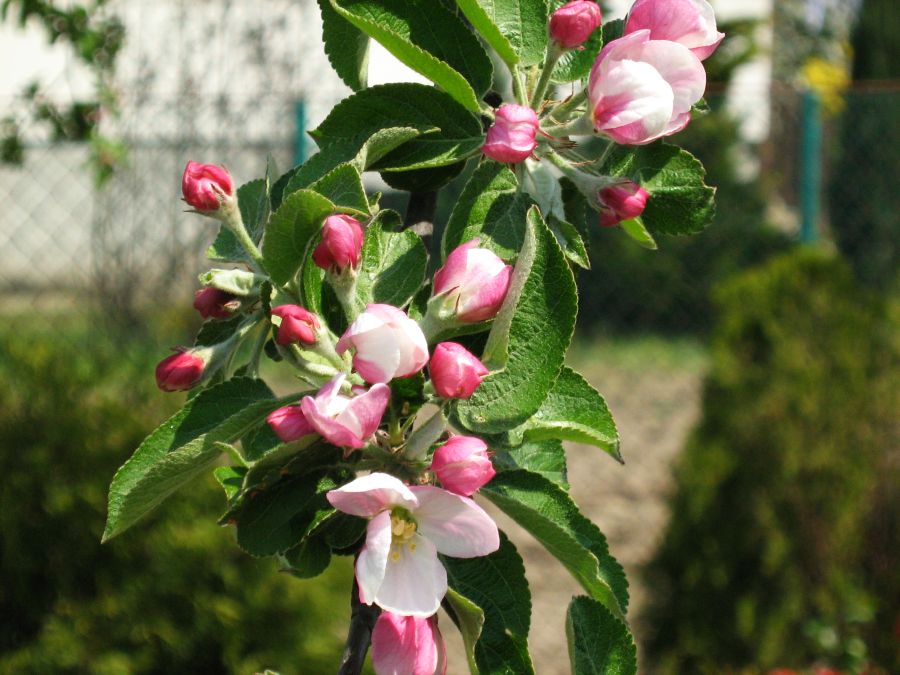
Photo: Łukasz Szczurowski — CC BY-SA 3.0 · source
Survives zone 4 through 8
Harvest calendar
Best planted in early spring after your last frost, or in fall before the ground freezes, depending on your climate.
This is the principal wild ancestor of the domesticated apple, native to the wild-apple forests of the Tian Shan in Kazakhstan and neighboring Central Asian countries — its fruit already shows the large size (up to 7–8 cm) and wide variation in flavor, color, and shape that breeders still mine today, and the species is now assessed as Vulnerable in the wild, making its native forests an active conservation priority.
- Hardiness
- Zone 4–8
- Habit
- Tree
- Edible part
- Fruit
- Ripens
- Summer–autumn
- Mature size
- Tree 5–12 m, occasionally to 15 m — the wild ancestor of the orchard apple
- Light
- Full sun
- Soil pH
- 6.0–7.0 (near-neutral)
- Environment
- Montane forest
- Native range
- Native to the wild-apple and walnut forests of the Tian Shan mountain system in Central Asia, chiefly the Ili valley of southeastern Kazakhstan, with populations extending through Kyrgyzstan, Tajikistan and Uzbekistan into the Pamir-Alai of Afghanistan and northern Pakistan, and east into western Xinjiang (China), typically at elevations of roughly 900–2,400 m.
- Status
- Wild
- Years to fruit
- 2–4 yrs
- Growth speed
- Medium; a broad-crowned, spreading tree reaching roughly 5–12 m (occasionally to 14 m) tall in the wild.
- Spacing
- 700 cm (276 in) apart — about 49 m² (527 sq ft) per plant
- Leaf shape
- Ovate to elliptic or oblong, 6–11 by 3–5.5 cm, densely hairy underneath when young and becoming less so with age, with bluntly toothed margins and an acute tip; about 62% of wild trees show red autumn foliage color, versus only about 2.8% of cultivated apple varieties.
- Root system
- Forms a wide, branching root system rather than a single taproot; wild stands can suffer root damage from fungal pathogens, one of the documented threats to the species.
- Fruit description
- Among the largest-fruited wild Malus species, described by PFAF as "large and well-flavoured" — typically 3–5 cm across but reaching up to 7–8 cm, yellow-green and variably flushed red, with globose, flattened, elongated, or ribbed forms; wild populations show striking diversity in sweetness and flavor.
- Propagation
- Seed is best sown fresh in autumn in a cold frame; stored seed needs about 3 months' stratification at 1°C (research trials have also used seed stored cold and moist, or seedcoat removal, to break dormancy) and germination can still take 12 months or more. Mature-wood cuttings can be taken in November. Because wild populations are so genetically diverse, seedlings do not come true, and named or selected forms are grafted.
- Pollination
- ⚠ Mostly SELF-INCOMPATIBLE — needs a 2nd cultivar
The edible parts listed above are a starting point, not a field guide. Identify a plant with certainty — ideally against a local authority — before eating any part of it, and read the full disclaimer. Spotted something wrong? Report it.
Growing guide
Fertilizing. Grows well in ordinary fertile, well-drained loamy soil across a mildly acid to mildly alkaline range and tolerates sandy or heavy clay soils, so it needs little routine feeding once established beyond what any young fruit tree benefits from.
How it spreads. Forms wild forest stands rather than a garden colonizer — natural regeneration is by bird- and mammal-dispersed seed (including bears and other large mammals feeding on the fruit), and this seed dispersal is itself part of what shaped the species' remarkable fruit diversity.
Growing tips. Malus sieversii is the primary wild progenitor of the cultivated apple, confirmed by DNA analysis in 2010 — it is treated by breeders as a critical genetic reservoir for traits such as cold tolerance, disease resistance (including apple scab and fire blight), and anthocyanin content for red-fleshed apple breeding. It is assessed as Vulnerable on the IUCN Red List and classified as endangered in China, threatened by overgrazing, timber-felling, disease, and climate change, with mortality of mature trees exceeding 80% in some surveyed areas (e.g., Xinyuan County) and poor natural seedling recruitment.
Grow journal
Sign in to keep a dated log of when you planted, bloomed and harvested this plant.