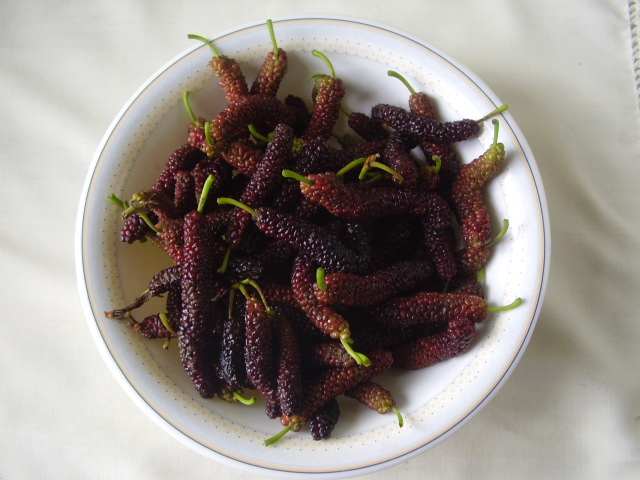
Photo: Khalid Mahmood — CC BY-SA 3.0 · source
Survives zone 7 through 9
Harvest calendar
Best planted in early spring after your last frost, or in fall before the ground freezes, depending on your climate.
Morus macroura, the shahtoot or king white mulberry, is a Himalayan-to-Southeast-Asian tree grown for its unusually elongated, honey-sweet aggregate fruit — up to 6–10cm long — that ripens from yellowish-white through pink to nearly black. It breaks dormancy very early, making its new growth highly vulnerable to late spring frost.
- Hardiness
- Zone 7–9
- Habit
- Tree
- Edible part
- Fruit
- Ripens
- June–Aug
- Mature size
- Tree 8–12 m; dwarf forms containerable
- Light
- Full sun
- Soil pH
- 6.0–7.5 (lime-tolerant)
- Environment
- Subtropical
- Native range
- The eastern Himalaya through southern China, Indochina, Myanmar, Thailand, Cambodia, peninsular Malaysia, and mountainous Indonesia, at elevations from about 300–2200m, mostly 1000–1300m.
- Status
- Cultivated
- Years to fruit
- 2–3 yrs
- Growth speed
- Fast-growing, reaching 7–20m tall (occasionally to 35m in favorable tropical conditions such as Thailand).
- Spacing
- 700 cm (276 in) apart — about 49 m² (527 sq ft) per plant
- Leaf shape
- Broadly ovate leaves, sometimes deeply lobed, per RHS description; more detailed species-specific documentation of lobing patterns is limited.
- Root system
- Brittle roots requiring careful handling during transplanting; grows as a single-trunked tree, not documented as a suckering spreader.
- Fruit description
- An unusually elongated aggregate fruit, cylindrical and up to 6–10cm long, made up of many small drupelets; color ranges from yellowish-white through pink to nearly black depending on the form, with a honey-sweet flavor in good selections, though some seedling trees are dry and insipid.
- Propagation
- Propagated from semi-ripe cuttings in midsummer or hardwood cuttings in autumn/early spring, from seed after 2–3 months' cold stratification, or — for named selections such as 'Pakistan' or 'Shahtoot' — by grafting; micropropagation from mature nodal explants has also been demonstrated experimentally.
- Pollination
- Dioecious — needs male + female
The edible parts listed above are a starting point, not a field guide. Identify a plant with certainty — ideally against a local authority — before eating any part of it, and read the full disclaimer. Spotted something wrong? Report it.
Growing guide
Fertilizing. Prefers deep, fertile, moist soil and benefits from an annual mulch of compost or well-rotted manure, though it is documented as adaptable to a range of soil types.
How it spreads. A single-trunked tree with a spreading, weeping canopy; no documented invasive or suckering spread.
Growing tips. Native to warm-temperate and subtropical Himalayan foothills, Indochina, and mountainous Indonesia, M. macroura is the most cold-tender species in this group and is genuinely marginal at the cold end of USDA zones 7–9 (some sources rate it to only zone 8b in practice). It breaks bud very early in spring, so even where dormant wood tolerates brief cold into the teens °F, late frosts routinely kill back new growth and can prevent fruiting that year; container culture with winter protection is worth considering further north. It is also documented as a very long-lived tree, capable of fruiting productively for several hundred years.
Grow journal
Sign in to keep a dated log of when you planted, bloomed and harvested this plant.