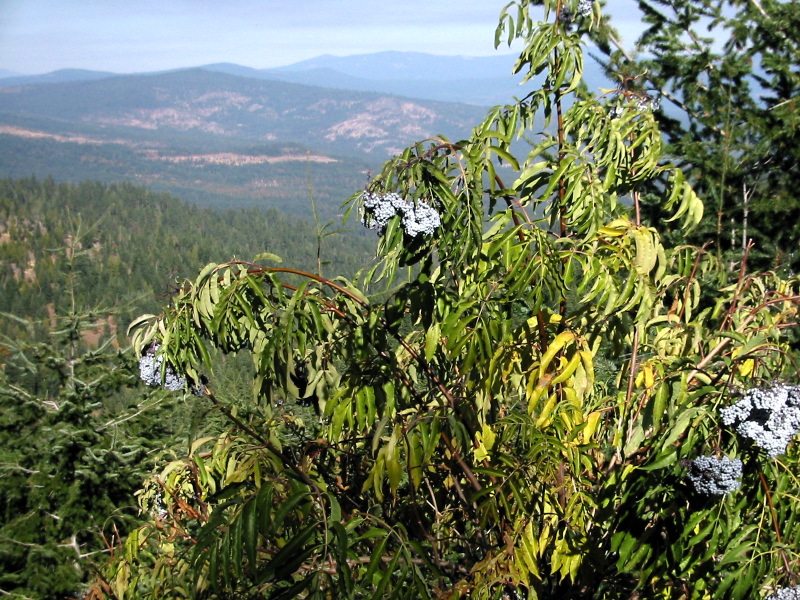
Photo: No machine-readable author provided. Wsiegmund assumed (based on copyright claims). — CC BY 2.5 · source
Survives zone 6 through 9
Harvest calendar
Best planted in early spring after your last frost, or in fall before the ground freezes, depending on your climate.
⚠ MUST BE COOKED — raw berries, leaves and stems are toxic. Native to the western US; the berries carry a powdery, glaucous bloom that gives them a dusty blue color over black skin, and are considered the sweetest-tasting of the North American elders. Taxonomically unsettled: also published as "Sambucus caerulea" (an orthographic variant of the same name) and as "Sambucus nigra subsp. cerulea" (treating it as part of the wider black-elder complex rather than its own species) — all three names describe the same western blue elder.
- Hardiness
- Zone 6–9
- Habit
- Shrub
- Edible part
- Flower, Fruit
- Ripens
- Aug–Sept
- Mature size
- Large shrub 3–6 m
- Light
- Full sun to partial
- Soil pH
- 5.5–7.0
- Environment
- Temperate
- Native range
- Western North America — from southern British Columbia south through California and the Great Basin to Baja California and northwestern Mexico, extending east into Montana, Wyoming, Colorado, Utah, Arizona, New Mexico and Trans-Pecos Texas — largely a riparian and forest-edge species from sea level up to roughly 3,000 m.
- Status
- Both wild and cultivated
- Years to fruit
- 2–3 yrs
- Growth speed
- 60–120 cm/year while establishing — FEIS rates it a 'very good' grower, often reaching full size in 3–4 years in the Intermountain West.
- Spacing
- 300 cm (118 in) apart — about 9 m² (97 sq ft) per plant
- Leaf shape
- Opposite, odd-pinnate leaves with 5–9 leaflets, each elliptic to lanceolate, 3–15 cm long, with sharply serrate margins and an acuminate tip.
- Root system
- Shallow, fibrous and spreading rather than deep-rooted, with no true taproot. Spreads mainly through basal or root-crown resprouting after damage rather than widely running rhizomes.
- Fruit description
- Small, round drupes 4–6 mm across, bluish-black under a waxy, glaucous bloom that gives the clusters a dusty powder-blue look, borne in large, flat-topped cymes. Considered the best-flavored of the North American elders — sweet and juicy when ripe but seedy and rather rank-tasting raw — used cooked for jam, syrup, pie and wine.
- Propagation
- Seed needs a two-stage stratification — about 60–90 days warm followed by 60–90 days cold (around 4°C) — or can simply be sown outdoors in autumn as soon as ripe; the hard seed coat otherwise delays germination for 2–5 years, so growers also scarify seed with sulfuric acid or heat to speed it up. Softwood or semi-ripe cuttings taken in July–August, and hardwood cuttings taken in late autumn, both root readily — elder is notoriously easy from cuttings.
- Pollination
- Self-fertile and generally doesn't require a second plant to set fruit, unlike S. nigra and S. canadensis selections, which crop far better with a cross-pollinating partner nearby.
The edible parts listed above are a starting point, not a field guide. Identify a plant with certainty — ideally against a local authority — before eating any part of it, and read the full disclaimer. Spotted something wrong? Report it.
Growing guide
Fertilizing. Adapted to lean, gravelly riparian soils and generally doesn't need routine feeding; on poor or sandy sites a balanced organic or slow-release fertilizer applied in early spring before growth starts helps establishment — but excess nitrogen pushes leafy growth at the expense of flowers and fruit.
How it spreads. Forms a large, multi-stemmed shrub or small tree rather than an aggressive thicket-former — the US Forest Service's Fire Effects Information System notes that its vegetative spread is mostly limited to vigorous coppicing and basal resprouting after stems are damaged or top-killed, rather than the far-ranging root suckering seen in S. nigra subsp. canadensis. Seed is bird-dispersed and can stay viable in the soil for up to 16 years, germinating readily once fire scarifies the seed coat.
Growing tips. Wants a sunny, moist but well-drained site — it tolerates soils from gravelly to heavy clay loam but grows best in loam or sandy loam with good organic matter — and is shade-intolerant to only slightly shade-tolerant. FEIS rates its disease and insect resistance as 'very good' relative to other elders, though the elderberry cane borer, rust (Puccinia sambuci) and aphids that affect other Sambucus can still occur. Because it resprouts vigorously from the base, it tolerates being cut back hard; remove dead or damaged canes each dormant season.
Grow journal
Sign in to keep a dated log of when you planted, bloomed and harvested this plant.