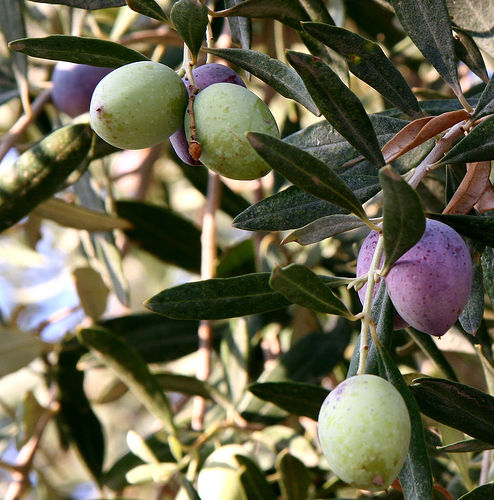
Photo: en:User:Nickfraser — CC BY-SA 3.0 · source
2
3
4
5
6
7
8
9
Survives zone 8 through 9
Harvest calendar
Jan
Feb
Mar
Apr
May
Jun
Jul
Aug
Sep
Oct
Nov
Dec
Best planted in early spring after your last frost, or in fall before the ground freezes, depending on your climate.
⚠ Raw olives are INEDIBLE until cured/brined. Care: Winter protection — mulch, fleece, or a warm wall.
- Hardiness
- Zone 8–9
- Habit
- Tree
- Edible part
- Fruit
- Ripens
- Late Sept–Nov (green → black)
- Mature size
- Evergreen 6–8 m; compact forms good in containers
- Light
- Full sun (obligate for fruiting)
- Soil pH
- 6.5–8.0 (genuinely lime/chalk-tolerant)
- Environment
- Mediterranean
- Native range
- The Mediterranean basin, with its wild ancestor (var. sylvestris, the oleaster) still in coastal scrub from Portugal to the Levant. Domesticated in the eastern Mediterranean some six thousand years ago and inseparable from the region's agriculture since.
- Status
- Cultivated
- Years to fruit
- 3–5 yrs ('Arbequina' 2–3)
- Growth speed
- Slow — and very long-lived, with productive trees of several centuries commonplace
- Spacing
- 600 cm (236 in) apart — about 36 m² (388 sq ft) per plant
- Leaf shape
- Opposite, narrow and lance-shaped 4–10 cm, leathery, grey-green above and silver-scaled beneath — the silver flicker of an olive grove in wind is those undersides. Evergreen, with leaves lasting two to three years.
- Root system
- Shallow and enormously wide-spreading, most of it in the top 60–100 cm but reaching far beyond the canopy, with a woody basal burl (the ovulo) that resprouts after fire, frost or felling. That burl is why an olive is so nearly impossible to kill and why ancient trees carry hollow, contorted trunks with living wood around them.
- Fruit description
- A drupe 1–4 cm ripening green through purple to black, with a single hard stone. ⚠ Raw olives are inedible — intensely bitter from oleuropein — and must be cured in brine, lye, salt or water before eating. Table varieties and oil varieties are different selections; the oil types are smaller and fattier.
- Propagation
- Semi-hardwood cuttings under mist, which root readily and keep the variety — the standard commercial route. Also grafting onto seedling stock, and truncheon cuttings or burl divisions in traditional practice. Seed is slow, variable and reverts toward the wild oleaster.
- Pollination
- Partially self-fertile — plant a 2nd cultivar for reliable set. 'Arbequina' is the usual single-plant choice
The edible parts listed above are a starting point, not a field guide. Identify a plant with certainty — ideally against a local authority — before eating any part of it, and read the full disclaimer. Spotted something wrong? Report it.
Grow journal
Sign in to keep a dated log of when you planted, bloomed and harvested this plant.