Photo: Unknown — Public domain · source
Survives zone 3 through 8
Harvest calendar
Best planted in early spring after your last frost, or in fall before the ground freezes, depending on your climate.
North America's wild 'beaked' hazelnut, named for the long, bristly, tubular husk that encloses the nut — smaller-nutted than European hazelnut, with a thin shell and sweet, well-flavored kernel.
- Hardiness
- Zone 3–8
- Habit
- Shrub
- Edible part
- Nut
- Ripens
- September
- Mature size
- Suckering shrub 1.5–4 m; coppiceable; container short-term
- Light
- Partial to full sun (forest-edge shrub)
- Soil pH
- 6.0–7.5 (lime-tolerant)
- Environment
- Temperate
- Native range
- North America, in two geographically distinct varieties — the eastern beaked hazelnut, from British Columbia across Canada to Newfoundland and south to Colorado, Mississippi and South Carolina; and the California hazelnut, from British Columbia south through Washington and Oregon to California, mostly west of the Cascades.
- Status
- Both wild and cultivated
- Years to fruit
- 3–4 yrs
- Growth speed
- Slow initially — resprouts reach only about 60 cm within two growing seasons after top-kill, taking 15–20 years to reach roughly 2.4 m.
- Spacing
- 350 cm (138 in) apart — about 12 m² (132 sq ft) per plant
- Leaf shape
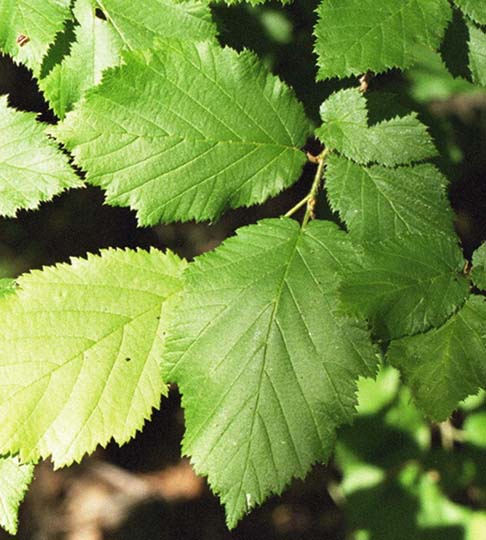
- Nearly round to ovate, 4–10 cm, doubly toothed margins, often velvety-hairy and paler beneath.
- Root system
- A shallow, dense, extensive network of rhizomes (over 90% in the top 15 cm of soil) plus a taproot extending 60 cm or more below the surface.
- Fruit description
- A hard-shelled nut fully enclosed in a stiff, hairy husk extended into a long tubular beak; the kernel is sweet and well-flavored with a thin shell, borne in clusters of 2–6.
- Propagation
- Best propagated from seed harvested early, while husks are still slightly green, then dried and either fall-sown or cold-stratified two to three months before spring sowing. Also propagated by transplanting root suckers in late winter or early spring, by fall layering, and by hardwood cuttings.
- Pollination
- Monoecious, wind-pollinated and self-fertile.
The edible parts listed above are a starting point, not a field guide. Identify a plant with certainty — ideally against a local authority — before eating any part of it, and read the full disclaimer. Spotted something wrong? Report it.
Growing guide
Fertilizing. Prefers dry-mesic soils around pH 5.7–6.3, thriving in moist but well-drained, loamy, acidic soil rich in organic matter; doesn't grow well on fine-textured clay or saturated ground.
How it spreads. Strongly rhizomatous and suckering, forming dense thickets that create a continuous shrub understory; occasionally also spreads by layering.
Growing tips. Roots and rhizomes are shallow and extensive — over 90% occur in the top 15 cm of soil, with a taproot extending 60 cm or more below the surface. Resprouts vigorously after fire or top-kill. Resistant to eastern filbert blight, though some regions restrict Corylus imports and sales to control blight spread in commercial orchards, so it's worth checking local regulations before planting.
Grow journal
Sign in to keep a dated log of when you planted, bloomed and harvested this plant.