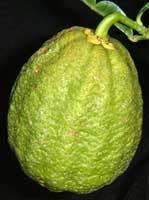
Photo: photo by Michael Saalfeld (www.homecitrusgrowers.co.uk) — CC BY-SA 2.5 · source
Survives zone 7 through 9
Harvest calendar
Best planted in early spring after your last frost, or in fall before the ground freezes, depending on your climate.
Citrus cavaleriei (Ichang papeda) is a slow-growing, evergreen wild citrus from the mountains of central China, valued less for its bitter, seedy fruit than as a parent of yuzu and other cold-hardy hybrid citrus.
- Hardiness
- Zone 7–9
- Habit
- Shrub
- Edible part
- Fruit
- Ripens
- Winter (citrus)
- Mature size
- Small evergreen tree 3–6 m; containerable, and usually grown that way outside China
- Light
- Full sun
- Soil pH
- 6.0–6.5 (slightly acid)
- Environment
- Montane subtropical
- Native range
- Native to southwestern and west-central China — including Gansu, Guangxi, Guizhou, Hubei, Hunan, Shaanxi, Sichuan and Yunnan provinces — where it grows wild in low montane forests up to 2,500–3,000 m; the species name is thought to reference the city of Yichang in Hubei.
- Status
- Both wild and cultivated
- Years to fruit
- 2–3 yrs
- Growth speed
- Slow
- Spacing
- 400 cm (157 in) apart — about 16 m² (172 sq ft) per plant
- Leaf shape
- Evergreen, simple (unifoliate) leaves with an unusually broad, winged petiole — a classic papeda trait shared with yuzu and kaffir lime — and strongly lemon-scented foliage.
- Root system
- Not well documented in detail, but the species is noted as intolerant of root disturbance and requires consistent, careful watering to avoid root stress and dieback.
- Fruit description
- A small, mandarin-like fruit, oval, spherical or flattened in shape, ripening yellow to orange with a fragrant but rough, bumpy rind. The pulp is scant and sour-to-bitter, packed with numerous large seeds — some fruit have almost no juice at all, just pith and seed. Essentially inedible fresh; historically used more as a breeding parent and rootstock than for eating out of hand.
- Propagation
- Propagated mainly from fresh seed sown in a greenhouse, which germinates in about 2–3 weeks at 13°C; it can also be increased by half-ripe cuttings taken in July–August or by layering in October. It is not typically grown as a rootstock itself, but is an important wild parent behind cold-hardy hybrid citrus such as yuzu, sudachi and kabosu.
- Pollination
- Most Citrus SELF-FERTILE (many parthenocarpic/seedless)
The edible parts listed above are a starting point, not a field guide. Identify a plant with certainty — ideally against a local authority — before eating any part of it, and read the full disclaimer. Spotted something wrong? Report it.
Growing guide
Fertilizing. Prefers a moderately heavy loam enriched with plenty of compost and sand, in a very sunny position, at a soil pH of about 5–6; it dislikes manure and cannot tolerate waterlogged ground.
How it spreads. A single-trunked evergreen shrub or small tree that does not sucker or spread vegetatively — slow-growing and still relatively rare in cultivation outside botanical and citrus-breeding collections.
Growing tips. Widely regarded as the second-hardiest citrus in cultivation after Citrus trifoliata, though sources disagree on the exact limit — PFAF rates dormant plants hardy to about -5°C (23°F) in a sheltered site, while several other horticultural accounts credit it with surviving undamaged well below -15°C. Young spring growth stays frost-tender regardless of how hardy the dormant wood is. It is intolerant of root disturbance and needs careful, even watering — plants can yellow and decline if allowed to dry out or sit wet. Species-specific data on citrus greening (HLB) susceptibility is not well documented in the available literature.
Grow journal
Sign in to keep a dated log of when you planted, bloomed and harvested this plant.