Photo: Kurt Stüber [1] — CC BY-SA 3.0 · source
Survives zone 4 through 8
Harvest calendar
Best planted in early spring after your last frost, or in fall before the ground freezes, depending on your climate.
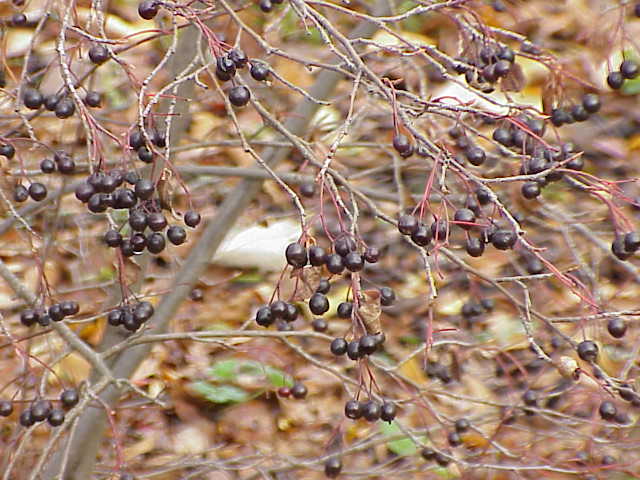
A natural hybrid between red and black chokeberry (A. arbutifolia × A. melanocarpa), with dark purple-black fruit intermediate in astringency between its two parents — still best cooked with sugar into jam, jelly, syrup or juice rather than eaten raw in quantity.
- Hardiness
- Zone 4–8
- Habit
- Shrub
- Edible part
- Fruit
- Ripens
- Summer–autumn
- Mature size
- Upright suckering shrub 1–3 m, intermediate between its parents
- Light
- Partial to full sun — best fruit in sun
- Soil pH
- 6.0–7.0 (near-neutral)
- Environment
- Temperate
- Native range
- Eastern North America — the natural hybrid of black and red chokeberry, occurring wherever the two parents' ranges overlap, from Nova Scotia south to the Appalachians.
- Status
- Both wild and cultivated
- Years to fruit
- 2–4 yrs
- Growth speed
- 20–40 cm/year — medium.
- Spacing
- 180 cm (71 in) apart — about 3.2 m² (35 sq ft) per plant
- Leaf shape
- Alternate, oval to obovate, finely toothed, and intermediate between its parents — thinly hairy beneath rather than either glabrous or densely felted — with the genus's dark glands along the midrib.
- Root system
- Shallow, fibrous and strongly suckering, spreading by underground runners to form colonies — excellent for stabilising banks, and easy to increase by division.
- Fruit description
- Round purple-black berries 7–10 mm across, intermediate between its parents in colour and size, astringent raw and used cooked.
- Propagation
- Division of rooted suckers is much the easiest route. Softwood cuttings in early summer root well; seed needs about three months cold stratification and, being apomictic, comes largely true.
- Pollination
- Self-fertile and apomictic — a single plant crops reliably with no partner needed, and its seed largely reproduces the parent. One cultivar is sufficient for a full crop. Insect-pollinated by bees.
The edible parts listed above are a starting point, not a field guide. Identify a plant with certainty — ideally against a local authority — before eating any part of it, and read the full disclaimer. Spotted something wrong? Report it.
Grow journal
Sign in to keep a dated log of when you planted, bloomed and harvested this plant.