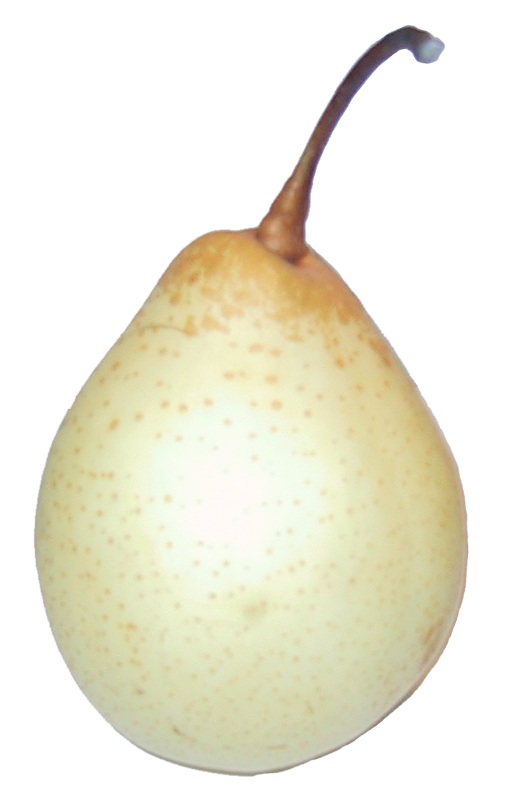
Photo: Unknown — CC BY-SA 2.0 de · source
Survives zone 4 through 8
Harvest calendar
Best planted in early spring after your last frost, or in fall before the ground freezes, depending on your climate.
The 'Chinese white pear' — juicy, white-to-light-yellow-fleshed pears shaped more like a European pear (narrowing toward the stem) than the round nashi/Asian pears also grown in East Asia. Unlike buttery European pear cultivars, the flesh stays crisp and high in water content even fully ripe, with a mild, subtly floral sweetness — it's eaten fresh rather than bletted.
- Hardiness
- Zone 4–8
- Habit
- Tree
- Edible part
- Fruit
- Ripens
- Summer–autumn
- Mature size
- Tree 8–14 m on seedling roots; on quince rootstock 3–4 m and trainable
- Light
- Full sun
- Soil pH
- 6.0–7.0 (near-neutral)
- Environment
- Temperate
- Native range
- North-central China — Gansu, Hebei, Henan, Qinghai, Shaanxi, Shandong, Shanxi and Xinjiang provinces — on slopes and in dry, cold regions at elevations of 100–2000 m.
- Status
- Cultivated
- Years to fruit
- 2–4 yrs
- Growth speed
- Moderate — a deciduous tree reaching about 6 m at maturity, flowering in May with fruit ripening September–October.
- Spacing
- 500 cm (197 in) apart — about 25 m² (269 sq ft) per plant
- Leaf shape
- Ovate to elliptic-ovate, 5–11 by 3.5–6 cm, tomentose (downy) on both surfaces when young becoming glabrous with age, base broadly cuneate, margin spinulose-serrate (fine, forward-pointing teeth), apex acuminate.
- Root system
- Standard, non-suckering single-trunked tree root form; grows in light, medium and heavy soils and tolerates a fairly wide pH range from mildly acid to mildly alkaline.
- Fruit description
- Rounded-to-pear-shaped fruit up to about 3 cm across in the wild type (cultivated selections like 'Ya Li' run 200–400 g); skin white to light yellow. Flesh is crisp and fine-grained with high juice content and comparatively low sugar and mild flavor — distinctly crunchy rather than the soft, buttery melt of European pear, closer in texture to a firm, juicy apple.
- Propagation
- Almost always grafted — named cultivars (e.g. 'Ya Li', 'Bai Li') are budded or grafted onto seedling pear rootstock rather than grown from seed, since seedlings don't come true to type. Seed itself needs 8–10 weeks of cold stratification at around 1°C, sown in autumn or given cold treatment for spring sowing, and is used mainly for raising rootstock or breeding stock.
- Pollination
- ⚠ Mostly SELF-INCOMPATIBLE — needs a partner
- Pollinator partners
- Ussurian pear
The edible parts listed above are a starting point, not a field guide. Identify a plant with certainty — ideally against a local authority — before eating any part of it, and read the full disclaimer. Spotted something wrong? Report it.
Growing guide
How it spreads. A standard, non-suckering single-trunked tree — it does not colonize or spread vegetatively.
Growing tips. Prefers a well-drained loam in full sun and tolerates heavy clay; established trees are drought-tolerant. As one of the wild Asian pear species behind many modern cultivars, it's an important genetic resource and is used in breeding programs — some Asian Pyrus germplasm of this type contributes fire-blight-tolerant rootstock and breeding lines, since fire blight (Erwinia amylovora) is the major bacterial disease of cultivated pear.
Grow journal
Sign in to keep a dated log of when you planted, bloomed and harvested this plant.