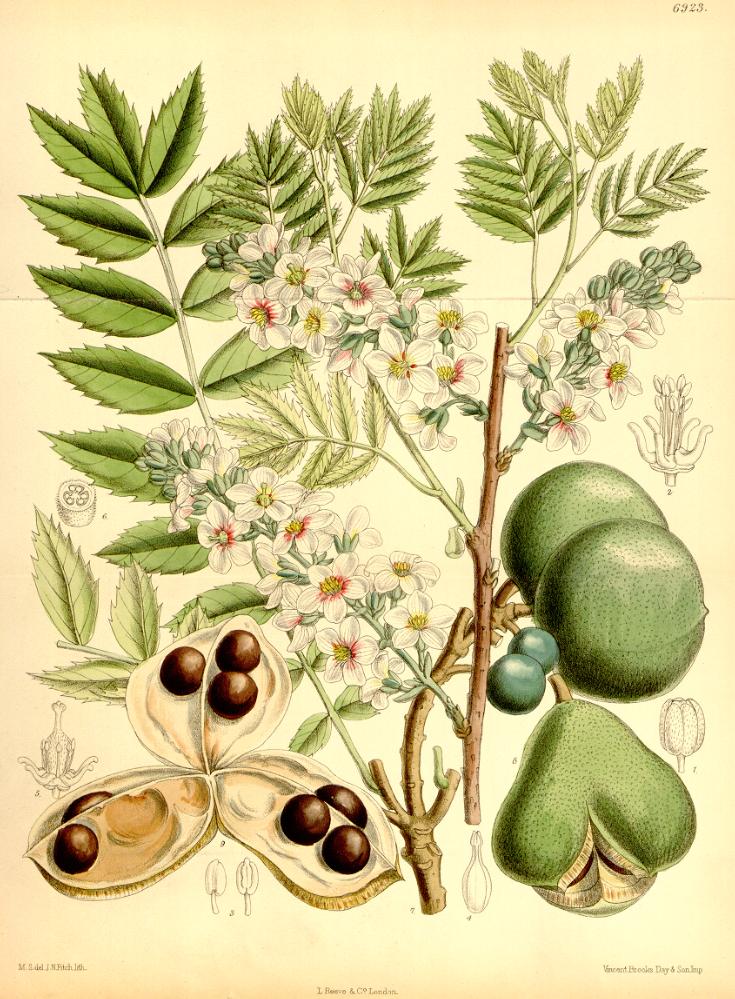
Photo: Joseph Dalton Hooker (1817-1911) — Public domain · source
Survives zone 4 through 8
Harvest calendar
Best planted in early spring after your last frost, or in fall before the ground freezes, depending on your climate.
Pea-sized seeds edible cooked — sweet, likened to sweet chestnut or macadamia; a genuine Chinese edible-oil crop. Young leaves and flowers also cooked. Edible seeds & flowers; ⚠ seed oil contains erucic acid (~9%) — consume in moderation.
- Hardiness
- Zone 4–8
- Habit
- Shrub
- Edible part
- Flower, Leaf, Seed
- Ripens
- Capsules split in autumn (Sept–Oct), 6–18 seeds per fruit
- Mature size
- Deciduous shrub/small tree 2–8 m
- Light
- Full sun (needs heat to flower/fruit)
- Soil pH
- 6.0–7.0
- Environment
- Temperate
- Native range
- Northern China — Inner Mongolia, Shaanxi, Gansu, Hebei and Henan — on dry hillsides and loess slopes. Grown at scale in China as a woody oil crop for marginal, eroding land.
- Status
- Both wild and cultivated
- Years to fruit
- 4–6 yrs
- Growth speed
- Moderate
- Spacing
- 400 cm (157 in) apart — about 16 m² (172 sq ft) per plant
- Leaf shape
- Alternate and pinnate, 15–30 cm, with 9–19 narrow, sharply toothed leaflets — the sorbifolium of the name is exact, the leaf is very like a rowan's.
- Root system
- A deep taproot with spreading laterals, drought-hardy and suckering — which is why it is planted for erosion control on the loess plateau. ⚠ It will not tolerate waterlogging: root rot on heavy wet ground is the usual way this plant is killed.
- Fruit description
- A thick-walled green capsule 4–6 cm splitting in autumn to drop 6–18 pea-sized dark brown seeds. Cooked, the seeds are sweet and rich, somewhere between sweet chestnut and macadamia, and they are pressed commercially for edible oil. The young leaves and the flowers are also cooked and eaten.
- Propagation
- Seed after cold stratification, sown deep for the taproot; root cuttings and grafting for the selected oil clones. It resents transplanting once past the seedling stage.
- Pollination
- Andromonoecious (hermaphrodite and male flowers on the same plant); insect-pollinated, can be shy-fruiting
The edible parts listed above are a starting point, not a field guide. Identify a plant with certainty — ideally against a local authority — before eating any part of it, and read the full disclaimer. Spotted something wrong? Report it.
Grow journal
Sign in to keep a dated log of when you planted, bloomed and harvested this plant.