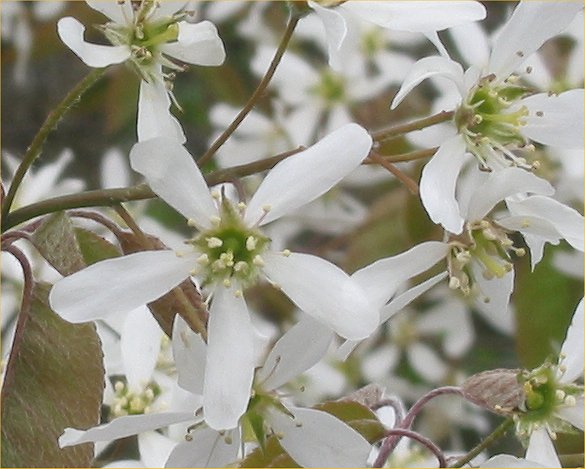
Photo: Rasbak — CC BY-SA 3.0 · source
Survives zone 3 through 8
Harvest calendar
Best planted in early spring after your last frost, or in fall before the ground freezes, depending on your climate.
Amelanchier canadensis is a wetland-adapted, strongly colony-forming shrub of the Atlantic coastal plain, distinct from the more upland, tree-form A. arborea and A. laevis it is frequently confused with in the nursery trade — its vigorous suckering habit makes it especially useful for naturalizing along pond and stream margins.
- Hardiness
- Zone 3–8
- Habit
- Shrub
- Edible part
- Fruit
- Ripens
- Summer–autumn
- Mature size
- Multi-stemmed shrub 3–6 m, suckering into a dense upright clump
- Light
- Partial to full sun — survives in shade, flowers/fruits poorly there
- Soil pH
- 6.0–7.0 (near-neutral)
- Environment
- Wetland
- Native range
- Eastern North America, concentrated on the Atlantic coastal plain from Newfoundland and Nova Scotia south to Georgia and the Gulf states, generally within about 200 miles of the coast and rarely above 200m elevation — it favors wet, often acidic sites such as pocosins, bogs, wet pine flatwoods, and maritime forest margins.
- Status
- Both wild and cultivated
- Years to fruit
- 2–4 yrs
- Growth speed
- Moderate, roughly 30-60 cm/year (1-2 ft), reaching mature size of 4.5-6m in about 10-20 years.
- Spacing
- 350 cm (138 in) apart — about 12 m² (132 sq ft) per plant
- Leaf shape
- Simple, oblong leaves 2.5-7.5cm long and under 2.5cm wide, serrate-margined with a rounded base and a small sharp tip; new growth is finely hairy, maturing to smooth medium-to-dark green above with persistent fine hairs beneath, turning showy orange-red in fall.
- Root system
- Multi-stemmed and colony-forming, spreading by root suckers from the crown rather than staying a single clump — this suckering habit is more pronounced than in the more tree-like A. arborea and A. laevis.
- Fruit description
- Berries about 10mm across (up to 12mm in good forms) with a sweet flavor carrying a hint of apple, though quality varies between plants and some individuals are noticeably more astringent; cooked seeds add an almond-like note.
- Propagation
- Rooted from hardwood cuttings taken in early spring or softwood cuttings taken in summer; seed can be sown untreated in fall or cold-moist stratified for 90-120 days before spring sowing (best results come from collecting seed green and sowing it immediately). Colony-forming root suckers can also be divided and transplanted.
- Pollination
- Hybridizes freely with other Amelanchier species where ranges overlap, consistent with the genus's polyploid apomictic complexes — this can blur species boundaries in the wild and means seedling offspring don't always resemble the parent plant.
The edible parts listed above are a starting point, not a field guide. Identify a plant with certainty — ideally against a local authority — before eating any part of it, and read the full disclaimer. Spotted something wrong? Report it.
Growing guide
Fertilizing. Prefers moist, well-drained sandy loam but tolerates both wet and dry sites, clay, and salt spray; being adapted to naturally acidic wetland soils, it benefits from acidic, humus-rich amendments and consistent moisture rather than heavy feeding, and is intolerant of harsh urban conditions.
How it spreads. A strongly colony-forming, multi-stemmed shrub that spreads by root suckers from the base — left unpruned it forms a dense thicket over time, which in the wild provides cover and nesting habitat along wetland and forest edges.
Growing tips. Grows in full sun to partial shade, with afternoon shade and extra moisture appreciated in hotter climates. Shares the Rosaceae disease complex of rust, fire blight, leaf spot, and powdery mildew, plus sawfly, leaf miner, borers, and scale insects, though none are usually serious. Best pruned right after flowering. Fall color is a showy orange-red.
Companion planting. Rosaceae host for cedar-apple/hawthorn rust (Gymnosporangium spp.), which needs both a Rosaceae host and a Juniperus (juniper/eastern red cedar) host to complete its life cycle. Spores can travel over a mile, so distance alone won't fully prevent it — resistant cultivars are the more reliable control, but avoiding nearby junipers helps.
Grow journal
Sign in to keep a dated log of when you planted, bloomed and harvested this plant.