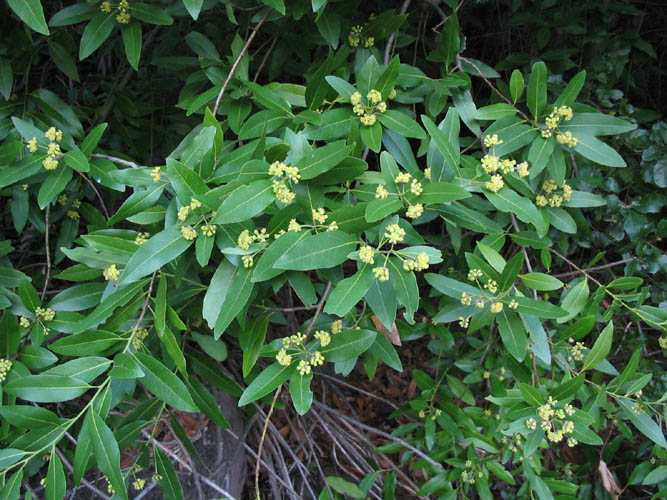
Photo: Public domain · source
Survives zone 7 through 9
Harvest calendar
Ripens: Fruit in autumn
Best planted in early spring after your last frost, or in fall before the ground freezes, depending on your climate.
The leaf is a stronger, more pungent stand-in for bay laurel (Laurus nobilis) — use less of it. Roasted seeds can be ground into a bitter flour once the raw bitterness is cooked out; the USDA specifically flags caution with any part of this tree as food or medicine given its strong volatile-oil content, so use sparingly and know what you're working with before eating it.
- Hardiness
- Zone 7–9
- Habit
- Tree
- Edible part
- Leaf, Seed
- Ripens
- Fruit in autumn
- Mature size
- Slow-growing to 15–25 m in the open; often smaller in cultivation
- Light
- Full sun to part shade
- Soil pH
- 5.5–7.0
- Environment
- Mediterranean-type coastal woodland
- Native range
- Pacific coastal Oregon and California, from the Umpqua River valley south beyond San Diego County — mixed coastal woodland, tolerant of clay and serpentine soils.
- Status
- Both wild and cultivated
- Years to fruit
- 5–8 yrs
- Growth speed
- Slow
- Spacing
- 700 cm (276 in) apart — about 49 m² (527 sq ft) per plant
- Leaf shape
- Narrow, glossy, dark green, intensely aromatic when crushed
- Root system
- A deep taproot with wide laterals, and a strong burl at the base from which the tree resprouts vigorously after fire or cutting — the reason California bay persists in chaparral and the reason a felled tree comes back as a multi-stemmed clump.
- Fruit description
- Round, olive-like drupe ripening from green to purple, single large seed
- Propagation
- Seed, or semi-hardwood cuttings — slow-growing and patience is needed either way.
- Pollination
- Insect-pollinated, with perfect (hermaphrodite) flowers, so a single tree sets fruit — unlike the dioecious Lindera and Sassafras it sits beside in this family. The crop is the leaf in any case.
The edible parts listed above are a starting point, not a field guide. Identify a plant with certainty — ideally against a local authority — before eating any part of it, and read the full disclaimer. Spotted something wrong? Report it.
Growing guide
Growing tips. Slow-growing and long-lived, tolerant of a wide range of soils including heavy clay and serpentine. The crushed foliage's strong aroma can trigger headaches in some people at close range — a real, documented reaction, not just intensity of scent.
Grow journal
Sign in to keep a dated log of when you planted, bloomed and harvested this plant.