Photo: Keith Weller — Public domain · source
Survives zone 4 through 8
Harvest calendar
Best planted in early spring after your last frost, or in fall before the ground freezes, depending on your climate.
Best ripened off the tree.
- Hardiness
- Zone 4–8
- Habit
- Tree
- Edible part
- Fruit
- Ripens
- Sept–Oct
- Mature size
- Tree 10–17 m on seedling roots; Quince A gives 4–5 m, Quince C 3–4 m and containerable
- Light
- Full sun
- Soil pH
- 6.0–7.0 (near-neutral)
- Environment
- Temperate
- Native range
- Not a wild species in the strict sense — the cultivated pear arose in western Asia and eastern Europe from Pyrus pyraster and related wild pears, and has been grown around the Mediterranean and across Europe for at least three thousand years.
- Status
- Cultivated
- Years to fruit
- 3–5 yrs
- Growth speed
- Moderate to fairly fast — young trees can reach 13 m given time, though grafted orchard trees are kept much smaller by rootstock choice and pruning.
- Spacing
- 245 cm (96 in) apart — about 6 m² (65 sq ft) per plant
- Leaf shape
- Alternate, ovate to elliptic, 5–8 cm, glossy dark green with finely toothed margins on a long slender petiole that lets the leaves flutter.
- Root system
- A branching heart-root pattern, dividing from the crown into several primary roots that spread down and out — not deeply taprooted.
- Fruit description
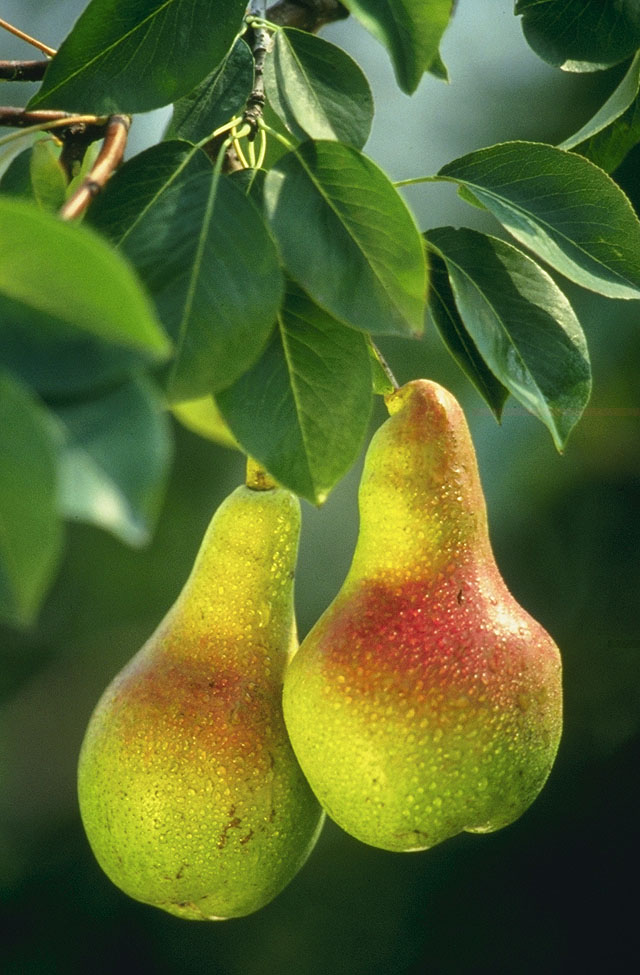
- Classic pear shape — round at the base, narrowing toward the stem — typically 5–10 cm long depending on cultivar, skin green, yellow, red-blushed or russeted. Properly ripened off the tree, flesh is soft, buttery and juicy with a sweet, aromatic flavor; if left to ripen on the tree it turns gritty and mealy from stone-cell development.
- Propagation
- Propagated almost exclusively by grafting or budding named cultivars onto rootstock — quince (Cydonia oblonga, e.g. Quince A or Quince C) for dwarfing, or seedling pear/Pyrus calleryana rootstock for full standard size — since seed-grown trees don't come true and take many years to bear. Grafting/budding is done in late winter or early spring before growth starts; seed propagation (8–10 weeks cold stratification at ~1°C) is used only for raising rootstock.
- Pollination
- ⚠ Mostly SELF-INCOMPATIBLE — needs a partner, normally a second European pear cultivar. Cross-pollinating with an Asian pear (P. pyrifolia) is genetically compatible but unreliable in practice since the two usually don't bloom at the same time.
- Pollinator partners
- Asian pear / nashi
The edible parts listed above are a starting point, not a field guide. Identify a plant with certainty — ideally against a local authority — before eating any part of it, and read the full disclaimer. Spotted something wrong? Report it.
Growing guide
Fertilizing. A moderate feeder — apply a balanced fertilizer in early spring as growth begins, with a second light feed possible after fruit set; avoid heavy nitrogen once trees are established, since excess nitrogen promotes soft, blight-susceptible shoot growth at the expense of fruiting and fire-blight resistance.
How it spreads. A standard, non-suckering single-trunked tree — though root suckers can occasionally appear if the trunk or roots are damaged.
Growing tips. Needs a real winter chill to break dormancy — typically 400–900 hours below about 45°F/7°C depending on cultivar — so it underperforms in mild-winter climates. Fire blight (Erwinia amylovora) is the single most serious disease of cultivated European pear and can kill branches or whole trees rapidly; pear scab and European pear rust are also well documented. Crucially, pears are one of the few fruits that don't ripen properly on the tree — left to soften on the branch they develop a gritty, mealy texture from stone (grit) cells and can rot from the inside out, so they're picked while still hard and green and ripened off the tree in a cool, dark spot for the characteristic smooth, buttery texture.
Companion planting. Sources disagree on juglone sensitivity for pears — some list them sensitive, others tolerant. Given the uncertainty, it's safest to keep pears out of black walnut's root zone too.
Grow journal
Sign in to keep a dated log of when you planted, bloomed and harvested this plant.