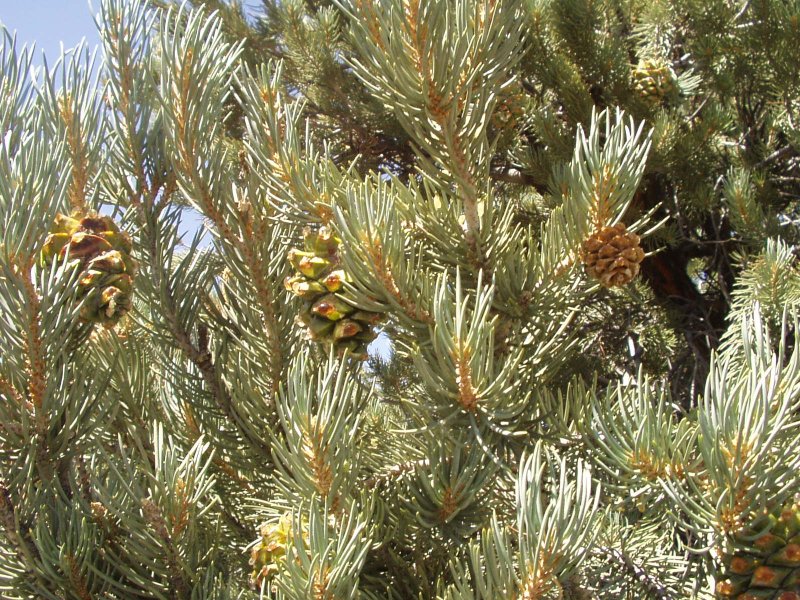
Photo: en:User:Toiyab — CC BY-SA 3.0 · source
Survives zone 6 through 8
Harvest calendar
Best planted in early spring after your last frost, or in fall before the ground freezes, depending on your climate.
Pine nuts — rich, oily, excellent.
- Hardiness
- Zone 6–8
- Habit
- Tree
- Edible part
- Nut
- Ripens
- Autumn (cones)
- Mature size
- Small tree 5–12 m
- Light
- Full sun — cone/seed set needs sun
- Soil pH
- 5.0–7.0
- Environment
- Arid
- Native range
- The Great Basin of western North America — eastern California, Nevada, Utah and Arizona, on dry foothills and mesas between roughly 1,200 and 2,300 m, forming the pinyon half of the pinyon-juniper woodland.
- Status
- Both wild and cultivated
- Years to fruit
- 10+ yrs
- Growth speed
- Very slow — a few centimetres a year, and cone-bearing age is measured in decades
- Spacing
- 500 cm (197 in) apart — about 25 m² (269 sq ft) per plant
- Leaf shape
- The only pine in the world that carries its needles singly. Where every other pine bundles two, three or five needles in a fascicle, this one has a solitary stiff blue-green needle 2–6 cm long, and it is the character the name monophylla records.
- Root system
- A deep taproot from the first year, later joined by wide laterals near the surface — the combination that lets these pines hold rocky, droughty ground where little else will. The taproot is also why container-grown plants must go out young: a spiralled root never recovers.
- Fruit description
- A squat resinous cone 4–8 cm across, taking two full seasons to mature, holding large wingless brown seeds about 1.5–2 cm — true pine nuts, oily and sweet, and a staple food of Great Basin peoples for millennia. Pinyon crops are usually described as a multi-year cycle for this reason, and they are strongly biennial to irregular — a heavy year is followed by little or nothing.
- Propagation
- Seed, after cold stratification, sown deep in a tall pot so the taproot can run — pinyons resent root disturbance and do badly from anything root-bound. Grafting is used in nut selection work. Expect decades to a first crop.
- Pollination
- Monoecious, wind-pollinated — plant more than one
The edible parts listed above are a starting point, not a field guide. Identify a plant with certainty — ideally against a local authority — before eating any part of it, and read the full disclaimer. Spotted something wrong? Report it.
Growing guide
Fertilizing. Adapted to naturally low-fertility, rocky or sandy soils and needs no routine fertilizing; ensuring a mycorrhizal fungal association at planting (inoculum from an existing pine stand) matters more than feeding, since without it seedlings can suffer phosphorus deficiency and poor growth.
How it spreads. Does not spread vegetatively and never suckers; it reproduces only from seed, and natural regeneration depends heavily on caching by pinyon jays. Growth is extremely slow (as little as 3 feet in 7 years), so it stays put and is never a nuisance.
Growing tips. Develops a long taproot early and resents transplanting once established, so start from small container stock and site it permanently while young rather than moving larger specimens. Established plants are otherwise low-maintenance with few reported pest problems.
Grow journal
Sign in to keep a dated log of when you planted, bloomed and harvested this plant.