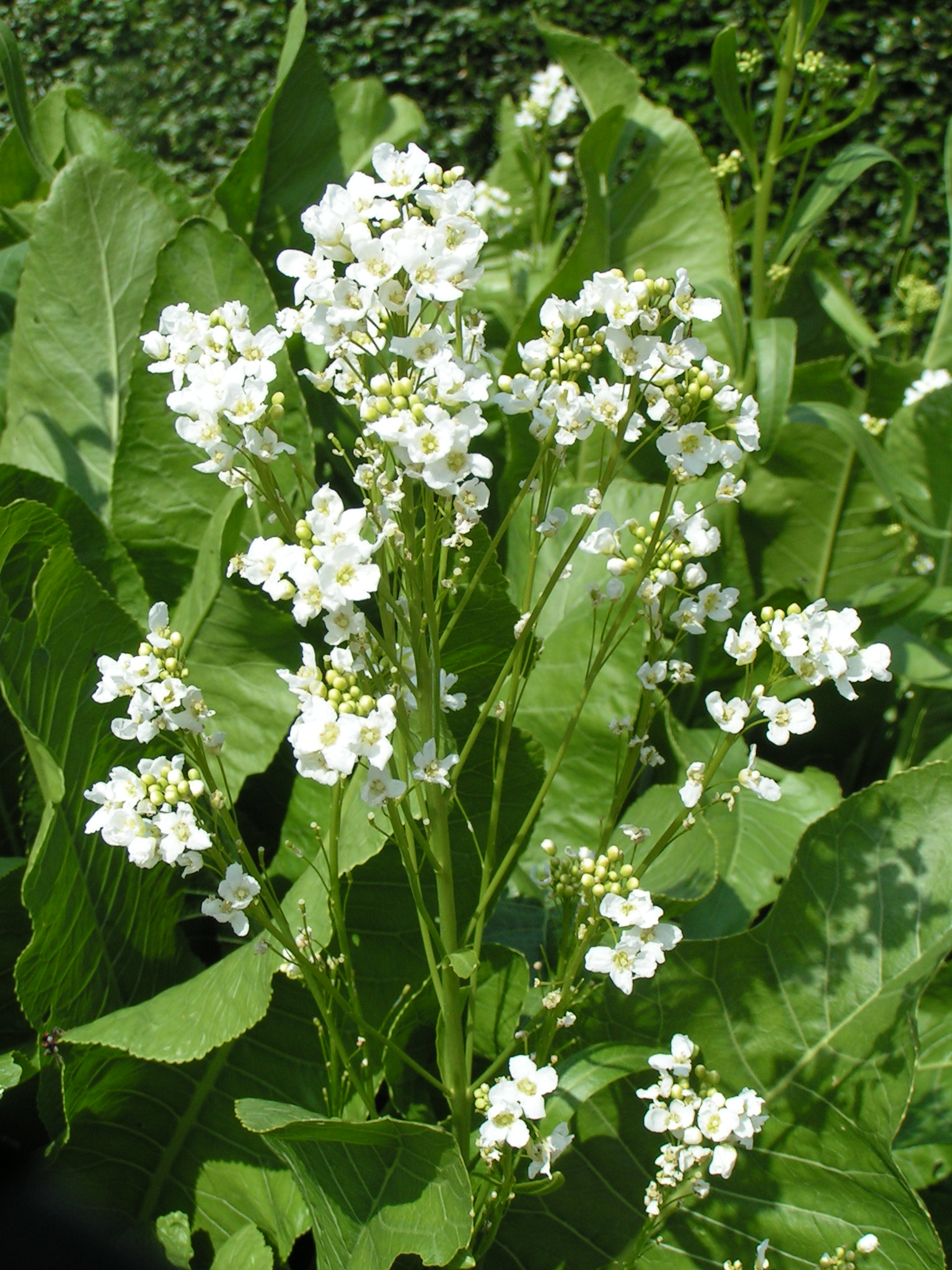
Photo: Pethan — CC BY-SA 3.0 · source
Survives zone 3 through 9
Harvest calendar
Ripens: Root harvested in late autumn after the first frost, for the sharpest flavor
Best planted in early spring after your last frost, or in fall before the ground freezes, depending on your climate.
Grated fresh root is intensely pungent — the sharp, sinus-clearing heat comes from the same class of compounds (glucosinolates) as mustard and wasabi, and fades quickly once cut or ground, so it's prepared close to serving. Extremely persistent once planted: even a small piece of root left in the ground will regrow.
- Hardiness
- Zone 3–9
- Habit
- Herb
- Edible part
- Root
- Ripens
- Root harvested in late autumn after the first frost, for the sharpest flavor
- Mature size
- Perennial to about 0.6–1 m; roots can run deep and wide
- Light
- Full sun to part shade
- Soil pH
- 6.0–7.5
- Environment
- Temperate
- Native range
- Southeastern Europe and western Asia, naturalized widely across temperate regions.
- Status
- Both wild and cultivated
- Years to fruit
- 1 yr
- Growth speed
- Fast — a set makes a harvestable root in a single season
- Spacing
- 45 cm (18 in) apart — about 4.9 per m² (4.6 per 10 sq ft)
- Leaf shape
- Very large basal leaves 30–100 cm, oblong, coarsely toothed and wavy-edged, on long stalks — young leaves are edible and mustard-hot, and worth knowing about since the plant makes far more leaf than root.
- Root system
- Long, deep taproot with vigorous lateral roots — hard to fully remove once established.
- Fruit description
- Not a fruit crop. Most cultivated horseradish is effectively sterile and sets no viable seed at all; where a plant does flower, the white sprays give small pods that come to nothing. The crop is the root.
- Propagation
- Root cuttings ("sets") planted in early spring, using side-root pieces from a harvested plant.
- Pollination
- Largely sterile in cultivation — the widely grown clones set little or no viable seed, and the plant is propagated only from root pieces. Pollination has no bearing on the crop.
The edible parts listed above are a starting point, not a field guide. Identify a plant with certainty — ideally against a local authority — before eating any part of it, and read the full disclaimer. Spotted something wrong? Report it.
Growing guide
How it spreads. Regrows readily from any root fragment left behind; can naturalize and persist well beyond where it was planted.
Growing tips. Wants deep, loose, fertile soil to grow a long, straight, easily harvested root — heavy clay produces a stunted, forked one. Site it deliberately, ideally in a bottomless container or bed edged well below the surface, since it is very difficult to remove once it has spread.
Grow journal
Sign in to keep a dated log of when you planted, bloomed and harvested this plant.