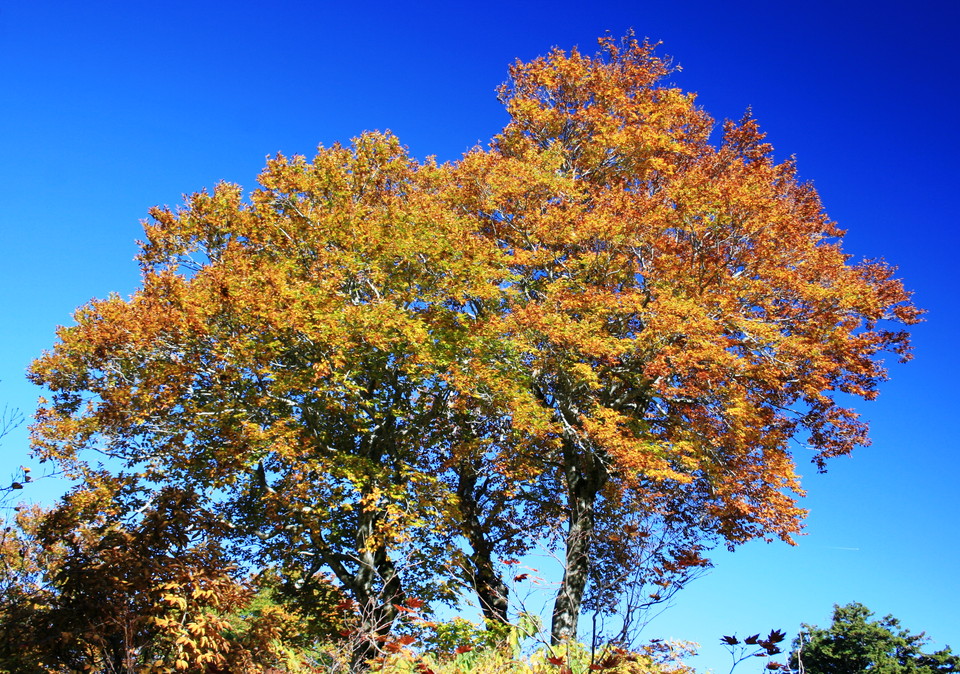
Photo: Alpsdake — Public domain · source
2
3
4
5
6
7
8
9
Survives zone 5 through 8
Harvest calendar
Jan
Feb
Mar
Apr
May
Jun
Jul
Aug
Sep
Oct
Nov
Dec
Best planted in early spring after your last frost, or in fall before the ground freezes, depending on your climate.
Triangular beechnuts edible, sweet — best lightly roasted. ⚠ Raw beechnuts contain fagin and oxalic acid — eat only in moderation or roast.
- Hardiness
- Zone 5–8
- Habit
- Tree
- Edible part
- Nut
- Ripens
- Sept–Oct
- Mature size
- Large tree 25–35 m — not containerable
- Light
- Shade-tolerant as a tree; mast needs a sunlit crown
- Soil pH
- Castanea 4.5–6.5 — ⚠ LIME-INTOLERANT (calcifuge, unlike other nut trees). Quercus/Fagus 5.0–6.5
- Environment
- Temperate
- Native range
- Japan — the dominant tree of the cool-temperate 'Japan Sea' beech forests of Honshu, Hokkaido, Shikoku and Kyushu, and a keystone species of that ecosystem.
- Status
- Wild
- Years to fruit
- 3–5 yrs grafted
- Growth speed
- 30–50 cm/year — slow to medium, and very long-lived.
- Spacing
- 1200 cm (472 in) apart — about 144 m² (1550 sq ft) per plant
- Leaf shape
- Alternate, oval, 5–8 cm long with a distinctly wavy, shallowly scalloped (crenate) margin — the character its name records — and 7–11 pairs of parallel veins.
- Root system
- ⚠ Notoriously shallow and wide-spreading, with a dense surface mat of roots and heavy shade above it — very little will grow beneath a mature beech, and the roots lift paving readily. No significant taproot once past the seedling stage.
- Fruit description
- Small triangular nuts about 1–1.5 cm long in a bristly four-valved husk, sweet when roasted, and produced in heavy irregular mast years that drive the whole forest's wildlife cycle. ⚠ Raw beechnuts contain fagin and oxalic acid, plus saponins, and cause stomach upset and symptoms of poisoning if eaten in quantity raw. Roasting breaks these down — properly roasted nuts are fine, and the flavour improves — but keep raw nibbling to a very few nuts.
- Propagation
- Seed (beechnuts) must be sown fresh in autumn or given about three months cold stratification; viability drops fast if the nuts dry out, and mast years are irregular. Named forms are grafted.
- Pollination
- Wind-pollinated and monoecious — separate male and female flowers on the same tree, so a single tree can bear. Strongly masting: heavy crops come only every few years, and it is those irregular mast years that drive the whole beech-forest wildlife cycle.
The edible parts listed above are a starting point, not a field guide. Identify a plant with certainty — ideally against a local authority — before eating any part of it, and read the full disclaimer. Spotted something wrong? Report it.
Grow journal
Sign in to keep a dated log of when you planted, bloomed and harvested this plant.