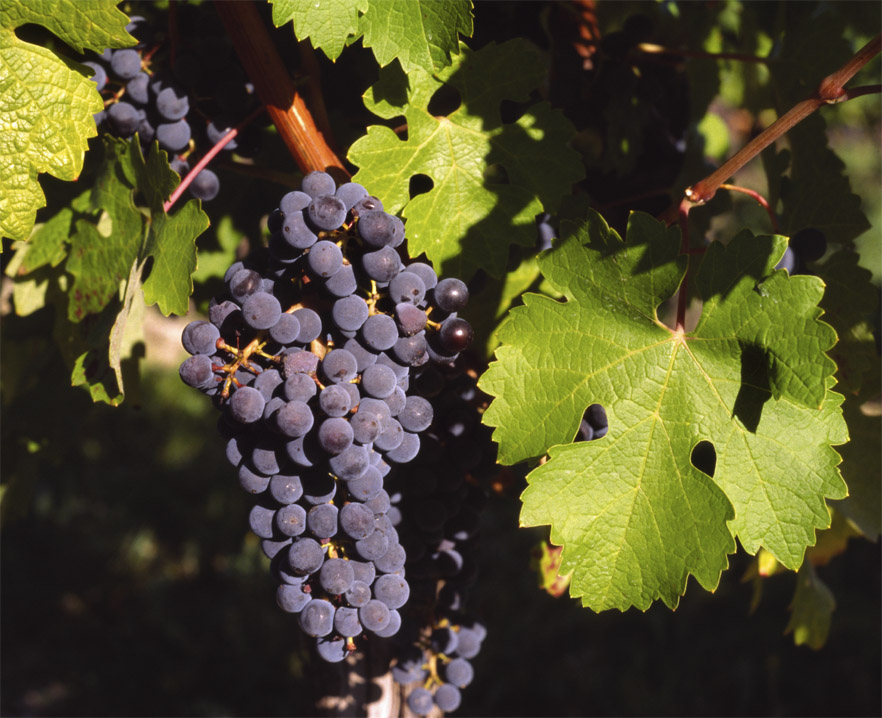
Photo: Unknown — CC BY-SA 3.0 · source
Survives zone 6 through 9
Harvest calendar
Best planted in early spring after your last frost, or in fall before the ground freezes, depending on your climate.
The species behind essentially all classic wine and table grapes — from Cabernet Sauvignon and Chardonnay to Thompson Seedless — domesticated roughly 6,000–8,000 years ago in the South Caucasus/Western Asia region from its wild ancestor Vitis vinifera subsp. sylvestris, with thousands of named cultivars now grown worldwide for wine, fresh eating and raisins.
Spread warning. Tracked as an introduced/naturalized species in parts of the US (e.g. recorded in EDDMapS and the Invasive Plant Atlas of the United States), where escaped vines persist outside cultivation
- Hardiness
- Zone 6–9
- Habit
- Vine
- Edible part
- Fruit
- Ripens
- Sept–Oct
- Mature size
- Vine 15–20 m unpruned; in cultivation pruned hard every winter to 1–3 m, and containerable that way
- Light
- Full sun (obligate — sugar/ripening needs sun)
- Soil pH
- 6.0–7.0
- Environment
- Mediterranean
- Native range
- Wild ancestor (subsp. sylvestris) native to Central and Southern Europe, North Africa, Western Asia and the Caucasus; the domesticated form spread outward from the South Caucasus
- Status
- Cultivated
- Years to fruit
- 2–3 yrs
- Growth speed
- Fast, to 15 m or more if unpruned; fruits within about 3 years
- Spacing
- 183 cm (72 in) apart — about 3.3 m² (36 sq ft) per plant
- Leaf shape
- Palmately lobed leaves, usually with 3–5 (occasionally 7) pointed, toothed lobes and a heart-shaped base
- Root system
- Multi-branching, non-aggressive root system that is highly vulnerable to phylloxera root-feeding, which is why commercial vines are almost universally grafted onto resistant American Vitis rootstocks
- Fruit description
- Sweet, juicy berries in tight clusters, extremely variable by cultivar in size, color (green to near-black) and skin adherence; used fresh, dried into raisins/sultanas/currants, or fermented into wine
- Propagation
- Almost always propagated vegetatively — hardwood cuttings, or grafting onto phylloxera-resistant American rootstock (commonly derived from V. riparia, V. rupestris or their hybrids) — since seed does not come true to cultivar and own-rooted vines are only viable in phylloxera-free regions
- Pollination
- SELF-FERTILE (hermaphrodite flowers)
The edible parts listed above are a starting point, not a field guide. Identify a plant with certainty — ideally against a local authority — before eating any part of it, and read the full disclaimer. Spotted something wrong? Report it.
Growing guide
Fertilizing. Usually kept on a conservative nitrogen regime: moderate nitrogen can lift yield and vigor on genuinely nitrogen-poor sites, but excess nitrogen drives dense canopy growth that shades fruit, raises fungal disease pressure and delays ripening, so vineyards generally fertilize only after tissue or soil testing shows a real deficiency
How it spreads. Tendril-climbing woody vine, trained and pruned annually onto a trellis or arbor in cultivation rather than left to spread
Growing tips. Fast-growing (to 15 m or more if untrained) and bears fruit within about 3 years. Hardy to roughly -20°C when dormant (USDA zones 6–10), but far more susceptible than American wild Vitis species to Pierce's disease, phylloxera, powdery and downy mildew, and black rot — which is why it is almost always grafted onto resistant rootstock outside phylloxera-free regions. Needs a warm, sunny, sheltered site plus annual pruning and trellising to ripen fruit well.
Companion planting. Hyssop is the most traditionally documented companion in European vineyards, said to attract pollinators and beneficial insects; inter-row cover crops (clovers, grasses, mustards, legumes) are widely used commercially to build soil organic matter, reduce erosion and support beneficial mycorrhizal fungi without cutting yield
Grow journal
Sign in to keep a dated log of when you planted, bloomed and harvested this plant.