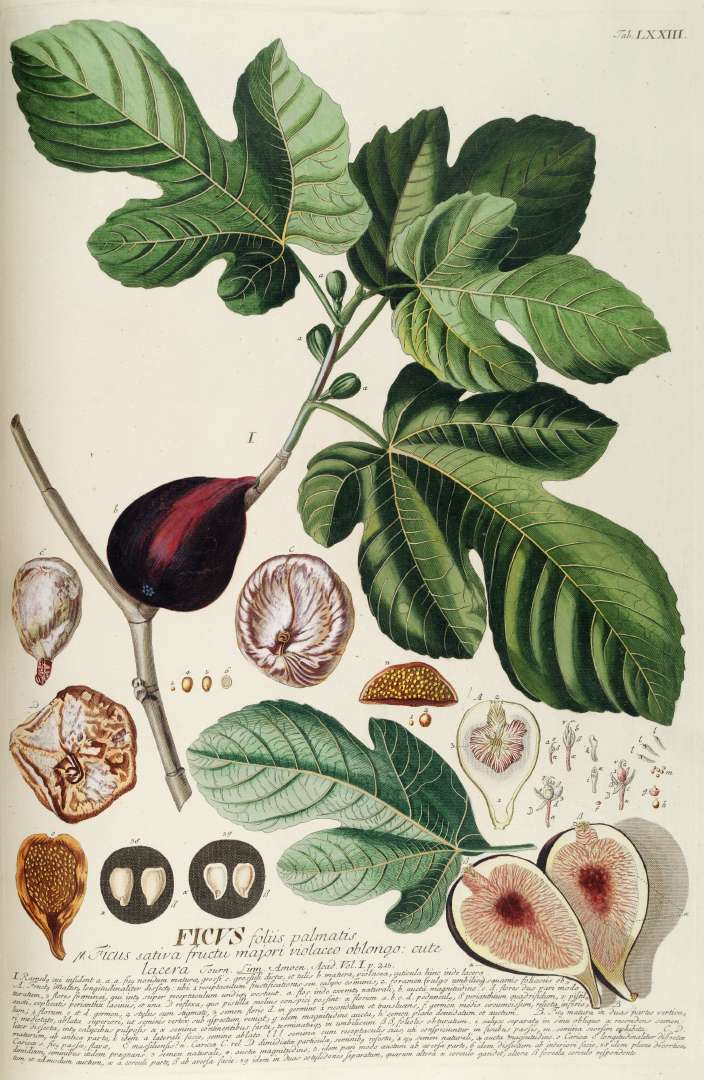
Photo: Trew, C.J — Public domain · source
Survives zone 7 through 9
Harvest calendar
Ripens: Breba early summer + main crop late summer–autumn
Best planted in early spring after your last frost, or in fall before the ground freezes, depending on your climate.
Excellent fresh and dried.
Spread warning. Rated a 'Moderate' invasiveness concern by the California Invasive Plant Council (Cal-IPC); naturalized and locally invasive in Southern California riparian forests, where it forms dense thickets that can smother native streamside vegetation.
- Hardiness
- Zone 7–9
- Habit
- Tree
- Edible part
- Fruit
- Ripens
- Breba early summer + main crop late summer–autumn
- Mature size
- Shrub or small tree 3–10 m; excellent in a container, where root restriction brings it into fruit sooner
- Light
- Full sun — fruit sugar needs sun and heat
- Soil pH
- 6.0–7.5 (lime-tolerant)
- Environment
- Mediterranean
- Native range
- Native to the Mediterranean basin and southwestern Asia, long cultivated and now naturalized well beyond that range.
- Status
- Cultivated
- Years to fruit
- 1–2 yrs
- Growth speed
- Fast
- Spacing
- 400 cm (157 in) apart — about 16 m² (172 sq ft) per plant
- Leaf shape
- Large, deeply 3- to 5-lobed leaves with a rough, hairy upper surface, among the most recognizable leaf shapes of any temperate fruiting tree.
- Root system
- Vigorous, wide-spreading, largely shallow fibrous roots (mostly in the top 30–90 cm of soil) that can extend two to three times the width of the canopy in search of water and are capable of lifting paving if planted too close to structures.
- Fruit description
- Pear-shaped to round fruit (technically a syconium) 4–8 cm, with skin color from green to brown to nearly black depending on cultivar; flesh is sweet, soft, and seedy, eaten fresh or dried.
- Propagation
- Very easily propagated by hardwood cuttings taken in the dormant season (rooted in soil or water) or by air layering; seed propagation is rarely used since cultivars don't come true.
- Pollination
- PARTHENOCARPIC (common types) — no pollination needed. ⚠ Never buy Smyrna types in a cool climate: they need the fig wasp and will drop all fruit
The edible parts listed above are a starting point, not a field guide. Identify a plant with certainty — ideally against a local authority — before eating any part of it, and read the full disclaimer. Spotted something wrong? Report it.
Growing guide
How it spreads. Does not sucker significantly in cultivation, but self-seeds via birds and other animals that eat the fruit; in riparian habitat outside its native range (notably Southern California) it has escaped and formed dense naturalized thickets along waterways.
Growing tips. Hardiness varies enormously by cultivar, from about zone 8–10 for most types down to zone 6–7 for selections like 'Chicago Hardy' and 'Brown Turkey', which can regrow from the roots after top-kill in a hard winter. The common cultivated type is parthenocarpic and needs no pollinator wasp; only traditional Smyrna-type cultivars require the fig wasp (Blastophaga psenes) via caprification and will drop fruit without it. Full sun and heat maximize fruit sugar; root restriction in a container or root-pruning encourages fruiting on young plants.
Grow journal
Sign in to keep a dated log of when you planted, bloomed and harvested this plant.