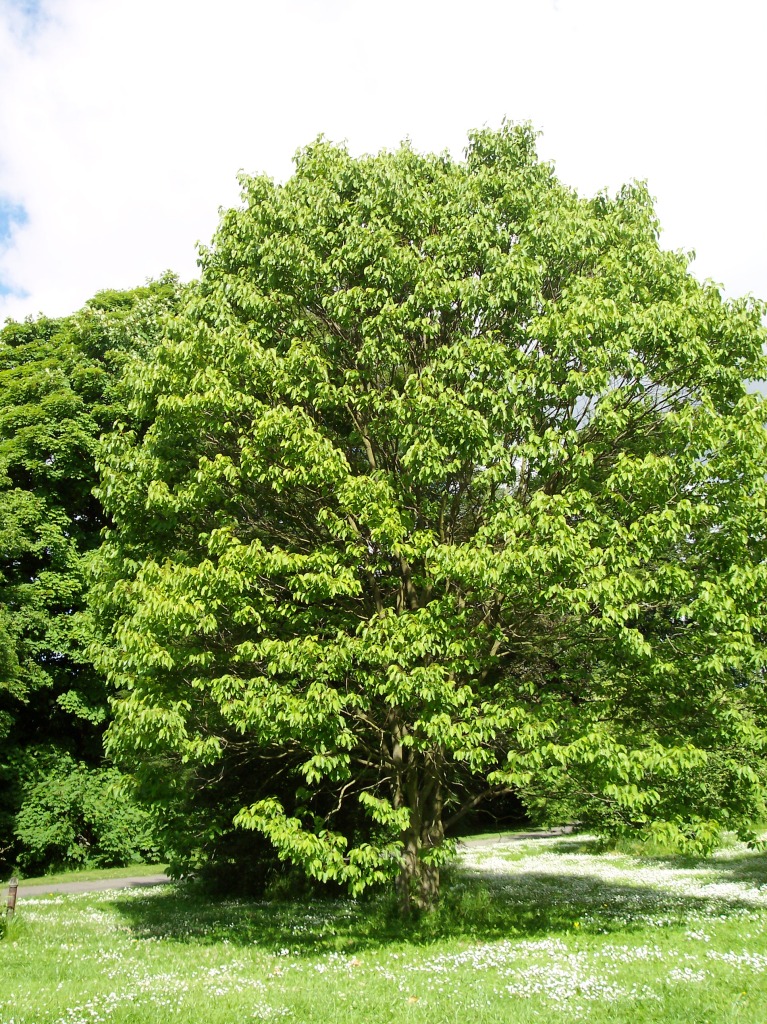
Photo: Unknown — CC BY-SA 3.0 · source
2
3
4
5
6
7
8
9
Survives zone 6 through 9
Harvest calendar
Jan
Feb
Mar
Apr
May
Jun
Jul
Aug
Sep
Oct
Nov
Dec
Best planted in early spring after your last frost, or in fall before the ground freezes, depending on your climate.
⚠ The edible part is the swollen PEDUNCLE (stalk), not the fruit — raisin/pear-like with clove notes. Often fails to ripen in cool summers.
- Hardiness
- Zone 6–9
- Habit
- Tree
- Edible part
- Shoot
- Ripens
- Autumn
- Mature size
- Tree 10–20 m — not containerable
- Light
- Full sun to partial
- Soil pH
- 6.0–7.5 (adaptable)
- Environment
- Temperate
- Native range
- China, Korea and Japan, in montane woodland; widely planted elsewhere and invasive in parts of Brazil and the south-eastern United States, which is worth checking before planting.
- Status
- Both wild and cultivated
- Years to fruit
- 3–4 yrs to flower, then 3–6 more to ripen (halved if vegetatively propagated)
- Growth speed
- Fast — one of the quicker temperate trees, 60–100 cm a year when young
- Spacing
- 700 cm (276 in) apart — about 49 m² (527 sq ft) per plant
- Leaf shape
- Alternate, broadly ovate to heart-shaped 8–20 cm, glossy, with three strong basal veins and shallow teeth — a handsome, almost tropical-looking leaf on a hardy tree.
- Root system
- Deep and wide-spreading, adaptable, with some suckering. Tolerant of poor and compacted ground, which is part of why it naturalises so readily where it is not native.
- Fruit description
- ⚠ The fruit itself is a small dry inedible capsule — the crop is the stalk. As the seed ripens, the branched flower stalks (peduncles) swell, redden and turn fleshy, and it is these knobbly contorted stalks that are eaten: sweet, crisp and tasting of raisin and pear with a clove note, best after a frost. In cool summers they often fail to swell at all.
- Propagation
- Seed after scarification and cold stratification; root cuttings and grafting are used for selected forms and cut years off the wait to a first crop.
- Pollination
- Self-fertile
The edible parts listed above are a starting point, not a field guide. Identify a plant with certainty — ideally against a local authority — before eating any part of it, and read the full disclaimer. Spotted something wrong? Report it.
Grow journal
Sign in to keep a dated log of when you planted, bloomed and harvested this plant.