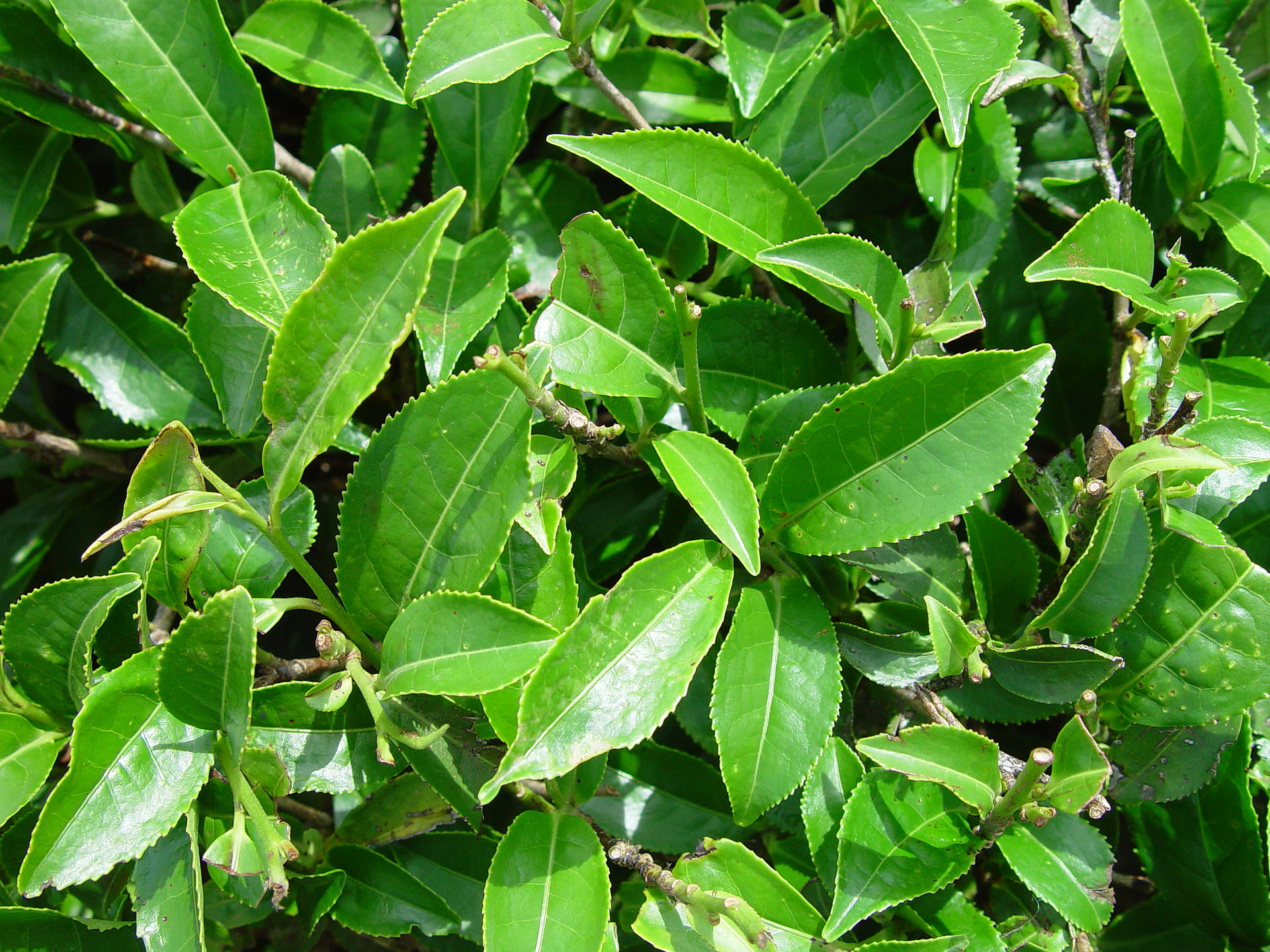
Photo: AxelBoldt at en.wikipedia — Public domain · source
Survives zone 7 through 9
Harvest calendar
Best planted in early spring after your last frost, or in fall before the ground freezes, depending on your climate.
A LEAF crop. Shading before harvest raises umami (matcha/gyokuro) — a quality technique, not a need.
- Hardiness
- Zone 7–9
- Habit
- Shrub
- Edible part
- Leaf
- Ripens
- Spring–autumn (leaf flushes)
- Mature size
- Kept as a bush 1–2 m by hard pruning; unpruned it makes a small tree to 5 m. Excellent in containers
- Light
- Full sun to partial — the plant needs good light; shading is a leaf-quality technique (matcha), not a requirement
- Soil pH
- 5.0–6.5 — ⚠ acid-loving
- Environment
- Subtropical montane
- Native range
- South-west China and the borderlands of northern Myanmar and Vietnam — the small-leaved, cold-hardier of the two tea varieties, and the one behind most Chinese and Japanese teas. Left alone it makes a small tree; the waist-high bush of a tea garden is entirely the result of hard pruning.
- Status
- Cultivated
- Years to fruit
- 3–4 yrs
- Growth speed
- Moderate — a plucking table takes three to four years to build
- Spacing
- 100 cm (39 in) apart — about 1 m² (11 sq ft) per plant
- Leaf shape
- Alternate, evergreen, elliptic 4–10 cm, leathery and glossy with finely serrated edges and a blunt tip. The crop is the bud and the top two leaves of each new flush, which is why the plucking interval matters more than the plant's size.
- Root system
- A taproot that goes deep on free soil, with a dense fibrous mat of feeders near the surface. It is an obligate calcifuge — tea will not tolerate lime, and yellowing on an alkaline soil is the commonest reason a plant fails.
- Fruit description
- Not the crop. Flowering is a sign the bush is under-plucked: white nodding flowers with a boss of yellow stamens in autumn, followed by hard three-lobed capsules holding one to three round brown seeds. The seeds yield an oil, but for oil the species to grow is C. oleifera.
- Propagation
- Single-leaf-bud cuttings under mist are the commercial standard, since the plant is self-incompatible and seedlings vary. Seed must be sown fresh — it is oily and dies quickly in store.
- Pollination
- SELF-INCOMPATIBLE — plant more than one
The edible parts listed above are a starting point, not a field guide. Identify a plant with certainty — ideally against a local authority — before eating any part of it, and read the full disclaimer. Spotted something wrong? Report it.
Growing guide
Fertilizing. Benefits from an acid-forming, balanced fertilizer formulated for camellias or azaleas, applied in mid-spring and again in early summer to support leaf flush; avoid lime, high-phosphorus feeds, and fertilizing during fall/winter dormancy.
How it spreads. Slow-growing and stays in a discrete upright clump; does not sucker, self-seed, or spread — left unpruned it eventually becomes a small tree rather than colonizing an area.
Growing tips. Tolerates hard annual pruning after flowering to keep it at a manageable, easy-to-harvest height (commercial bushes are kept below about 1.5 m); scale insects are the most serious pest, with aphids and spider mites also possible, and container-grown plants are more cold-sensitive than in-ground specimens and need protection in climates colder than roughly zone 7.
Grow journal
Sign in to keep a dated log of when you planted, bloomed and harvested this plant.