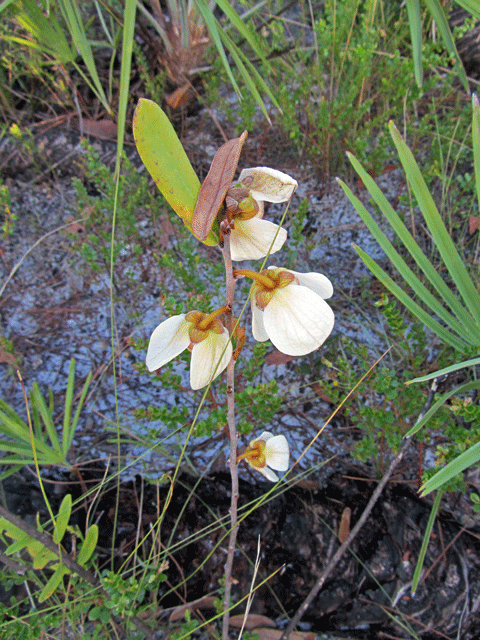
Photo: Homer Edward Price — CC BY 2.0 · source
Survives zone 8 through 9
Harvest calendar
Best planted in early spring after your last frost, or in fall before the ground freezes, depending on your climate.
A Florida scrub and sandhill endemic (also called flag or scrub pawpaw) with a G3 vulnerable NatureServe rank — its fruit is edible but documented as mostly seed, with dry, bitter flesh carrying only a hint of mango and banana, nothing like the rich custard texture of A. triloba. It is grown far more for its large showy white flowers and as a zebra swallowtail host plant than for fruit. ⚠ As with all pawpaws, eat the flesh only — skin and seeds concentrate annonacin and are not food.
- Hardiness
- Zone 8–9
- Habit
- Shrub
- Edible part
- Fruit
- Ripens
- Sept–Oct
- Mature size
- Shrub or small tree to about 3.5 m
- Light
- Partial to full sun
- Soil pH
- 5.5–7.0 (slightly acid)
- Environment
- Temperate
- Native range
- Endemic to peninsular Florida, occurring in dry hammocks, dry hardwood forests, sandhills, clay hills and scrub — a much narrower range than the widespread A. triloba. NatureServe ranks it G3 (vulnerable) due to this restricted, fire-dependent scrub distribution.
- Status
- Wild
- Years to fruit
- 3–5 yrs grafted, 4–8 from seed
- Growth speed
- Slow
- Spacing
- 250 cm (98 in) apart — about 6.3 m² (67 sq ft) per plant
- Leaf shape
- Alternate, leathery leaves 4-12cm long, obovate to oblong or oblanceolate, with a rounded to broadly wedge-shaped base, a rounded to blunt (often notched) apex, and margins scarcely to prominently rolled under; young growth is covered in dense red hairs that thin with age.
- Root system
- Long taproot, as in other Asimina species — the trait that makes nursery stock difficult to transplant and root disturbance something to avoid.
- Fruit description
- Green, elongated fruit reaching roughly 7-10cm long, resembling a small banana; documented as mostly seed with dry, bitter flesh and only a hint of mango-banana flavor — distinctly poorer fruit quality than A. triloba.
- Propagation
- Usually grown from nursery stock rather than dug from the wild — as in other Asimina species, a long taproot makes bare-root transplanting difficult, so root disturbance should be minimized and moisture kept constant until established. Can also be grown from seed.
- Pollination
- Pollinated by beetles including Typocerus zebra, Trichiotinus rufobrunneus, T. lunulatus and Euphoria sepulcralis — genus-wide, Asimina flowers rely on flies and beetles rather than bees.
The edible parts listed above are a starting point, not a field guide. Identify a plant with certainty — ideally against a local authority — before eating any part of it, and read the full disclaimer. Spotted something wrong? Report it.
Growing guide
Fertilizing. Native to nutrient-poor, well-drained Florida sand and clay-hill soils — unlike A. triloba it does not want rich, amended garden soil. Plant in lean, acidic sand and avoid heavy feeding, which suits neither its natural scrub habitat nor its growth habit.
How it spreads. Grows as a single- to multi-stemmed shrub or small tree from a long taproot. No rhizomatous or root-suckering colony formation has been documented for this species, unlike the thicket-forming habit of A. triloba.
Growing tips. A warm-temperate to subtropical Florida scrub endemic, suitable to roughly USDA zones 8b-9b — it is not cold-hardy like A. triloba and is unsuited to a cold-hardy wiki's colder zones. NatureServe lists it as G3 (vulnerable) globally, though it is not federally listed; it depends on periodic fire to maintain the open scrub and sandhill habitat it needs.
Grow journal
Sign in to keep a dated log of when you planted, bloomed and harvested this plant.