Zone 2 gallery
54 species in the database survive zone 2.

squashberry / mooseberry
Viburnum edule
Fruit is a tart, juicy red drupe, edible raw once fully ripe — the flesh is pleasant but each has a large, flattened stone and a musky odor that some find off-putting, so it is more often cooked into jelly or sauce than eaten out of hand.

nannyberry
Viburnum lentago
Fruit ripens to a bluish-black, sweet, raisin-like pulp over a single flattened stone — good eaten fresh off the shrub once fully ripe, though the thick skin and large seed limit it mostly to jam, sauce, or leather.

paper birch
Betula papyrifera
Spring sap tapped for syrup — the classic North American sap birch; under 1% sugar, but the sweetest of the birches here. A large volume of sap is needed per litre of syrup.

silver birch
Betula pendula
Spring sap tapped for syrup or drunk fresh — around 2.5% sugar; the standard European tapping birch.

downy birch
Betula pubescens
Spring sap tapped for syrup or drunk fresh — around 2.6% sugar, comparable to silver birch.

brittle prickly pear
Opuntia fragilis
Prickly-pear fruit sweet and seedy; young pads as a vegetable. ⚠ Glochids.

blue honeysuckle / honeyberry / haskap
Lonicera caerulea
Sweet-tart, blueberry-meets-raspberry — good fresh and processed. ⚠ Worth knowing at genus level: haskap is one of the few honeysuckles that is good to eat. Many Lonicera berries are emetic or toxic, so this is not a genus to forage on a family resemblance — identify to species.

mountain fly honeysuckle
Lonicera villosa
The North American mountain fly honeysuckle, and a genuine close relative of haskap — botanists still argue whether it is a separate species or a subspecies of Lonicera caerulea. Small blue berries, sweet-tart and edible like haskap, though smaller and borne more sparsely than the selected cultivars. ⚠ Worth knowing at genus level: this and haskap are among the few edible honeysuckles. Many Lonicera berries are emetic or toxic — identify to species rather than trusting the genus.

bunchberry
Cornus canadensis
⚠ Honestly: mild, faintly sweet, soft/mealy "pudding-berry" — pleasant but bland fresh; better cooked into jam or pudding. Grown as much as a groundcover as for fruit. Unripe berries may cause mild stomach upset; pulp and stone are hard to separate.

Russian olive
Elaeagnus angustifolia
Dry and mealy rather than juicy, but genuinely sweet once fully ripe — astringent if picked even slightly early. Eaten fresh once ripe, or made into jelly and preserves.

American silverberry
Elaeagnus commutata
The least palatable fresh-eating fruit of this catalog's Elaeagnus — dry, mealy and quite astringent unless fully ripe, and not particularly enjoyable raw even then. Birds take it readily; for people it's really a cooked fruit, used in jelly and soup, or historically fried in fat.

silver buffaloberry
Shepherdia argentea
⚠ Honestly: bitter and saponin-rich — an acquired taste, poor fresh.

russet buffaloberry
Shepherdia canadensis
⚠ Honestly: bitter and saponin-rich; whipped into 'Indian ice cream' — an acquired taste, poor fresh.

bearberry
Arctostaphylos uva-ursi
Bearberry — dry and mealy; mostly for cooking.

crowberry
Empetrum nigrum
Crowberry — bland and watery; a famine/curiosity food.

lowbush blueberry
Vaccinium angustifolium
The true wild blueberry of Maine and Atlantic Canada — smaller-fruited and more intensely flavored than highbush, traditionally harvested from sprawling rhizome colonies ("barrens") rather than grown as individual planted bushes.

American cranberry
Vaccinium macrocarpon
The commercial cranberry — tart, firm, red berries grown on sandy, highly acidic bogs and almost always eaten cooked or processed rather than raw. Bogs are flooded for harvest and frost protection, not because the plant is aquatic.

European cranberry
Vaccinium oxycoccos
A wild, circumboreal bog cranberry — the smaller-fruited European counterpart of the commercially grown American cranberry (V. macrocarpon), foraged across Northern and Eastern Europe and used the same way, in preserves and sauces.

bog bilberry
Vaccinium uliginosum
A circumboreal arctic-alpine bilberry, historically the most popular foraged fruit for Native communities around Fort Yukon, Alaska; blue-black berries with a bluish bloom, used in jams, jellies and pies.

lingonberry
Vaccinium vitis-idaea
Lingonberry — sharply tart, classically served as a jam or sauce with Scandinavian meatballs, pork or game; its unusually high benzoic acid content gives it a long shelf life that made it a valued preserved fruit long before refrigeration.

Siberian pea shrub
Caragana arborescens
⚠ Honestly: young seeds and pods are edible cooked but bland — an emergency/fallback food and poultry fodder rather than a treat. Cook the seeds (reported to contain the amino-acid analogue L-canavanine; eat in moderation); nitrogen-fixing.

alpine currant
Ribes alpinum
Fruit is red and translucent like a redcurrant but bland and insipid — this is grown almost entirely as a tough, shearable ornamental hedge shrub, not for eating.

American blackcurrant
Ribes americanum
A true wild black currant of eastern and central North America — smooth, low-fat, high-sugar berries used historically for jam, jelly and pie.
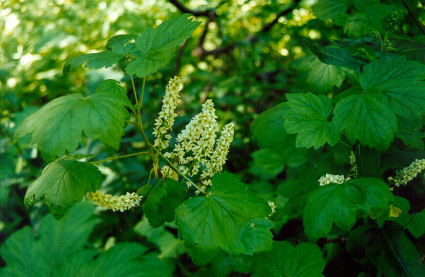
Hudson Bay currant
Ribes hudsonianum
Black fruit that's notably bitter eaten raw — worth growing for jam and jelly rather than fresh eating.

Canada gooseberry
Ribes oxyacanthoides
A small, spiny, very cold-hardy wild gooseberry of boreal and northern prairie regions, historically used by Indigenous peoples and early settlers — its flavor is thinly documented compared to cultivated gooseberry types.

northern redcurrant
Ribes triste
A cold-hardy, wetland-loving wild red currant found across boreal North America and northeast Asia — tart fruit used for pies and preserves, and historically valuable to breeders for introducing cold-hardiness into cultivated redcurrant lines. Genuinely thin on culinary documentation compared to R. rubrum.

sweetfern
Comptonia peregrina
Not a fruit crop — an aromatic shrub whose leaves make a herbal tea; it bears a small bur-like nutlet, not a fleshy edible fruit. Leaves for tea; nitrogen-fixing. Distinct from the related Myrica/Morella (yangmei), which has the edible fruit.

Siberian dwarf pine
Pinus pumila
Siberian dwarf pine is a low, shrubby, extremely cold-hardy species — its seeds are edible, oily and nutritious, but harvested only locally and casually in Siberia and Japan rather than traded commercially like its larger pine relatives.

Siberian pine
Pinus sibirica
Siberian pine — called kedr (cedar) in Russia and a genuine source of national pride — produces the seeds pressed into prized Siberian 'cedar nut' oil, noted for one of the highest pinolenic acid contents of any pine nut; wild stands crop unpredictably, with a good harvest only about once every four years.

saskatoon berry
Amelanchier alnifolia
Saskatoon — sweet, blueberry-like with a distinct almond note. Very good.
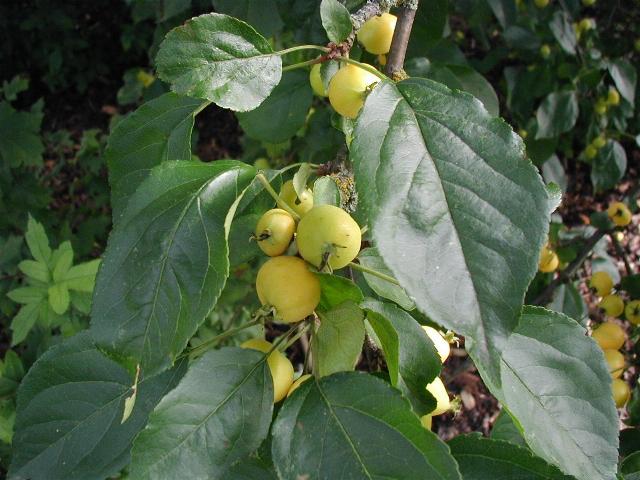
Siberian crabapple
Malus baccata
The Siberian crabapple is among the coldest-hardy and most disease-resistant species in the genus, valued both as an ornamental (fragrant white flowers, cherry-sized red-to-yellow fruit in dense clusters) and as a foundational genetic resource — its cold tolerance and broad disease resistance make it a common parent in breeding programs for hardy apple cultivars and rootstocks in northern climates.

prairie crabapple
Malus ioensis
Prairie crabapple is a thicket-forming native of the American tallgrass prairie region, distinguished from most other Malus species here by its tendency to sucker from the roots, and prized horticulturally for intensely fragrant spring blossom — the double-flowered selection 'Bechtel's Crab' was a popular 19th- and early-20th-century dooryard tree grown specifically for its fragrance.
cherry prinsepia
Prinsepia sinensis
Red, juicy fruit with a pleasant, slightly tart, cherry-like flavor — eaten out of hand or made into jam, juice and pies. Extremely cold-hardy. ⚠ Kernels cyanogenic, as with other stone fruit in the rose family.
hedge prinsepia
Prinsepia uniflora
Small cherry-like drupes, red or purple-black depending on the plant — a close relative of P. sinensis but far less documented for flavor, grown more as a tough, spiny hedging shrub in its cold, arid native range than as a fruit crop. ⚠ Kernels cyanogenic, as with other stone fruit in the rose family.
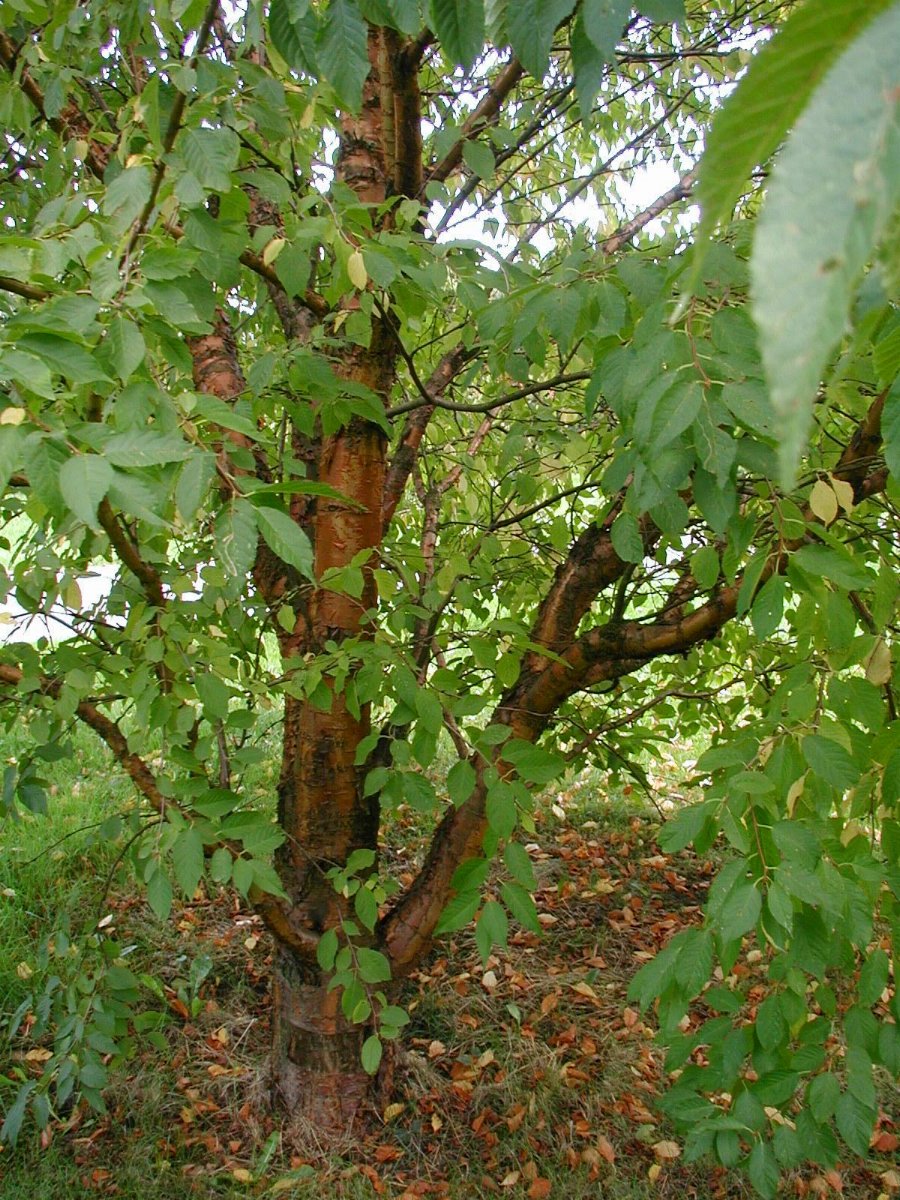
Amur chokecherry
Prunus maackii
The small black cherries are astringent and rarely eaten out of hand, but are gathered for jams, jellies, and wine, and are an important late-summer food source for birds. ⚠ Kernels/pits cyanogenic.

Manchurian apricot
Prunus mandshurica
Wild-type fruit is small, dry, and sour to slightly bitter, but seedling trees vary widely and some produce sweet, juicy, apricot-flavored fruit good for fresh eating, jams, and preserves. ⚠ As with other apricots, the kernels are cyanogenic and should not be eaten raw.

pin cherry
Prunus pensylvanica
The small, sour cherries are too tart for most fresh eating but are traditionally cooked down into jams, jellies, and syrups, and are an important food source for dozens of bird species as well as small mammals and bears. ⚠ Kernels/pits cyanogenic.

Siberian apricot
Prunus sibirica
The flesh is thin, dry, and sour to the point of being barely palatable fresh, so the species is grown mainly for its almond-flavored kernel, pressed for oil, and as extremely cold-hardy apricot breeding stock — ⚠ kernels are bitter and cyanogenic if eaten raw in quantity.

Nanking cherry
Prunus tomentosa
⚠ Fruit ranges from sweet to tart depending on the seedling and ripens earlier than most cherries, often by June; eaten fresh or made into pies, jellies, and wine — pits are cyanogenic like other Prunus stones.

chokecherry
Prunus virginiana
Fruit is very astringent and bitter fresh off the tree but transforms into good jelly, syrup, and wine once cooked with sugar, and was historically pounded whole into pemmican by Plains peoples — ⚠ seeds, bark, and wilted leaves are cyanogenic.

arctic rose
Rosa acicularis
Arctic rose is the most cold-hardy of the six species here, native well into the boreal and Arctic zone. Its hips are modest in size and thin-fleshed compared with rugosa or villosa, but they were a genuine traditional food source for northern peoples, eaten fresh after frost or dried for tea and winter stores. ⚠ Deseed the hips before eating: the ring of stiff hairs around the seeds is a gut and skin irritant, and is what old-fashioned itching powder was made from. Strain it out of any purée or syrup.

rugosa rose
Rosa rugosa
Rugosa rose produces the largest, fleshiest, best-tasting hips of the six species here, genuinely excellent for jam and syrup, and is also the most disease-resistant rose in the group. Its strong suckering habit is a double edge — a useful trait for stabilizing sandy ground, but also the reason it has become an invasive coastal weed in parts of Europe and North America outside its native range. ⚠ Deseed the hips before eating: the ring of stiff hairs around the seeds is a gut and skin irritant, and is what old-fashioned itching powder was made from. Strain it out of any purée or syrup.

arctic raspberry / nagoonberry
Rubus arcticus
A dwarf, thornless groundcover raspberry of arctic and boreal bogs and clearings, spreading by rhizomes into low mats rarely more than 20–30 cm tall. The fruit is a small aggregate of 10–30 deep-red to dark-purple drupelets with a distinctive pineapple-like aroma — prized across Scandinavia for jam and for mesimarja, a liqueur made from the berries since 1882. It is also a parent, alongside red raspberry, of the hybrid "nectar raspberries" bred for garden use in Scandinavia and Scotland.

cloudberry
Rubus chamaemorus
Cloudberry is a genus outlier in almost every respect — a low, unbranched, non-prickly perennial of cold bogs rather than a caned bramble, it is dioecious (needing separate male and female plants, unlike the mostly self-fertile Rubus genus) and demands acidic, waterlogged peat rather than ordinary garden soil. It is culturally significant across Scandinavia — served with cheese in Finland, as a dessert topping in Sweden (where it is nicknamed "Norrland's gold"), and as moltekrem (cloudberry cream) in Norway — and appears on Finland's two-euro coin.

stone bramble
Rubus saxatilis
⚠ Honestly: only 2–6 large translucent red drupelets per fruit — sharply acidic, more curiosity than crop; used for cordial in Scandinavia.

American mountain ash
Sorbus americana
American mountain ash is a small, hardy boreal tree whose bright red berries are famous winter wildlife food for birds, bears and browsing moose and deer rather than a mainstream human food — the raw fruit is thin-fleshed, sour and heavily tannic, and only becomes reliably edible for people after the first hard freeze softens and sweetens it, when it can be used for pies and jelly. ⚠ Not just astringent: raw fruit in this group contains parasorbic acid, which causes vomiting, stomach cramps and diarrhoea if you eat any quantity of it. Cooking, freezing, drying or a hard frost converts it to harmless sorbic acid — which is exactly why every traditional recipe cooks it and why the fruit is picked after the first frosts.

riverbank grape
Vitis riparia
One of the most cold-hardy grape species on Earth — some vines survive to about -57°C (-71°F) — and thanks to that hardiness plus resistance to phylloxera and powdery mildew, it has been the key rootstock and breeding parent behind cold-climate hybrid wine grapes such as Frontenac, Marechal Foch and Baco Noir. ⚠ Know the look-alike: across eastern and central North America, moonseed (Menispermum canadense) twines alongside wild grapes, carries similar dark hanging clusters, and is potentially fatal. Three checks — a grape has 2–4 rounded, pear-shaped seeds while moonseed has ONE flat crescent seed; a grape climbs by forked tendrils and moonseed has none; a grape's leaves are toothed and moonseed's are not. Open a berry and look at the seed before eating any wild grape.

Crowberry
Empetrum hermaphroditum
The hermaphrodite crowberry — the arctic-alpine counterpart of common crowberry, and the reason it fruits where nothing pollinates reliably: each flower carries both sexes, so a single plant sets a crop. Black berries about 7.5mm, watery and mildly acid, much improved by frost and long a staple of Arctic diets.

Canada plum
Prunus nigra
Extremely cold-hardy, one of the toughest plums here. Fruit is small, thick-skinned and sour off the tree — a few hard frosts improve the flavour tremendously, so this is a plum worth leaving on the tree into late season. ⚠ Kernels/pits cyanogenic.

Cinnamon rose
Rosa majalis
One of the hardiest roses grown, reportedly to about -35°C — a genuinely northern species reaching deep into Scandinavia and Siberia. Named for cinnamon-scented bark rather than the fruit.

Northern mountain ash
Sorbus decora
Also called showy mountain ash — one of the hardiest rowans here, native well into Labrador. Shiny red fruit clusters persist after leaf drop, an important winter and early-spring food source for birds. ⚠ Not just astringent: raw fruit in this group contains parasorbic acid, which causes vomiting, stomach cramps and diarrhoea if you eat any quantity of it. Cooking, freezing, drying or a hard frost converts it to harmless sorbic acid — which is exactly why every traditional recipe cooks it and why the fruit is picked after the first frosts.

American highbush cranberry
Viburnum trilobum
The true North American highbush cranberry — not a true cranberry (Vaccinium) at all despite the name, but a viburnum that converges on the same bright-red, acidic fruit. Tart and cranberry-like, excellent for jelly and sauce, and it improves markedly after the first hard frost; raw fruit can still cause mild stomach upset if eaten unripe or in quantity. This catalog previously carried it twice, the second time under Viburnum opulus var. americanum — see the note where that entry used to be.
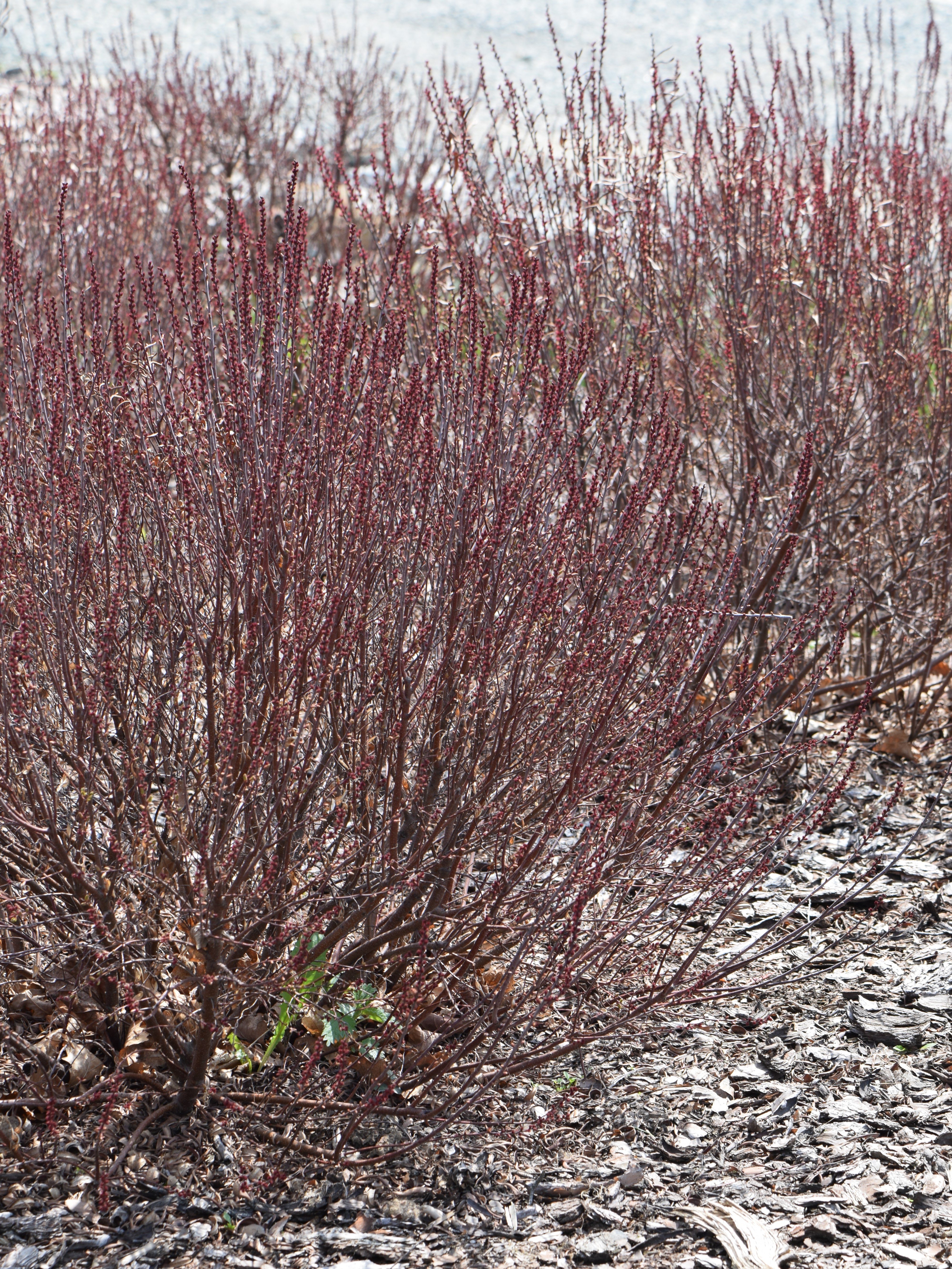
Bog myrtle
Myrica gale
The sweet-resinous leaves and small waxy fruit are used as a flavoring, most historically in beer before hops largely took over that role, and the crushed foliage doubles as an insect repellent. Sources genuinely disagree on the cold-hardiness floor, from zone 2 to zone 5 depending on the source — a wide-ranging boreal wetland shrub, so this catalog takes the more generous end, but treat zone 2-3 survival as less certain than the fully-sourced zone 5-7 core of its range.

Buckwheat
Fagopyrum esculentum
Not a true cereal grass despite the name and use — a relative of rhubarb and sorrel, grown for its starchy, gluten-free triangular seeds, ground into flour for soba noodles, blini and buckwheat pancakes. Also grown as a fast, weed-smothering cover crop and bee forage.