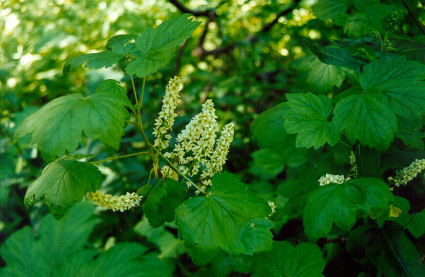
Photo: Unknown authorUnknown author — Public domain · source
Survives zone 2 through 6
Harvest calendar
Best planted in early spring after your last frost, or in fall before the ground freezes, depending on your climate.
Black fruit that's notably bitter eaten raw — worth growing for jam and jelly rather than fresh eating.
- Hardiness
- Zone 2–6
- Habit
- Shrub
- Edible part
- Fruit
- Ripens
- June–Aug
- Mature size
- Deciduous shrub 0.5–2 m, spreading by suckers
- Light
- Partial to full sun (woodland/thicket)
- Soil pH
- 6.0–7.0
- Environment
- Boreal
- Native range
- Alaska south through British Columbia to Oregon/Idaho/Washington, and east across every Canadian province to Quebec and Minnesota.
- Status
- Wild
- Years to fruit
- 1–2 yrs
- Growth speed
- Fast, and easily grown.
- Spacing
- 150 cm (59 in) apart — about 2.3 m² (24 sq ft) per plant
- Leaf shape
- Kidney-shaped to round, 3-lobed (rarely 5), 2–12 cm, deeply heart-shaped base, dotted with yellow glands on the underside, coarsely toothed margins.
- Root system
- Shallow and fibrous, the bulk of it in the top 30–45 cm and spreading wider than the bush is tall. Two consequences worth planning for: it dries out quickly in a hot summer, so mulch and water rather than cultivate around it, and low branches that touch the ground will often layer themselves, which is the easiest way to get a new plant.
- Fruit description
- Small (to 1.3 cm) round berries studded with yellow glands, ripening green through purplish to black; bitter-tasting, on a plant with an overall strong, unpleasant scent.
- Propagation
- Hardwood cuttings are close to foolproof: take pencil-thick shoots about 20–25 cm long in late autumn, push two-thirds into free-draining ground outdoors and leave them a year. Layering a low branch works too. Seed needs several months of cold stratification and is only worth it for breeding.
- Pollination
- Hermaphrodite flowers, insect-pollinated. No self-compatibility study for this species specifically: cultivated currants and gooseberries are largely self-fruitful, but controlled work on wild western Ribes found several species outright self-sterile, so a single plant is not a safe assumption. Plant two.
The edible parts listed above are a starting point, not a field guide. Identify a plant with certainty — ideally against a local authority — before eating any part of it, and read the full disclaimer. Spotted something wrong? Report it.
Growing guide
Companion planting. A confirmed blister rust host, though how severe a vector it is hasn't been quantified in the sources checked — site away from white pines as a precaution even without a specific risk rating.
Grow journal
Sign in to keep a dated log of when you planted, bloomed and harvested this plant.