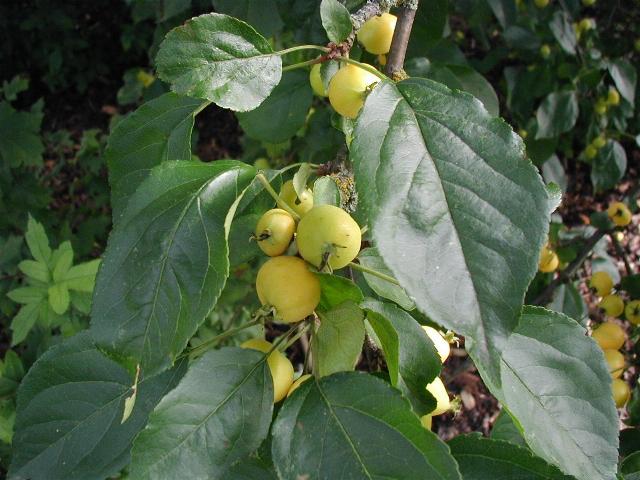
Photo: Sten at Danish Wikipedia — CC BY-SA 3.0 · source
Survives zone 2 through 7
Harvest calendar
Best planted in early spring after your last frost, or in fall before the ground freezes, depending on your climate.
The Siberian crabapple is among the coldest-hardy and most disease-resistant species in the genus, valued both as an ornamental (fragrant white flowers, cherry-sized red-to-yellow fruit in dense clusters) and as a foundational genetic resource — its cold tolerance and broad disease resistance make it a common parent in breeding programs for hardy apple cultivars and rootstocks in northern climates.
- Hardiness
- Zone 2–7
- Habit
- Tree
- Edible part
- Fruit
- Ripens
- Summer–autumn
- Mature size
- Tree 10–14 m — the largest crab here
- Light
- Full sun
- Soil pH
- 6.0–7.0 (near-neutral)
- Environment
- Boreal
- Native range
- Native to temperate Asia — Siberia, the Russian Far East (Amur region), Mongolia, northern and northeastern China, Korea, and extending into the Himalayan foothills of Bhutan, India, and Nepal — where it grows in mixed forests on hilly slopes up to about 1,500 m elevation. It has since naturalized in parts of the Great Lakes region and northeastern United States.
- Status
- Both wild and cultivated
- Years to fruit
- 2–4 yrs
- Growth speed
- Medium — trees reach roughly 10-14 m tall over several decades; smaller varieties such as var. gracilis stay in the 4-6 m range.
- Spacing
- 900 cm (354 in) apart — about 81 m² (872 sq ft) per plant
- Leaf shape
- Elliptic to ovate leaves, 3-8 cm long by 2-3.5 cm wide, with a cuneate-to-rounded base, an acuminate tip, and a serrate margin; fall color is typically an unremarkable yellow, with some sources noting early leaf drop rather than a strong display.
- Root system
- Typical Malus root habit — a fibrous, laterally spreading root system rather than a strong taproot; feeder roots concentrate in the upper 30-60 cm of soil.
- Fruit description
- Small, spherical fruit about 1 cm in diameter, ripening red to yellow in September-October in dense, cherry-like clusters — sour and astringent, not eaten fresh as a dessert apple, though edible fresh or dried and used in preserves.
- Propagation
- Grown from seed sown as soon as it is ripe in autumn in a cold frame — stored seed needs about three months of cold stratification at 1°C and can still take 12 months or more to germinate. Seedlings are fairly uniform and are the usual method of propagating the species itself, but named ornamental selections are grafted; mature-wood cuttings taken in November are an alternative vegetative method.
- Pollination
- ⚠ Mostly SELF-INCOMPATIBLE — needs a 2nd cultivar
- Pollinator partners
- apple
The edible parts listed above are a starting point, not a field guide. Identify a plant with certainty — ideally against a local authority — before eating any part of it, and read the full disclaimer. Spotted something wrong? Report it.
Growing guide
Fertilizing. Succeeds in most fertile soils, including heavy ones, and tolerates mildly acidic through basic (alkaline) pH — little supplemental feeding is needed on reasonable soil, though a moisture-retentive, well-drained loam gives the best growth.
How it spreads. Forms a standard with a non-suckering single trunk — it does not colonize by root suckers — but the abundant small fruit is bird-dispersed, and the species self-seeds readily, which is how it has naturalized outside its native range.
Growing tips. One of the hardiest Malus species, tolerating temperatures down to about -40°C, and one of the most disease-resistant crabapples generally. It is a well-documented source of cold-hardiness and disease-resistance genes used in apple breeding and rootstock development — genomic studies have found large numbers of NBS-LRR resistance genes and cold-regulated genes in M. baccata, and it is widely used in high-latitude apple breeding programs in Russia and China for both hardiness and disease resistance. Like other Malus it remains notably susceptible to honey fungus (Armillaria).
Grow journal
Sign in to keep a dated log of when you planted, bloomed and harvested this plant.