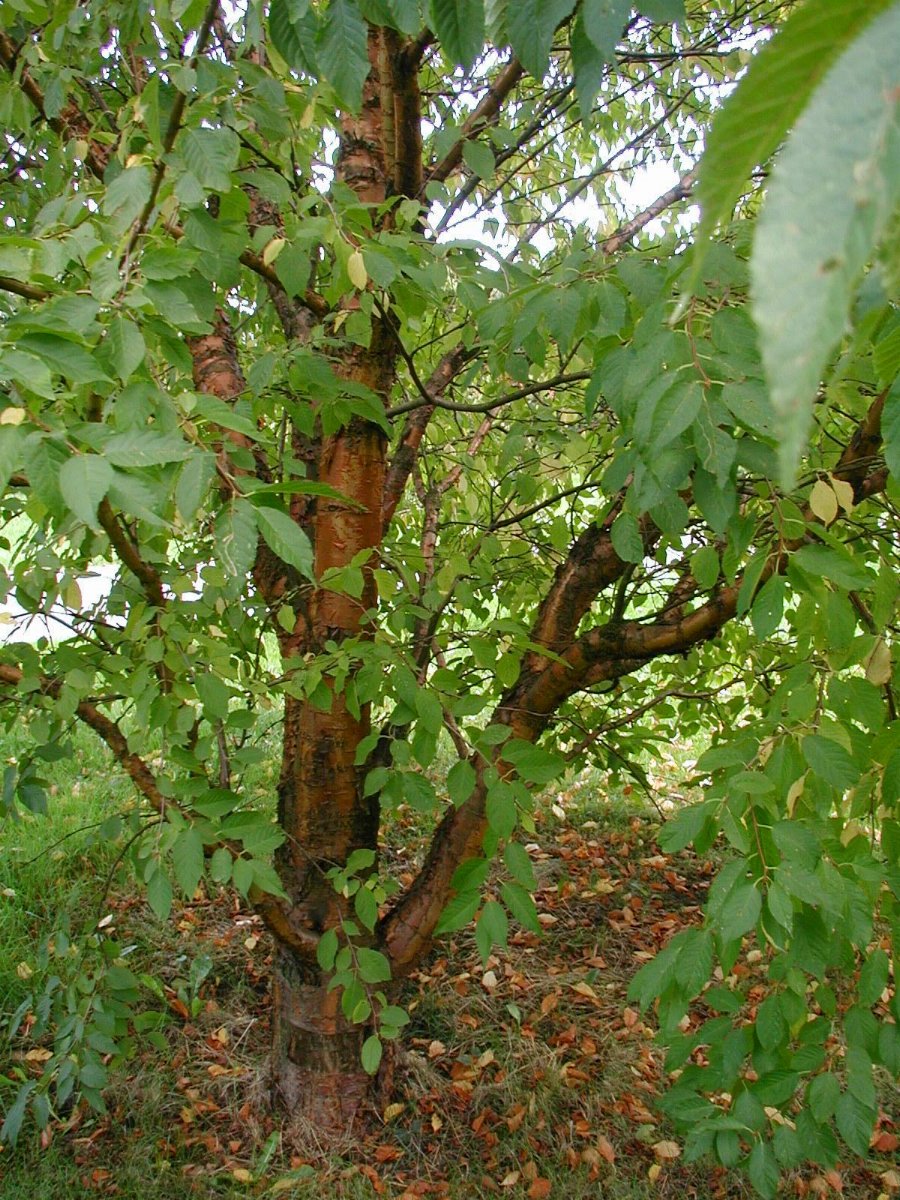
Photo: No machine-readable author provided. Sten assumed (based on copyright claims). — CC BY-SA 3.0 · source
Survives zone 2 through 6
Harvest calendar
Best planted in early spring after your last frost, or in fall before the ground freezes, depending on your climate.
The small black cherries are astringent and rarely eaten out of hand, but are gathered for jams, jellies, and wine, and are an important late-summer food source for birds. ⚠ Kernels/pits cyanogenic.
- Hardiness
- Zone 2–6
- Habit
- Tree
- Edible part
- Fruit
- Ripens
- Summer–autumn
- Mature size
- Tree 10–15 m with peeling amber bark
- Light
- Full sun to partial
- Soil pH
- 6.0–7.0 (near-neutral)
- Environment
- Temperate
- Native range
- Manchuria (northeastern China), the Russian Far East, and Korea
- Status
- Ornamental
- Years to fruit
- 2–4 yrs
- Growth speed
- Moderate to fast
- Spacing
- 500 cm (197 in) apart — about 25 m² (269 sq ft) per plant
- Leaf shape
- Elliptic to oblong-ovate, 5–10 cm long, finely serrate margins, dark green and glossy above.
- Root system
- Worth knowing that in cultivation this is usually the rootstock's root system, not the species' — most Prunus are sold grafted, and vigour, suckering and soil tolerance follow the stock rather than the top. On its own roots the species is shallow-rooted, with the bulk in the top 40–60 cm spreading well beyond the canopy, so it dislikes cultivation underneath and competes badly with grass.
- Fruit description
- Small (about 8 mm), nearly black cherries borne in drooping clusters, with thin skin, bitter astringent flesh, and a single small stone.
- Propagation
- By seed, which shows a mix of non-deep and intermediate physiological dormancy — a warm stratification period (about 30 days near 20°C) followed by cold stratification (about 60 days near 4°C) gives the best germination rates; also grown from softwood cuttings.
- Pollination
- Hermaphrodite, insect-pollinated flowers — self-fertility isn't specifically documented for this species
The edible parts listed above are a starting point, not a field guide. Identify a plant with certainty — ideally against a local authority — before eating any part of it, and read the full disclaimer. Spotted something wrong? Report it.
Growing guide
Fertilizing. Grows best in fertile, well-drained soil across a wide pH range (5.0–8.0); established trees need feeding only every 2–3 years, applied in early spring, and benefit from a cool root run kept mulched with 7–10 cm of wood chips.
Growing tips. Grown chiefly for its glossy, exfoliating copper-to-golden bark, most striking in winter; tolerant of severe winter cold but stressed by summer heat, so keep the root zone cool and mulched.
Grow journal
Sign in to keep a dated log of when you planted, bloomed and harvested this plant.