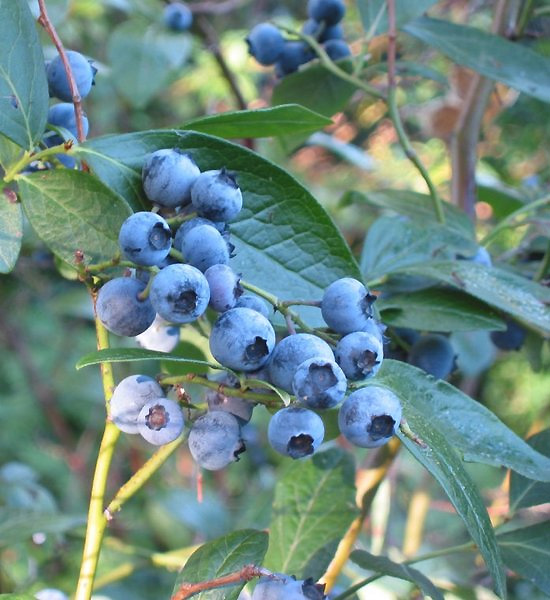
Photo: Unknown — CC BY-SA 3.0 · source
Survives zone 3 through 7
Harvest calendar
Best planted in early spring after your last frost, or in fall before the ground freezes, depending on your climate.
The dominant commercial blueberry worldwide — most supermarket blueberries are highbush cultivars or their hybrids. Large, sweet-tart fruit with the classic dusty-blue bloom on the skin.
- Hardiness
- Zone 3–7
- Habit
- Shrub
- Edible part
- Fruit
- Ripens
- July–Sept
- Mature size
- Low shrub 0.2–2 m; excellent in containers
- Light
- Full sun — tolerates light shade with reduced crop
- Soil pH
- 4.0–5.5 — ⚠ strictly acid; dies above pH 6
- Environment
- Temperate
- Native range
- Eastern North America from Nova Scotia and Quebec south through the Appalachians to eastern Texas and northern Florida, west to Michigan, Missouri and Oklahoma. The Pacific Northwest plants are not a native disjunct but an agricultural escape — British Columbia treats it as exotic, and it has invaded bogs in the Fraser Delta.
- Status
- Cultivated
- Years to fruit
- 2–3 yrs (first fruit); peak production at 6–8 yrs
- Growth speed
- Moderate, roughly 15–30 cm of new lateral shoot growth a year on established plants.
- Spacing
- 91 cm (36 in) apart — about 1.2 per m² (1.1 per 10 sq ft)
- Leaf shape
- Ovate to narrowly elliptic, 1.5–7 cm, somewhat leathery, margins sharply toothed or entire.
- Root system
- Shallow, fine and fibrous, lacking root hairs, generally no deeper than 30–45 cm, with roughly half to two-thirds of roots in the top 30 cm near the crown; requires acidic soil (pH 4.5–5.5).
- Fruit description
- Round berries 6–12 mm across, blue to black with a powdery grayish-white waxy bloom; juicy flesh with tiny seeds.
- Propagation
- Commercially propagated from softwood cuttings in spring or hardwood cuttings of the previous season's unbranched shoots; nurseries also use tissue culture. Seed is used mainly for breeding, not for named cultivars.
- Pollination
- Self-fertile but MUCH better with a 2nd cultivar
The edible parts listed above are a starting point, not a field guide. Identify a plant with certainty — ideally against a local authority — before eating any part of it, and read the full disclaimer. Spotted something wrong? Report it.
Growing guide
Fertilizing. Needs ammonium-form nitrogen (ammonium sulfate, urea) rather than nitrate forms like ammonium nitrate or calcium nitrate — research on this species specifically found ammonium is absorbed roughly twice as fast and moved to the shoots about four times faster than nitrate.
Growing tips. Forms ericoid mycorrhizal partnerships (documented with the fungus Oidiodendron maius among others) that measurably improve nitrogen uptake, flowering and fruit yield in field and nursery trials — a good reason to use peat or pine-bark mulch rather than fertile garden loam. Bell-shaped flowers need buzz-pollination from bumblebees to release pollen; honeybees are markedly less effective. Mummy berry (Monilinia vaccinii-corymbosi) is the most damaging disease, capable of up to 70% yield loss in a wet spring — "Bluetta" and "Olympia" are relatively resistant, "Blueray", "Berkeley", "Blueribbon" and "Earliblue" are notably susceptible.
Companion planting. Sensitive to juglone — avoid planting within the root zone of black walnut (Juglans nigra) or butternut (J. cinerea).
Grow journal
Sign in to keep a dated log of when you planted, bloomed and harvested this plant.