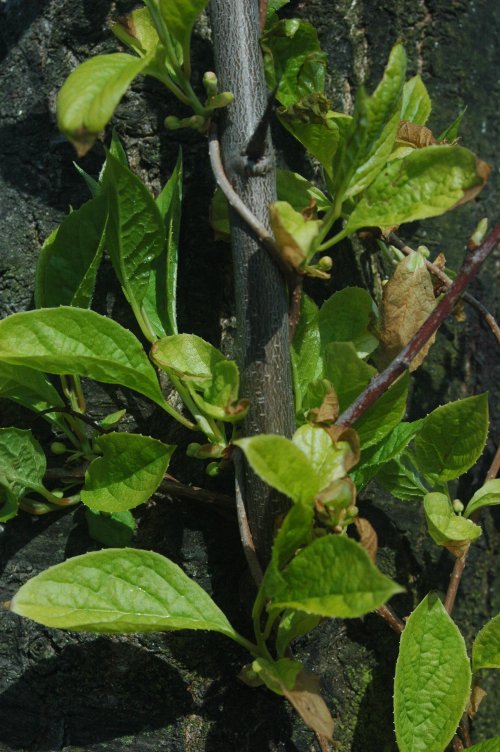
Photo: Doronenko — CC BY 2.5 · source
Survives zone 4 through 7
Harvest calendar
Best planted in early spring after your last frost, or in fall before the ground freezes, depending on your climate.
⚠ Five-flavour berry — MEDICINAL/adaptogenic (tart, harsh, resinous). Used dried, as tea or tincture — NOT a dessert fruit.
- Hardiness
- Zone 4–7
- Habit
- Vine
- Edible part
- Fruit
- Ripens
- Autumn
- Mature size
- Vine 6–9 m, needs a trellis
- Light
- PARTIAL — forest vine: shaded, cool roots with the top growth in sun; scorches in full sun
- Soil pH
- 5.5–7.0 (rich, moist)
- Environment
- Temperate forest
- Native range
- North-east China, Korea, Japan and the Russian Far East — cool mixed forest, where it climbs through birch and pine. Known in China as wu wei zi, the five-flavour berry.
- Status
- Both wild and cultivated
- Years to fruit
- 3–4 yrs
- Growth speed
- Moderate — 1–2 m a year once established, slow in the first two seasons
- Spacing
- 200 cm (79 in) apart — about 4 m² (43 sq ft) per plant
- Leaf shape
- Alternate, elliptic to obovate 5–10 cm, thin, slightly fleshy and bright green, on reddish twining stems; the crushed leaf is faintly aromatic.
- Root system
- Shallow, fibrous and wide-spreading, almost all of it in the top 30 cm, and it will not take drying out — this is a forest-floor root that expects leaf litter and shade. Mulch it, keep the root run cool, and give the top growth the light; the usual failure with these vines is a hot, bare, dry root zone.
- Fruit description
- Hanging spikes of bright red berries 6–8 mm, ripening in autumn, each holding one or two seeds. The name is literal — the skin is sweet, the flesh sour and salty, the seed bitter and pungent, and all five register at once. ⚠ Harsh and resinous rather than pleasant: this is a dried, brewed or tinctured crop, not a dessert fruit.
- Propagation
- Seed after a long cold stratification — three months at least, and germination is still erratic. Softwood cuttings in early summer under mist are more dependable, and layering works. Since the plants are dioecious, cuttings are the only way to be sure what sex you are planting.
- Pollination
- DIOECIOUS — needs male and female plants
The edible parts listed above are a starting point, not a field guide. Identify a plant with certainty — ideally against a local authority — before eating any part of it, and read the full disclaimer. Spotted something wrong? Report it.
Growing guide
Fertilizing. Not a heavy feeder; an annual mulch of compost or well-rotted manure supports fruiting in the rich, moisture-retentive soil it prefers, but excess nitrogen favors foliage over fruit.
How it spreads. Grows as one or several twining shoots from a woody crown and can produce root suckers over time, forming a multi-stemmed clump; suckers are easily removed or used for propagation, and the vine is not considered invasive.
Growing tips. Needs a sturdy trellis, arbor, or fence to twine on, and is largely untroubled by pests or diseases in cultivation. The dormant plant tolerates temperatures down to about -17°C (0°F), but young growth in spring can be damaged by late frosts.
Grow journal
Sign in to keep a dated log of when you planted, bloomed and harvested this plant.